Original question & working
A river as the intersection of two planes · source reference
[2017/JJC/Prelim/II/3] · Question pp. 8 · Working pp. 36, 37, 38
Open the interactive lessonThe working and teaching notes are included in the interactive lesson.
View source review notesFull original question, working & notes
Printed question
Peter is using equations of planes to model two hillsides that meet along a river. The river is modelled by the line where the two planes meet.
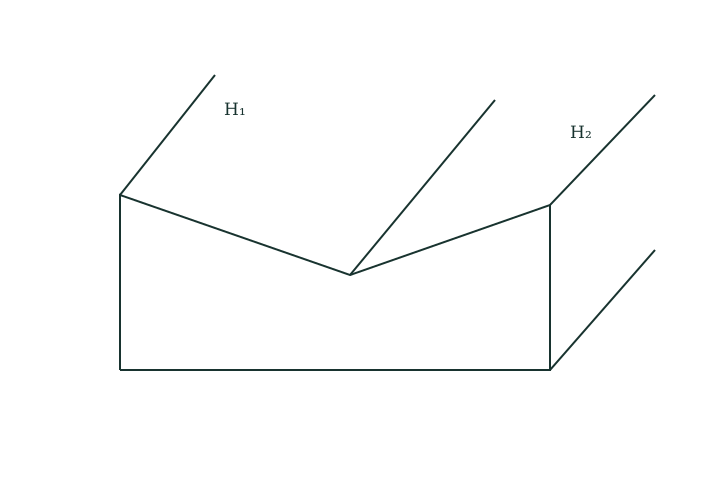
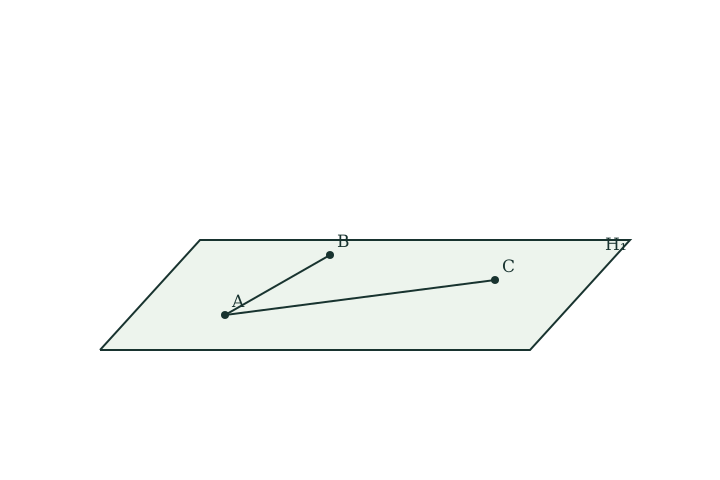
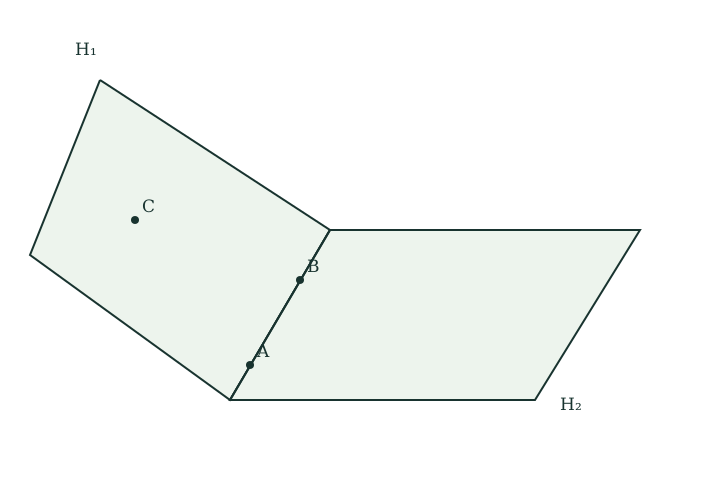
One of the hillsides, , contains the points with coordinates respectively. The point is on the river. The other hillside has equation , where is a constant.
(i) Find a vector equation of in scalar product form. [4]
(ii) Show that and deduce that point is also on the river. [3]
(iii) Write down a cartesian equation of the river. [1]
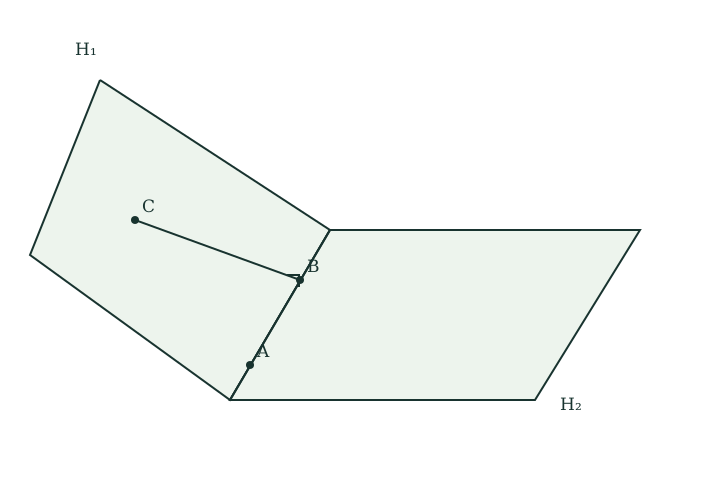
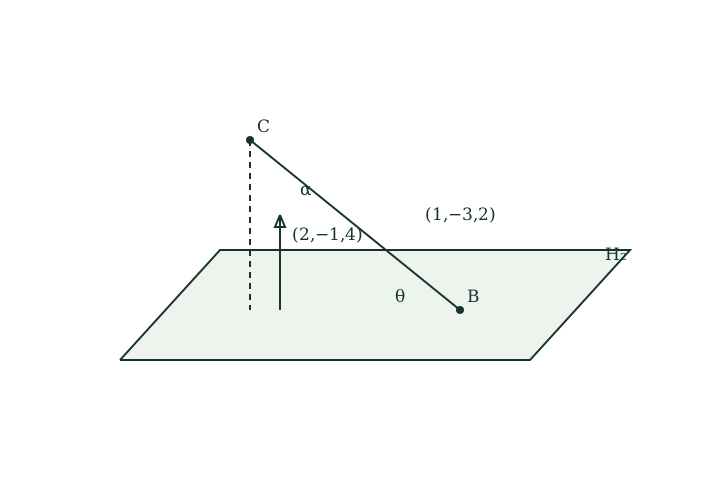
(iv) Show that is the point on the river that is nearest to . Hence find the exact shortest distance from to the river. [3]
(v) Find the acute angle between . [2]
[2017/JJC/Prelim/II/3]
Printed working
(i) .
.
A normal to is .
Thus, vector equation of is , i.e. .
(ii) is on the river, the intersection of the 2 planes lies on .
(Shown).
Thus, equation of is .
Substitute the point into equation of :
LHS RHS.
Since satisfies the equation of , point lies on . Since point lies on both , thus lies on the river. (Shown)
(iii) Since lie on the river, a direction vector of river is .
Thus a vector equation of river is .
The cartesian equation of river is , .
(iv) .
Since , is perpendicular to .
is the point on the river that is nearest to .
Shortest distance from to the river .
(v) Let be acute angle between , and .
Then .
.
Thus (correct to 1 d.p.).
Printed answer key
(i) . (iii) . (iv) units. (v) . Short key omits (ii).
Source provenance
2025 TJC H2 Math (9758) JC2 MSM: VECTORS. Question booklet PDF pages 4–12 (printed 80–88); solution booklet PDF pages 17–44. Column vectors are typeset as ordered coordinate triples here; the entries, products, intermediate equations and original parameter/domain restrictions are retained.