Porisma

Original question & working

A regular tetrahedron and the methane angle · source reference

[2018/ACJC/Prelim/I/11] · Question pp. 9 · Working pp. 39, 40, 41, 42

Open the interactive lesson

The working and teaching notes are included in the interactive lesson.

There are two possible tetrahedron vertices on opposite sides of the base; the source asks for the displayed one.

View source review notes
Full original question, working & notes

Printed question
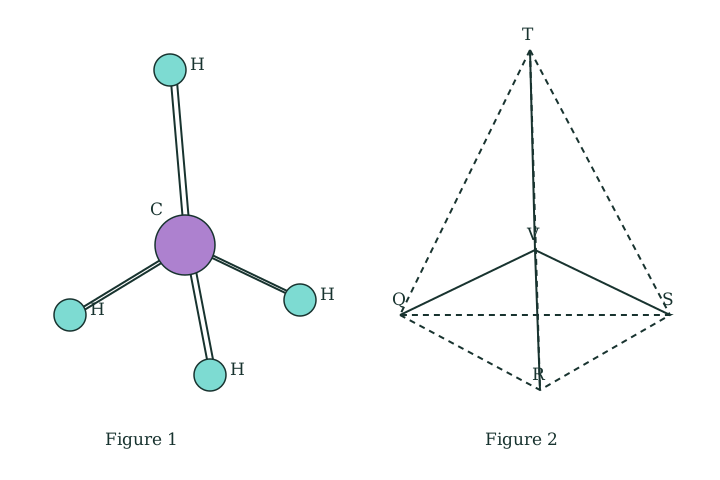
Native methane molecule and tetrahedron, Figure 1 and Figure 2

Figure 1 shows a methane molecule consisting of a carbon atom with four hydrogen atoms symmetrically placed around it. Figure 2 shows the tetrahedron structure of the methane molecule with the centres of the hydrogen atoms represented by points Q,R,S,TQ,R,S,T and the centre of the carbon atom represented by point VV.

The points Q,R,SQ,R,S have coordinates (8,1,8),(8,7,2),(2,1,2)(8,1,8),(8,7,2),(2,1,2) respectively and form an equilateral triangle.

(i) Find a cartesian equation of the plane pp which passes through the points Q,R,SQ,R,S. [4]

(ii) Find a cartesian equation of the plane p1p_1 which passes through the midpoint of QRQR and is perpendicular to QRQR. [2]

Plane p2p_2 which passes through the midpoint of RSRS and is perpendicular to RSRS has equation x+y=9x+y=9.

(iii) Find a vector equation of the line ll where p1,p2p_1,p_2 meet. [1]

(iv) The point TT is on the line ll such that QRSTQRST is a regular tetrahedron with QR=QTQR=QT. Show that the possible coordinates for point TT is (2,7,8)(2,7,8). Hence, or otherwise, find the coordinates of a point on plane pp that is closest to point TT. [5]

(v) Given that TVTV is 34\frac34 of the vertical height of tetrahedron QRSTQRST. Find the coordinates of point VV and hence show that the bonding angle TVQTVQ of the methane molecule is 109.5∘109.5^\circ (correct to 1 decimal place). [4]

[2018/ACJC/Prelim/I/11]

Printed working

(i) OQ→=(8,1,8)\overrightarrow{OQ}=(8,1,8), OR→=(8,7,2)\overrightarrow{OR}=(8,7,2), OS→=(2,1,2)\overrightarrow{OS}=(2,1,2).

QR→=OR→−OQ→=(8,7,2)−(8,1,8)=(0,6,−6)=6(0,1,−1)\overrightarrow{QR}=\overrightarrow{OR}-\overrightarrow{OQ}=(8,7,2)-(8,1,8)=(0,6,-6)=6(0,1,-1).

QS→=OS→−OQ→=(2,1,2)−(8,1,8)=(−6,0,−6)=6(−1,0,−1)\overrightarrow{QS}=\overrightarrow{OS}-\overrightarrow{OQ}=(2,1,2)-(8,1,8)=(-6,0,-6)=6(-1,0,-1).

n=(0,1,−1)×(−1,0,−1)=(−1,1,1)\mathbf n=(0,1,-1)\times(-1,0,-1)=(-1,1,1).

r⋅(−1,1,1)=(2,1,2)⋅(−1,1,1)⇒r⋅(−1,1,1)=1\mathbf r\cdot(-1,1,1)=(2,1,2)\cdot(-1,1,1)\Rightarrow\mathbf r\cdot(-1,1,1)=1.

The cartesian equation of plane pp is −x+y+z=1-x+y+z=1.

(ii) Midpoint of QR=OR→+OQ→2=(8,7,2)+(8,1,8)2=(8,4,5)QR=\frac{\overrightarrow{OR}+\overrightarrow{OQ}}2=\frac{(8,7,2)+(8,1,8)}2=(8,4,5).

r⋅(0,1,−1)=(8,4,5)⋅(0,1,−1)⇒r⋅(0,1,−1)=−1\mathbf r\cdot(0,1,-1)=(8,4,5)\cdot(0,1,-1)\Rightarrow\mathbf r\cdot(0,1,-1)=-1.

The cartesian equation of plane p1p_1 is y−z=−1y-z=-1.

(iii) p1:y−z=−1p_1:y-z=-1; p2:x+y=9p_2:x+y=9.

Using GC: The vector equation of the line ll is r=(10,−1,0)+λ(−1,1,1)\mathbf r=(10,-1,0)+\lambda(-1,1,1), where λ∈R\lambda\in\mathbb R.

(iv) Since point TT is on line ll, OT→=(10−λ,−1+λ,λ)\overrightarrow{OT}=(10-\lambda,-1+\lambda,\lambda).

∣QR→∣=∣QT→∣|\overrightarrow{QR}|=|\overrightarrow{QT}|.

∣(0,6,−6)∣=∣(10−λ,−1+λ,λ)−(8,1,8)∣|(0,6,-6)|=|(10-\lambda,-1+\lambda,\lambda)-(8,1,8)|.

∣(0,6,−6)∣=∣(2−λ,−2+λ,λ−8)∣|(0,6,-6)|=|(2-\lambda,-2+\lambda,\lambda-8)|.

72=(2−λ)2+(−2+λ)2+(λ−8)2\sqrt{72}=\sqrt{(2-\lambda)^2+(-2+\lambda)^2+(\lambda-8)^2}.

72=3λ2−24λ+7272=3\lambda^2-24\lambda+72.

λ=0\lambda=0 or λ=8\lambda=8.

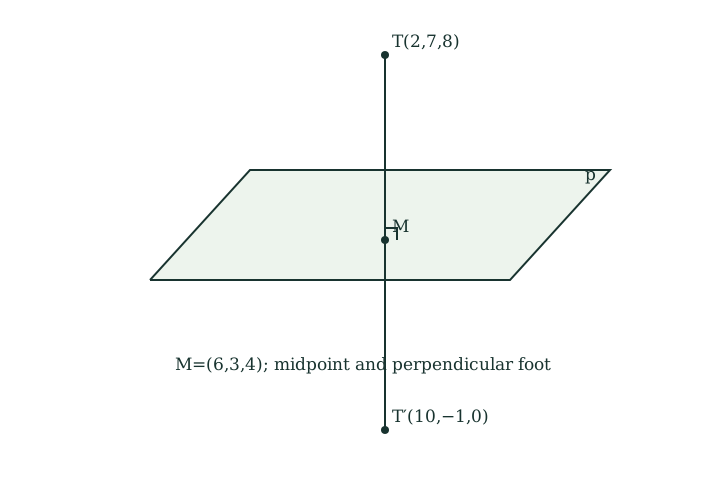
When λ=8\lambda=8, OT→=(10−8,−1+8,8)=(2,7,8)\overrightarrow{OT}=(10-8,-1+8,8)=(2,7,8).

When λ=0\lambda=0, OT′→=(10+0,−1+0,0)=(10,−1,0)\overrightarrow{OT'}=(10+0,-1+0,0)=(10,-1,0).

Hence possible coordinates for point TT are (2,7,8)(2,7,8) (Shown).

Method 1

(2,7,8)+(10,−1,0)2=(6,3,4)\frac{(2,7,8)+(10,-1,0)}2=(6,3,4).

The coordinates of point on plane pp that is closest to point TT is (6,3,4)(6,3,4).

Method 2

The vector equation of line through point TT perpendicular to plane pp is r=(2,7,8)+μ(−1,1,1)\mathbf r=(2,7,8)+\mu(-1,1,1), where μ∈R\mu\in\mathbb R.

(2−μ,7+μ,8+μ)⋅(−1,1,1)=1⇒−2+μ+7+μ+8+μ=1⇒μ=−4(2-\mu,7+\mu,8+\mu)\cdot(-1,1,1)=1\Rightarrow-2+\mu+7+\mu+8+\mu=1\Rightarrow\mu=-4.

When μ=−4\mu=-4, r=(2,7,8)+(−4)(−1,1,1)=(6,3,4)\mathbf r=(2,7,8)+(-4)(-1,1,1)=(6,3,4).

The coordinates of point on plane pp that is closest to point TT is (6,3,4)(6,3,4).

(v) Using ratio theorem,

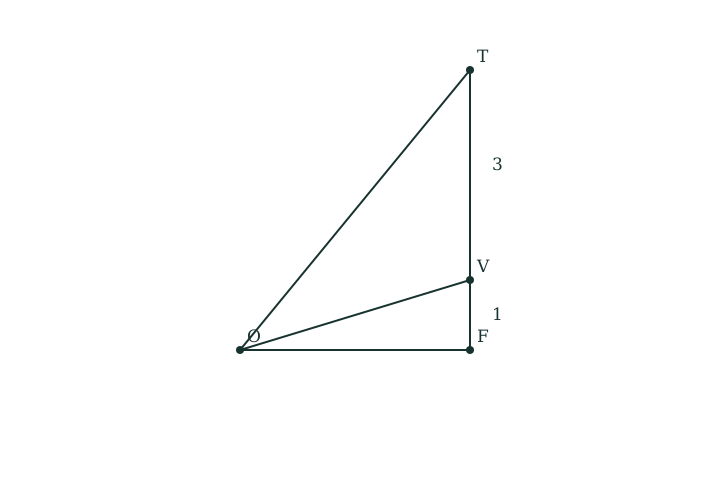
OV→=3(6,3,4)+(2,7,8)4=(5,4,5)\overrightarrow{OV}=\frac{3(6,3,4)+(2,7,8)}4=(5,4,5).

The coordinates of VV is (5,4,5)(5,4,5).

OQ→=(8,1,8)\overrightarrow{OQ}=(8,1,8), OV→=(5,4,5)\overrightarrow{OV}=(5,4,5), OT→=(2,7,8)\overrightarrow{OT}=(2,7,8).

VQ→=OQ→−OV→=(8,1,8)−(5,4,5)=(3,−3,3)\overrightarrow{VQ}=\overrightarrow{OQ}-\overrightarrow{OV}=(8,1,8)-(5,4,5)=(3,-3,3).

VT→=OT→−OV→=(2,7,8)−(5,4,5)=(−3,3,3)\overrightarrow{VT}=\overrightarrow{OT}-\overrightarrow{OV}=(2,7,8)-(5,4,5)=(-3,3,3).

∠TVQ=cos⁡−1(3,−3,3)⋅(−3,3,3)32+(−3)2+32(−3)2+32+32\angle TVQ=\cos^{-1}\frac{(3,-3,3)\cdot(-3,3,3)}{\sqrt{3^2+(-3)^2+3^2}\sqrt{(-3)^2+3^2+3^2}}.

=cos⁡−1−9−9+927=cos⁡−1−927=109.471∘=109.5∘=\cos^{-1}\frac{-9-9+9}{27}=\cos^{-1}\frac{-9}{27}=109.471^\circ=109.5^\circ (1 d.p.).

Native source teaching diagram, Q22 foot Native source teaching diagram, Q22 ratio

Teacher notes

Since plane p1p_1 is perpendicular to QRQR, (0,1,−1)(0,1,-1) parallel to line QRQR is normal to plane p1p_1.

Method 1: Pt on plane pp closest to TT is MM, midpt of T,T′T,T'.

Method 2: The point on plane pp that is closest to TT is the foot of perpendicular, FF, from TT to plane pp. FF is the point of intersection between the line through TT perpendicular to pp and plane pp.

cos⁡∠TVQ=VQ→⋅VT→∣VQ→∣∣VT→∣\cos\angle TVQ=\frac{\overrightarrow{VQ}\cdot\overrightarrow{VT}}{|\overrightarrow{VQ}||\overrightarrow{VT}|}.

To find ∠TVQ\angle TVQ, the 2 vectors bounding the angle must both be directed towards pt VV (TV→,QV→\overrightarrow{TV},\overrightarrow{QV}) or directed away from pt VV (VT→,VQ→\overrightarrow{VT},\overrightarrow{VQ}).

Note: Do not put in the modulus sign for VT→⋅VQ→\overrightarrow{VT}\cdot\overrightarrow{VQ}.

Printed answer key

(i) −x+y+z=1-x+y+z=1. (ii) y−z=−1y-z=-1. (iii) r=(10,−1,0)+λ(−1,1,1)\mathbf r=(10,-1,0)+\lambda(-1,1,1) where λ∈R\lambda\in\mathbb R. (iv) (6,3,4)(6,3,4). (v) (5,4,5)(5,4,5).

Editorial qualification

There are two tetrahedron apexes: T=(2,7,8) and T′=(10,−1,0). The source shows both in its working, then selects the requested T=(2,7,8). “Vertical height” here is the perpendicular altitude to plane p, not the ambient z-axis. V=(5,4,5) and angle109.5° refer to the selected apex.

Source provenance

2025 TJC H2 Math (9758) JC2 MSM: VECTORS. Question booklet PDF pages 4–12 (printed 80–88); solution booklet PDF pages 17–44. Column vectors are typeset as ordered coordinate triples here; the entries, products, intermediate equations and original parameter/domain restrictions are retained.