Original question & working
The shortest cable to an inclined roof diagonal · source reference
[2010/PJC/Prelim/II/3] · Question pp. 10 · Working pp. 43, 44
Open the interactive lessonThe working and teaching notes are included in the interactive lesson.
View source review notesFull original question, working & notes
Printed question
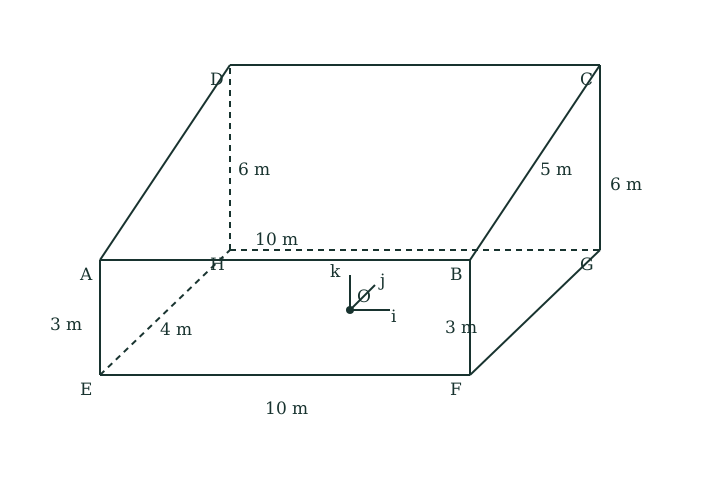
The diagram above shows a partial design of the roof of the gallery of an amphitheatre. is an inclined rectangular roof, where m and m. is a rectangle on a horizontal ground, where m and m. The points are 3 m directly above respectively. The points are 6 m directly above respectively.
Point is the centre of and is taken as the origin. Perpendicular unit vectors are in the direction of respectively.
(i) Find a vector equation of the line passing through . [2]
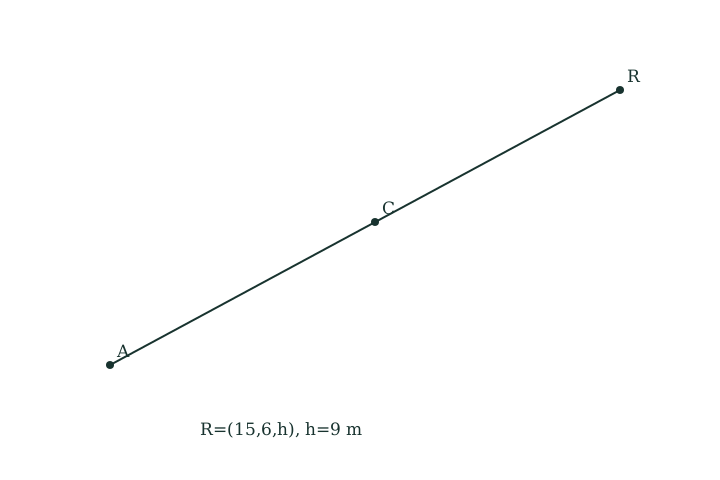
(ii) A spot light is fixed at the top of a vertical pillar erected at point with coordinates . Find the height of the pillar if the top of the pillar is collinear with . [3]
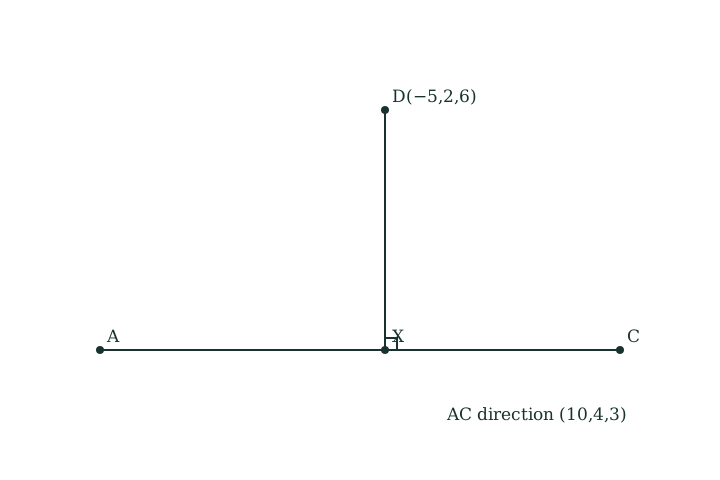
(iii) The main electrical supply to the gallery runs along the diagonal . Find the position vector of point on such that the length of the electric cable that is required to provide electricity from the main electrical supply to an amplifier mounted at , will be the least. [3]
[2010/PJC/Prelim/II/3]
Printed working
(i) .
Line , , or , .
(ii) Let point be the top of pillar of height , i.e. .
Since lies on line , for some real .
Equating .
.
Thus, height of pillar is 9 m.
Alternative solution
Since are collinear points, for some real .
.
From 1st row: .
From 3rd row: .
Thus, height of pillar is 9 m.
(iii) Since lies on , for some real .
For to be the least, , i.e. .
.
.
.
Thus .
Printed answer key
(i) , , or , . (ii) 9 m. (iii) .
Editorial qualification
The question first defines O as the origin, then calls the pillar base O with coordinates (15,6,0). These are incompatible point names. The printed working uses a pillar top R=(15,6,h); Porisma retains the original wording and interprets the base as a separately named point (15,6,0).
Source provenance
2025 TJC H2 Math (9758) JC2 MSM: VECTORS. Question booklet PDF pages 4–12 (printed 80–88); solution booklet PDF pages 17–44. Column vectors are typeset as ordered coordinate triples here; the entries, products, intermediate equations and original parameter/domain restrictions are retained.