Original question & working
Odd-indexed terms and an alternating tail · source reference
[2023/ACJC/Promo/8] · Question pp. 1 · Working pp. 4, 5, 6
Open the interactive lessonThe working and teaching notes are included in the interactive lesson.
View source review notesFull original question, working & notes
Printed question
(a)(i) The sum of the first terms of a sequence is . Show . [2]
(ii) Hence show that the sequence is an arithmetic progression. [2]
(iii) State the first 3 odd-numbered terms . Hence find the least such that the sum of the first odd-numbered terms is more than 500. [3]
(b)(i) Find the range of for which the following geometric series converges: . [2]
(ii) Given , find the sum of all the terms of this geometric series after, and including, the 8th term. [3]
Printed working
(a)(i)
(ii) , constant, hence AP.
(iii) . Common difference of odd-indexed terms .
From GC, gives 469.68 (<500), gives 651.4 (>500), so least .
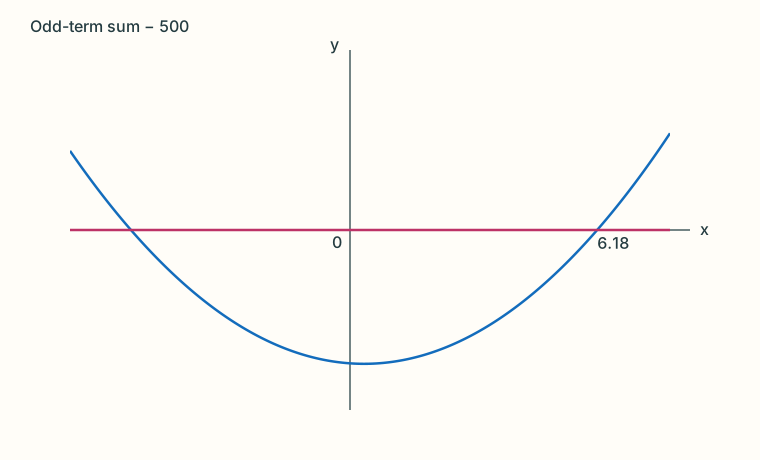
Alternatively sketch . The positive -intercept is approximately 6.18; the graph is positive for . Least .
(b)(i) Common ratio .
(ii) At , .
Method 1:
Method 2: .
Teacher notes
, , so . Replace by to obtain an expression for .
To show AP, prove or is constant using general terms. Showing proves only those three terms are in AP.
If has common difference , the odd terms form an AP with difference , since each spans two differences.
AP sum : here .
GC table: Y=, enter expression replacing by ; 2nd window → TblStart:1, ΔTbl:1; 2nd graph, scroll to rows changing from <500 to >500.
GC graph: Y=, replace by ; zoom → 0:ZoomFit. To find -intercept: 2nd calc → 2:zero → left bound → right bound (move cursor on the curve) → zero.
Common ratio .
, . The sum after and including term 8 is .
Source tables and calculator displays
| Odd-term sum | |
|---|---|
| 6 | 469.68 <500 |
| 7 | 651.4 >500 |
Source diagrams redrawn
Printed answer key
(a)(iii) ; 7. (b)(i) ; (ii) −0.00181 (3 s.f.)
Mathematical review and qualifications
(a)(i) (also correct at ). (ii) , constant. (iii) The odd-indexed terms begin , with difference . Their sum is . At it is about , at about , so least .
(b)(i) iff , giving . (ii) At , , eighth term . Its tail is (3 s.f.).
Provenance
2025 TJC H2 Math (9758) JC2 MSM: ARITHMETIC & GEOMETRIC PROGRESSIONS. [2023/ACJC/Promo/8] Question PDF pages 1; solution PDF pages 4, 5, 6. The original files remain private QA records outside this native content.