Original question & working
Alternating terms, even terms and products · source reference
[2009/IJC/Prelim/I/12] · Question pp. 2 · Working pp. 10, 11
Open the interactive lessonThe working and teaching notes are included in the interactive lesson.
View source review notesFull original question, working & notes
Printed question
A geometric series G is given by , where is a negative real number.
(i) Show that G is convergent. [2]
(ii) Its sum to infinity is . Given that the sum to infinity of the even-numbered terms (the second, fourth, sixth, … terms) is , find exactly. [4]
(iii) In another series H, each term is the modulus of the corresponding G term. Given , find the greatest such that the product of H’s first terms exceeds 15000. [4]
Printed working
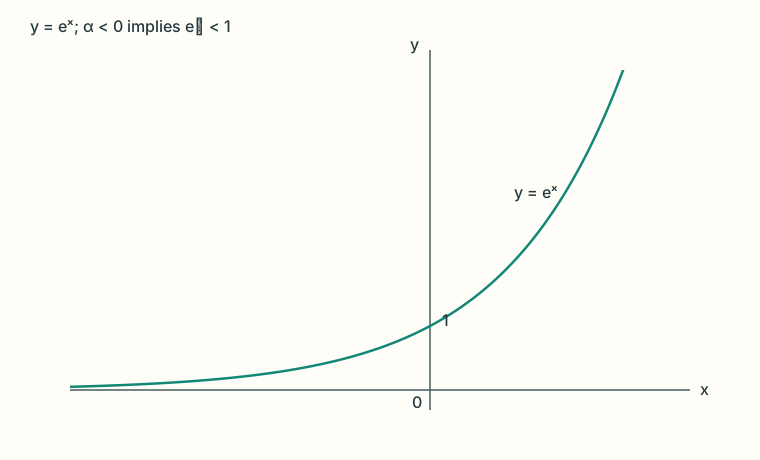
(i) Common ratio ; since , so G converges.
(ii) . Even-term sum:
(iii) H is . Product of terms:
Given this ,
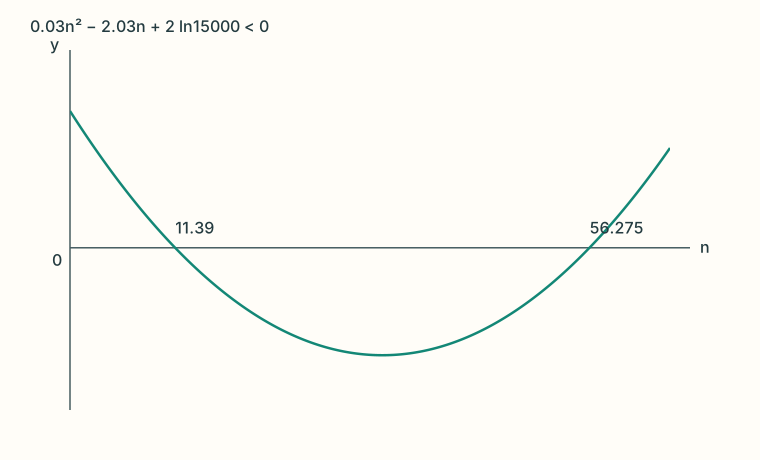
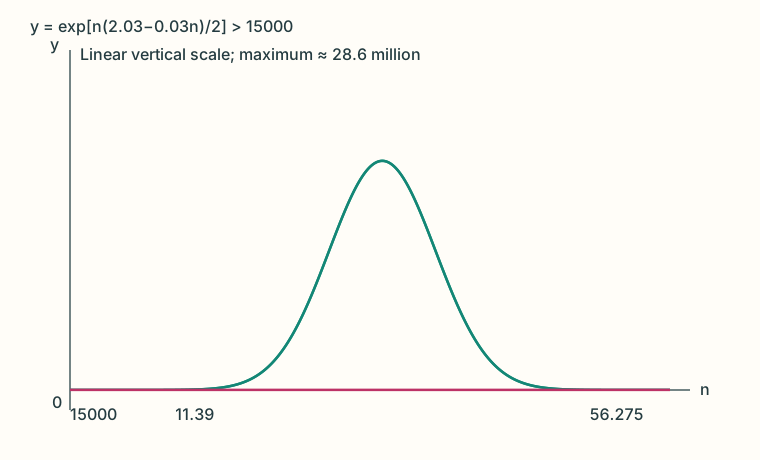
Roots 11.39 and 56.275. Thus , greatest .
Alternative: graph against . Intersections 11.39,56.275 yield the same interval and answer.
Teacher notes
G converges when .
Even-indexed terms form a GP with first term and common ratio .
H takes the modulus of each G term, giving .
Source diagrams redrawn
Printed answer key
(ii) ; (iii) 56
Mathematical review and qualifications
(i) Ratio is , with modulus below one, so converges.
(ii) and the even-indexed sum is . Equality gives , hence , .
(iii) The product is . At its logarithm is . Solve , giving approximately . The greatest integer is 56; the logarithms at 56 and 57 are 9.8 and 9.12, bracketing .
Provenance
2025 TJC H2 Math (9758) JC2 MSM: ARITHMETIC & GEOMETRIC PROGRESSIONS. [2009/IJC/Prelim/I/12] Question PDF pages 2; solution PDF pages 10, 11. The original files remain private QA records outside this native content.