Original question & working
A filling machine and an insufficient tail · source reference
[2013/CJC/Prelim/II/1] · Question pp. 3 · Working pp. 15, 16
Open the interactive lessonThe working and teaching notes are included in the interactive lesson.
View source review notesFull original question, working & notes
Printed question
(i) A certain machine A pumps liquid into an empty container of total volume . The first pumping action fills it with . Each subsequent action fills it with more than the previous action. Pumping continues until it is completely filled. Find the overflow volume at the final pumping action. [3]
(ii) Suppose after A’s 50th action, a different machine B fills the remaining volume. B first fills , then each subsequent action fills the amount filled in the previous action.
(a) Find the total volume filled after B’s 10th action. [3]
(b) Explain whether the container would be completely filled eventually. [2]
Printed working
(i) Total volume .
Roots −66.29 and 51.29 give (reject, ) or . Thus action 52 completely fills the container with some overflow.
overflow .
(ii)(a) For A, .
For B,
Total (3 s.f.).
(ii)(b) Ratio , so sum to infinity exists:
Volume remaining for B . The theoretical maximum B adds is only , so it never fills completely.
Teacher notes
AP , here , or with .
GC roots: apps → 9:PlySmlt2 → 1:Polynomial Root Finder → Order 2 → graph (Next). Key coefficients; graph (solve).
GP sum ; B has . Its theoretical maximum is the GP infinite sum .
The source writes an equality to the displayed fraction , a close calculator rational approximation rather than the exact finite sum: the exact ten-term sum is , approximately 25.1548. The decimal and final answer are consistent with the correct formula.
Source tables and calculator displays
| Pump A | Amount () |
|---|---|
| 1st | 4 |
| 2nd | |
| 3rd | |
| … | … |
| th |
| Pump B | Amount () |
|---|---|
| 1st | 5 |
| 2nd | |
| … | … |
| th |
Source diagrams redrawn
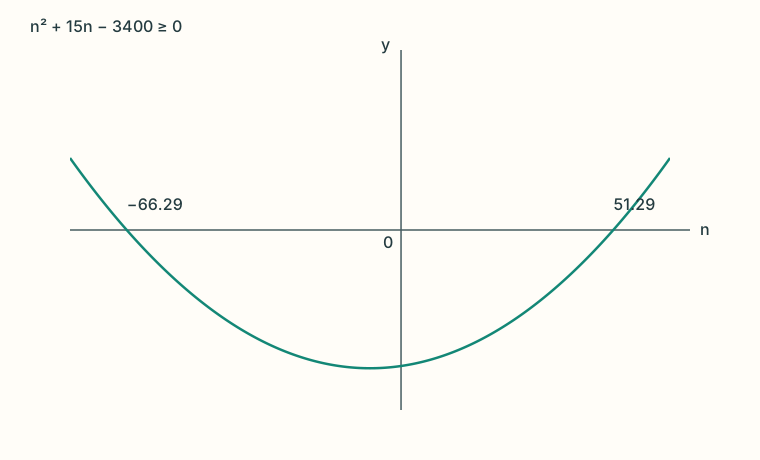
Printed answer key
(i) ; (ii)(a) (3 s.f.); (b) No
Mathematical review and qualifications
(i) . At 51 actions the volume is 841.5; at 52 it is 871. Overflow is .
(ii)(a) After 50 A actions, volume is 812.5. Ten B actions add , giving total about , or 838 (3 s.f.). (b) B adds at most , so total remains below 842.5, itself below 850. It never fills completely.
Provenance
2025 TJC H2 Math (9758) JC2 MSM: ARITHMETIC & GEOMETRIC PROGRESSIONS. [2013/CJC/Prelim/II/1] Question PDF pages 3; solution PDF pages 15, 16. The original files remain private QA records outside this native content.