Original question & working
AP lap times against GP lap times · source reference
[2023/JPJC/Prelim/I/8] · Question pp. 4 · Working pp. 18, 19
Open the interactive lessonThe working and teaching notes are included in the interactive lesson.
Lap totals establish a lead change between laps 3 and 4. The precise within-lap crossing time needs a speed model; the source gives only lap durations.
Full original question, working & notes
Printed question
A marathon runner and a sprinter run laps on a 400m track. The sprinter takes 56 seconds for lap 1, then 6 seconds more each subsequent lap. The marathon runner takes 1 minute for lap 1, then 4% more than the previous lap.
(i) Show the sprinter’s time for laps is . [2]
(ii) Find the marathon runner’s time for laps in terms of . [2]
(iii) How many complete laps does it take for the marathon runner to first exceed 40 minutes total? [3]
They decide to do a 12km race with the same starting point.
(iv) Determine who finishes first. [3]
(v) Determine which lap the winner is on when first overtaking the other runner. [3]
Printed working
(i) Sprinter: ; AP first term 56, difference 6.
(ii) Marathon: ; GP first 60, ratio 1.04.
(iii) .
Method 1: . Needs 25 laps.
Method 2: use the table below; the first value above 2400 is at 25 laps.
(iv) . Sprinter time s; marathon time s (5 s.f.). Marathon runner finishes first.
(v) Consider . Method 1 uses the table below.
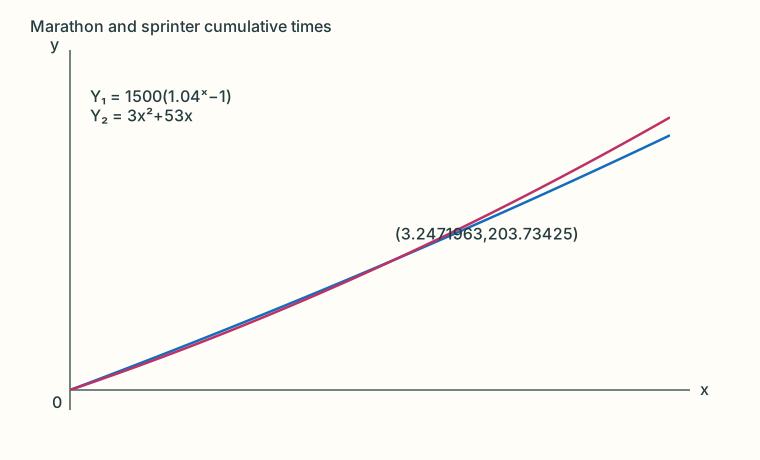
Method 2 sketches , . Their first positive intersection is ; source rounds (3 s.f.), hence . Marathon runner first overtakes on lap 4.
Source tables and calculator displays
| Marathon total seconds | |
|---|---|
| 24 | 2345 <2400 |
| 25 | 2498.8 >2400 |
| 26 | 2658.7 >2400 |
| 3 | 187.3 | 186 |
| 4 | 254.79 | 260 |
| 5 | 324.98 | 340 |
Source diagrams redrawn
Printed answer key
(ii) ; (iii) 25 laps; (iv) marathon runner; (v) 4th lap
Mathematical review and qualifications
(i) .
(ii) seconds.
(iii) Solve , giving . First complete count is 25 (24 gives about 2345 s; 25 gives 2499 s).
(iv) For 30 laps, s and s, so the marathon runner wins.
(v) At three laps, ; at four, . The marathon runner first overtakes during lap 4 under the usual constant-speed-per-lap model. The first three lap endpoint comparisons retain the sprinter lead.
Lap totals establish a lead change between laps 3 and 4. The precise within-lap crossing time needs a speed model; the source gives only lap durations.
Provenance
2025 TJC H2 Math (9758) JC2 MSM: ARITHMETIC & GEOMETRIC PROGRESSIONS. [2023/JPJC/Prelim/I/8] Question PDF pages 4; solution PDF pages 18, 19. The original files remain private QA records outside this native content.