Original question & working
Selected terms and a rabbit–fox chase · source reference
[2022/ASRJC/Prelim/I/9] · Question pp. 5 · Working pp. 23, 24
Open the interactive lessonThe working and teaching notes are included in the interactive lesson.
The model specifies synchronised endpoints. Within-hop motion is unspecified; the distance calculation follows the source endpoint/constant-progress model. A strict real lower bound has an infimum rather than an attained minimum.
Full original question, working & notes
Printed question
(a) An AP has first term and difference . Its eighth, third and second terms are the first three terms of an infinite GP.
(i) Find its common ratio. [3]
(ii) Find the exact sum of its odd-numbered terms in terms of . [3]
(b) A programmer codes a rabbit-fox chase along a straight path to model an actual hunt. The rabbit first hops 1.75m, then 1% less each hop. The fox first leaps 3m, then 0.02m less each leap. Initially the rabbit is 60m ahead. They start and end each hop/leap at the same time.
(i) Find the total distances after leaps/hops, and the minimum number for catch-up. [4]
(ii) Find fox leaps before stopping. Hence find the minimum starting distance in metres such that the fox never catches the rabbit, to the nearest integer. [2]
Printed working
(a)(i) Let be GP first term and common ratio:
gives (4); gives (5).
Divide (4) by (5):
or 1 (reject since ).
(ii) From (5), ; from (3), .
(b)(i)
For catch-up . Let be the left side; GC table below gives least .
(ii) Let be the starting gap. No catch-up requires
Fox stops when :
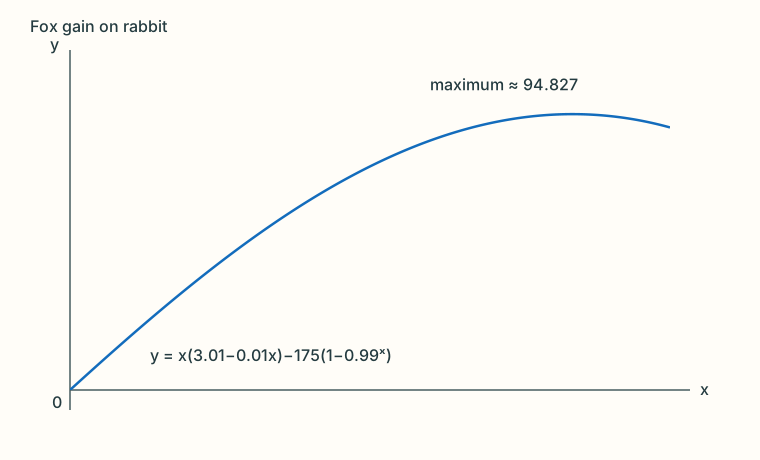
It takes 150 positive leaps. For , the GC maximum is approximately 94.827. Hence minimum whole-metre gap 95m.
Teacher notes
Eliminate first. Then eliminate simultaneously by dividing (4) by (5); the final equation contains only.
Odd-indexed GP terms , first , ratio .
Fox: is AP (). Rabbit: and ratio as printed in the margin. This is a source typo: the question and working consistently use 0.99, since distance decreases by 1%.
Refer to Q15(iv) for GC table skills. The gap calculation is distance travelled by fox minus distance travelled by rabbit.
Source tables and calculator displays
| 53 | 59.171 <60 |
| 54 | 60.084 >60 |
| 55 | 60.987 >60 |
Source diagrams redrawn
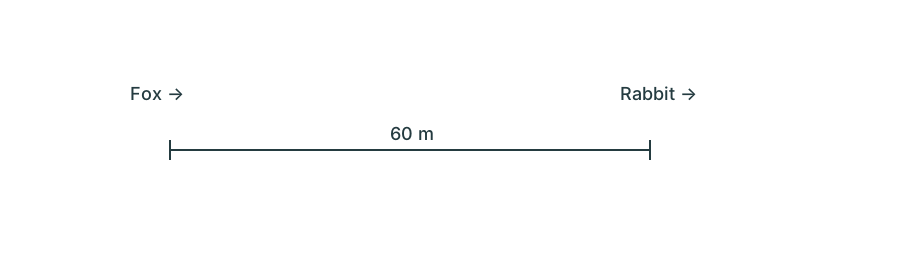
Printed answer key
(a)(i) ; (ii) ; (b)(i) 54; (ii) 150 leaps; 95m
Mathematical review and qualifications
(a)(i) gives . As , and . (ii) The GP first term is . Its odd-indexed sum is .
(b)(i) and . Catch-up requires . The values at 53 and 54 are about 59.171 and 60.084; first count is 54.
(ii) The fox nth leap is , zero at , hence 150 positive leaps. Checking integer gives maximum gain about m at . A gap strictly above this is safe in the endpoint model; the minimum whole-metre gap is 95 m. The source continuous-index maximum is approximately 94.827, consistent with the same integer answer.
The model specifies synchronised endpoints. Within-hop motion is unspecified; the distance calculation follows the source endpoint/constant-progress model. A strict real lower bound has an infimum rather than an attained minimum.
Provenance
2025 TJC H2 Math (9758) JC2 MSM: ARITHMETIC & GEOMETRIC PROGRESSIONS. [2022/ASRJC/Prelim/I/9] Question PDF pages 5; solution PDF pages 23, 24. The original files remain private QA records outside this native content.