Original question & working
Out-and-back circuits and changing growth rates · source reference
[2022/SAJC/Prelim/I/9] · Question pp. 7 · Working pp. 30, 31, 32
Open the interactive lessonThe working and teaching notes are included in the interactive lesson.
Nine increases reach session 10; sixty further increases reach session 70. Rounded lower bounds are approximate and should not replace the exact inequality in calculations.
Full original question, working & notes
Printed question
Besto’s coach designs a training programme starting with a 400m run on session 1. Each subsequent session covers 250m more than the previous.
(i) Find the minimum sessions for at least 20km in one session. [3]
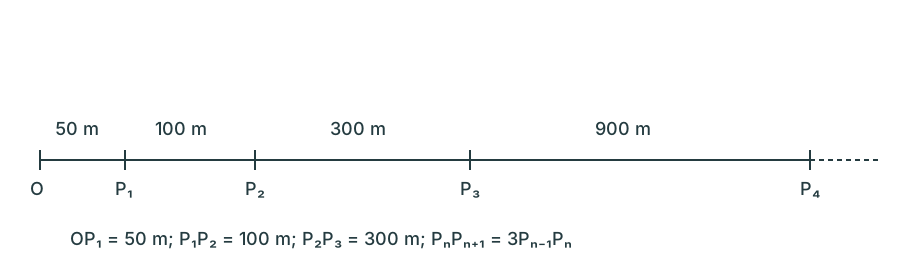
For another group in Besto, a stamina circuit starts at O with points increasingly far away on a straight line. Stage 1 goes O to and back, stage 2 O to and back, etc. The diagram (Fig. 1) gives m, m, m and .
(ii) Find distance after stages. [3]
(iii) Hence find distance from O and travel direction after exactly 42km. [3]
Choco’s coach designs another programme starting at 400m in session 1. Each subsequent distance increases by 10% of the previous session’s distance. From session 11 onward and for every subsequent session, distance increases by % of the previous distance.
(iv) If Choco runners cover at least 20km in session 70, find the range of . [4]
Printed working
(i) Let denote distance covered in session . It is an AP with difference 250:
GC table below gives minimum .
Alternative: . Minimum 80.
(ii) From the stage table below,
(iii) Completed stages satisfy . Table below shows six completed stages, 36400m. Remaining m. Since , runner is moving away from O, 5600m from O, and has not reached .
(iv) Session 10: m. From session 11 on, session distance .
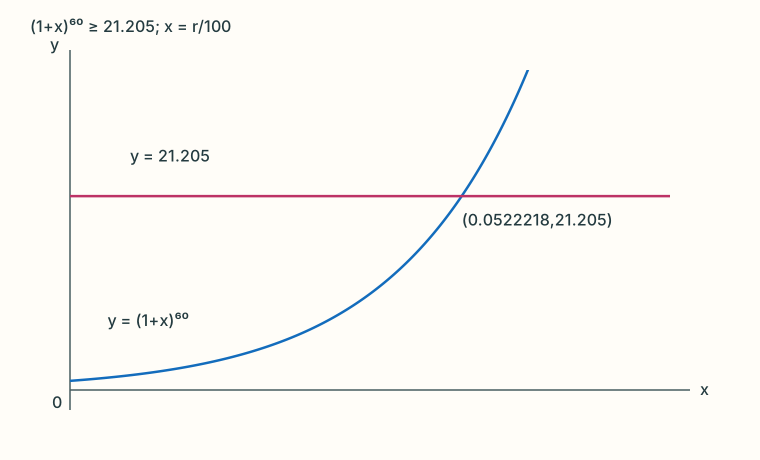
Let . GC intersection of and is . Thus (3 s.f.).
Source tables and calculator displays
| 79 | 19900 <20000 |
| 80 | 20150 >20000 |
| 81 | 20400 >20000 |
| Total stage distance expansion | |
|---|---|
| 1 | |
| 2 | |
| 3 | |
| … | … |
| 5 | 12100 <42000 |
| 6 | 36400 <42000 |
| 7 | 109300 >42000 |
Source diagrams redrawn
Printed answer key
(i) 80; (ii) ; (iii) running away from O at distance 5600m; (iv) (3 s.f.)
Mathematical review and qualifications
(i) gives , so first session 80.
(ii) (including ). Total out-and-back distance is metres.
(iii) Six stages cover m, while seven cover 109300 m. Remaining travel is m in stage 7. Since m, the runner is still on the outward leg, 5600 m from O and running away.
(iv) Session 10 distance is . Session 70 distance is . For the intended increase , this gives , reported as (3 s.f.) with the exact lower bound retained.
Nine increases reach session 10; sixty further increases reach session 70. Rounded lower bounds are approximate and should not replace the exact inequality in calculations.
Provenance
2025 TJC H2 Math (9758) JC2 MSM: ARITHMETIC & GEOMETRIC PROGRESSIONS. [2022/SAJC/Prelim/I/9] Question PDF pages 7; solution PDF pages 30, 31, 32. The original files remain private QA records outside this native content.