Original question & working
A logarithmic fixed-point iteration · source reference
[2012/MI/Prelim/10] · Question pp. 2 · Working pp. 6
Open the interactive lessonThe working and teaching notes are included in the interactive lesson.
Finding possible limits does not prove convergence; every logarithm requires >1.
Full original question, working & notes
Printed question
The diagram shows . Its roots are , with .
(i) Find correct to 3 decimal places. [2]
A sequence of real numbers satisfies , .
(ii) Prove algebraically that if the sequence converges, it converges to either or . [3]
(iii) By considering the maximum point of , show . [3]
Printed working
(i) From GC: .
(ii) If a sequence converges, as , .
Hence or .
(iii) Maximum point: .
Since , , so .
Source diagrams redrawn
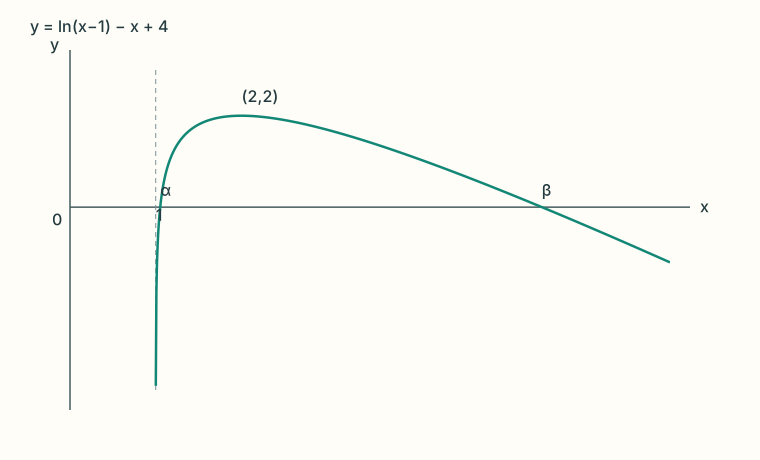
Printed answer key
(i)
Mathematical review and qualifications
(i) Numerical solution on and gives , to 3 d.p.
(ii) For a convergent real sequence defined at every step, is impossible, since would tend to . Hence , and continuity gives , so . Therefore or .
(iii) , zero only at 2; . The global maximum is . Thus .
Finding possible limits does not prove convergence; every logarithm requires x_n>1.
Provenance
2025 TJC H2 Math (9758) JC2 MSM: RECURRENCE RELATIONS. [2012/MI/Prelim/10] Question PDF pages 2; solution PDF pages 6. The original files remain private QA records outside this native content.