Original question & working
An exponential denominator creates a stable limit · source reference
[2011/YJC/Prelim/I/1] · Question pp. 4 · Working pp. 11, 12
Open the interactive lessonThe working and teaching notes are included in the interactive lesson.
The denominator is 2 raised to . Establishing an upper bound is necessary; increasing alone does not imply convergence.
Full original question, working & notes
Printed question
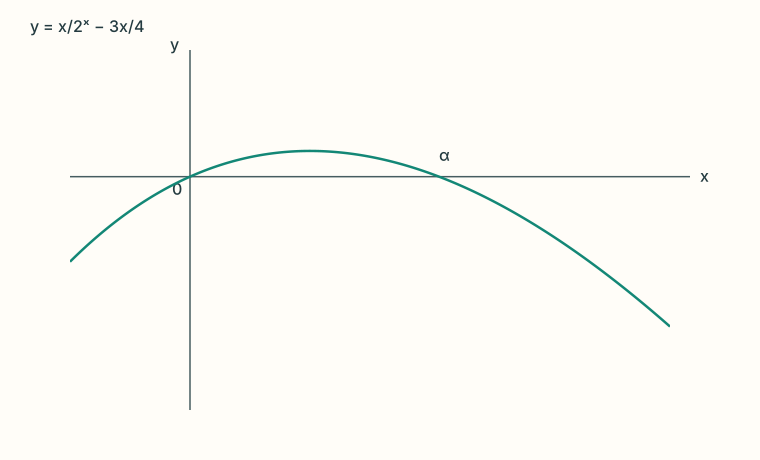
The diagram shows . The two roots of are .
(i) Find exactly. [2]
A sequence of positive real numbers satisfies , .
(ii) Considering , show if . [2]
(iii) For , use (i),(ii) to find the exact limit. [3]
Printed working
(i)
Since , .
(ii)
From the graph, if , , hence .
(iii) The printed solution starts “Since the sequence converges”. As , .
From (i), . From (ii), if , so it is increasing. Hence .
Teacher notes
If , the graph of is above the -axis, so . Replace by in this inequality.
Source diagrams redrawn
Printed answer key
(i) ; (iii)
Mathematical review and qualifications
(i) , so .
(ii) For , , hence .
(iii) Set . On , , since . With , this maps into itself. Thus the sequence increases and is bounded above by . Its limit solves ; as , .
The denominator is 2 raised to x_n. Establishing an upper bound is necessary; increasing alone does not imply convergence.
Provenance
2025 TJC H2 Math (9758) JC2 MSM: RECURRENCE RELATIONS. [2011/YJC/Prelim/I/1] Question PDF pages 4; solution PDF pages 11, 12. The original files remain private QA records outside this native content.