Original question & working
An alternating fifth-root iteration · source reference
[2014/TJC/Promo/7] · Question pp. 4 · Working pp. 12, 13
Open the interactive lessonThe working and teaching notes are included in the interactive lesson.
View source review notesFull original question, working & notes
Printed question
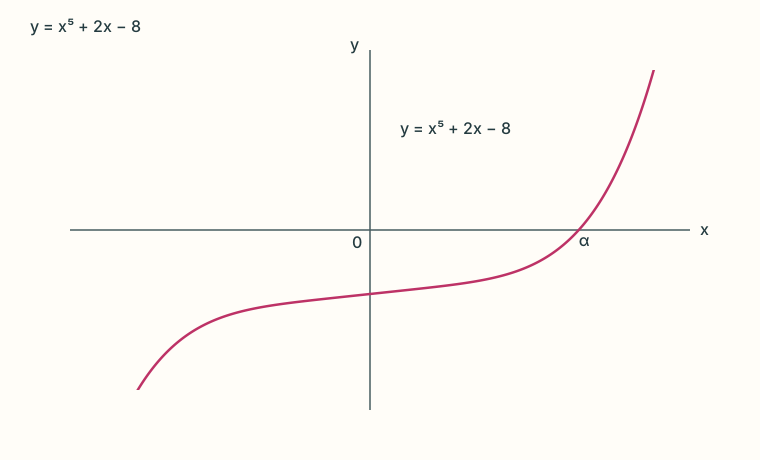
The diagram shows . Its root is denoted by .
(i) Find correct to 3 decimal places. [1]
The real numbers satisfy , .
(ii) Using (i), show that if the sequence converges, it converges to . [2]
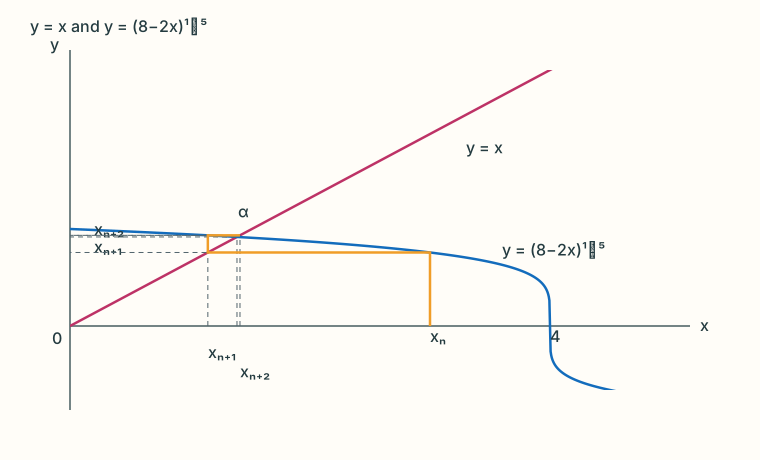
(iii) Considering the graphs of and on the same diagram, or otherwise, prove that if , then (a) , (b) . [3]
(iv) Given , use (iii) to obtain an inequality relating . With a graphic calculator, describe the sequence behaviour. [2]
Printed working
(i) . Using GC, (3 d.p.).
(ii) If it converges to (the limit), then as , .
From (i), is the root, so . Hence if it converges, it converges to 1.392.
(iii) and intersect at . Recurrence: . From the diagram, if , then and .
(iv) When , . By (iii), and . That is . Using GC, the sequence oscillates and converges to 1.392.
Printed repeated block (v): the solution sheet repeats the same argument, the inequality and the statement that it oscillates and converges to 1.392. There is no part (v) in the question.
Source tables and calculator displays
GC polynomial-root finder setup: ORDER 1 2 3 4 5 6 7 8 9 10 (5 selected); REAL / a+bi / re^(θi) (a+bi selected); DEC / FRAC; NORMAL / SCI / ENG; FLOAT 0 1 2 3 4 5 6 7 8 9; RADIAN / DEGREE (DEGREE selected). Screen buttons: MAIN, HELP, NEXT; equation ; roots-screen buttons MAIN, MODE, COEF, STO.
| Root | First displayed panel | Second displayed panel |
|---|---|---|
| x₁ | −1.26390490… | …0.9922772727i |
| x₂ | −1.26390490… | −1.26390490… |
| x₃ | 0.5681535179… | 0.5681535179… |
| x₄ | 0.5681535179… | 0.5681535179… |
| x₅ | 1.39150277 | 1.39150277 |
These are the literal truncated source displays, not full complex-root claims. The graph reads Intersection X=1.3915028 Y=0. Only the real root is requested.
Source diagrams redrawn
Printed answer key
(i) 1.392 (3 d.p.); (iv) ; oscillates and converges to 1.392
Mathematical review and qualifications
(i) Since , there is exactly one real root, numerically (3 d.p.).
(ii) Continuity gives , hence and .
(iii)(a) is decreasing and , so . (b) With , decreasingness gives . To show , it suffices that . Using , this becomes . Here and , so the bracket exceeds . Thus .
(iv) , , giving . Iteration gives oscillation converging to . The odd subsequence decreases above ; the even subsequence increases below it. Their limiting two-cycle would require ; the upper limit is at least , so the bracket is positive and the limits coincide at .
Provenance
2025 TJC H2 Math (9758) JC2 MSM: RECURRENCE RELATIONS. [2014/TJC/Promo/7] Question PDF pages 4; solution PDF pages 12, 13. The original files remain private QA records outside this native content.