Porisma

Original question & working

Telescoping logs and a rational GP ratio · source reference

[2023/MI/Prelim/II/3] · Question pp. 1 · Working pp. 5, 6

Open the interactive lesson

The working and teaching notes are included in the interactive lesson.

View source review notes
Full original question, working & notes

Printed question

(a) A sequence u2,u3,u4,…u_2,u_3,u_4,\ldots is such that un=ln⁡(n−1n+1)u_n=\ln(\frac{n-1}{n+1}), n≥2n\ge2. Find in terms of NN an expression for SN=u2+u3+⋯+uN−1+uNS_N=u_2+u_3+\cdots+u_{N-1}+u_N, leaving your answer as ln⁡a−f(N)\ln a-f(N), where aa is positive. [3]

(b)(i) Find the set of xx for which ∑n=1∞(3xx+1)n\sum_{n=1}^{\infty}(\frac{3x}{x+1})^n has a finite sum. [3]

(ii) Given x=0.25x=0.25, find its value. [2]

Printed working

(a)

SN=ln⁡13+ln⁡24+ln⁡35+⋯+ln⁡N−2N+ln⁡N−1N+1=ln⁡1⋅2⋅3⋯(N−2)(N−1)3⋅4⋅5⋯(N−1)N(N+1)=ln⁡2N(N+1)=ln⁡2−ln⁡[N(N+1)].\begin{aligned}S_N&=\ln\frac13+\ln\frac24+\ln\frac35+\cdots+\ln\frac{N-2}N+\ln\frac{N-1}{N+1}\\&=\ln\frac{1\cdot2\cdot3\cdots(N-2)(N-1)}{3\cdot4\cdot5\cdots(N-1)N(N+1)}\\&=\ln\frac2{N(N+1)}=\ln2-\ln[N(N+1)].\end{aligned}

(b)(i) The series (3xx+1)+(3xx+1)2+⋯(\frac{3x}{x+1})+(\frac{3x}{x+1})^2+\cdots is geometric, ratio r=3xx+1r=\frac{3x}{x+1}. Finite sum requires ∣r∣<1|r|<1.

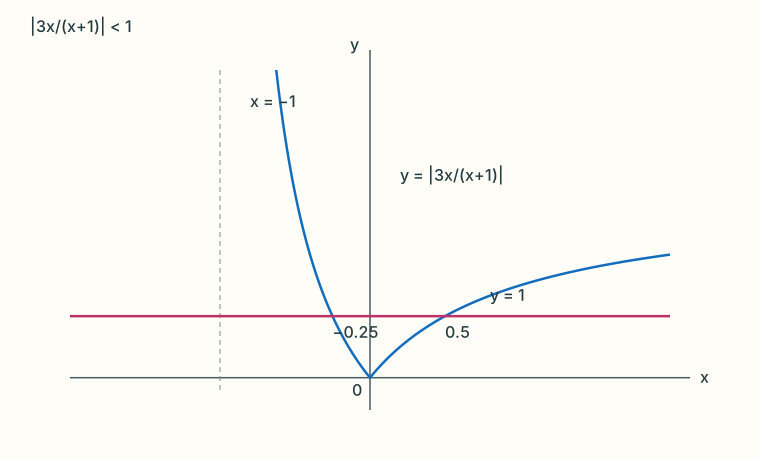
Method 1 (graphical): intersections of y=∣3xx+1∣y=|\frac{3x}{x+1}| and y=1y=1 are x=−0.25,0.5x=-0.25,0.5. The graph lies below 1 between them: −0.25<x<0.5-0.25<x<0.5.

Method 2 (algebraic):

∣3xx+1∣<1⇒∣3x∣<∣x+1∣⇒(3x)2<(x+1)2⇒9x2<x2+2x+1,\left|\frac{3x}{x+1}\right|<1\Rightarrow|3x|<|x+1|\Rightarrow(3x)^2<(x+1)^2\Rightarrow9x^2<x^2+2x+1, 8x2−2x−1<0⇒(4x+1)(2x−1)<0⇒−0.25<x<0.5.8x^2-2x-1<0\Rightarrow(4x+1)(2x-1)<0\Rightarrow-0.25<x<0.5.

(b)(ii) Method 1: at x=0.25x=0.25, the series is ∑n=1∞(35)n=35+(35)2+⋯=3/51−3/5=32\sum_{n=1}^{\infty}(\frac35)^n=\frac35+(\frac35)^2+\cdots=\frac{3/5}{1-3/5}=\frac32.

Method 2:

3x/(x+1)1−3x/(x+1)=3x1−2x=3(0.25)1−2(0.25)=1.5.\frac{3x/(x+1)}{1-3x/(x+1)}=\frac{3x}{1-2x}=\frac{3(0.25)}{1-2(0.25)}=1.5.

Teacher notes

For x=0.25x=0.25, this is a GP with first term 35\frac35 and common ratio 35\frac35.

Source diagrams redrawn

14-06

Printed answer key

(a) SN=ln⁡2−ln⁡[N(N+1)]S_N=\ln2-\ln[N(N+1)]; (b)(i) −0.25<x<0.5-0.25<x<0.5; (b)(ii) 1.5

Mathematical review and qualifications

(a) SN=ln⁡[1⋅2⋯(N−1)/(3⋅4⋯(N+1))]=ln⁡[2/(N(N+1))]=ln⁡2−ln⁡[N(N+1)]S_N=\ln[1\cdot2\cdots(N-1)/(3\cdot4\cdots(N+1))]=\ln[2/(N(N+1))]=\ln2-\ln[N(N+1)].

(b)(i) ∣3x/(x+1)∣<1|3x/(x+1)|<1 is equivalent to (4x+1)(2x−1)<0(4x+1)(2x-1)<0, giving −1/4<x<1/2-1/4<x<1/2. (ii) At x=1/4x=1/4, the ratio is 3/53/5 and the first term is 3/53/5, so the sum is (3/5)/(1−3/5)=3/2(3/5)/(1-3/5)=3/2.

Provenance

2025 TJC H2 Math (9758) JC2 MSM: SIGMA NOTATION. [2023/MI/Prelim/II/3] Question PDF pages 1; solution PDF pages 5, 6. The original files remain private QA records outside this native content.