Original question & working
Conjugation and component equations · source reference
[2015/JJC/Prelim/II/1] · Question pp. 1 · Working pp. 2, 3
Open the interactive lessonThe working and teaching notes are included in the interactive lesson.
View source review notesFull original question, working & notes
Question
(a) Given , where are real and positive, find in terms of and/or :
(i) ;
(ii) . [3]
(b) Solve and , giving in the form , where are real. [5]
[2015/JJC/Prelim/II/1]
Source working
Printed working
(a)(i) .
(a)(ii) .
(b)
Let :
Comparing real and imaginary parts:
Substitute (3) into (4): , hence . Thus and .
Diagram labels and geometry
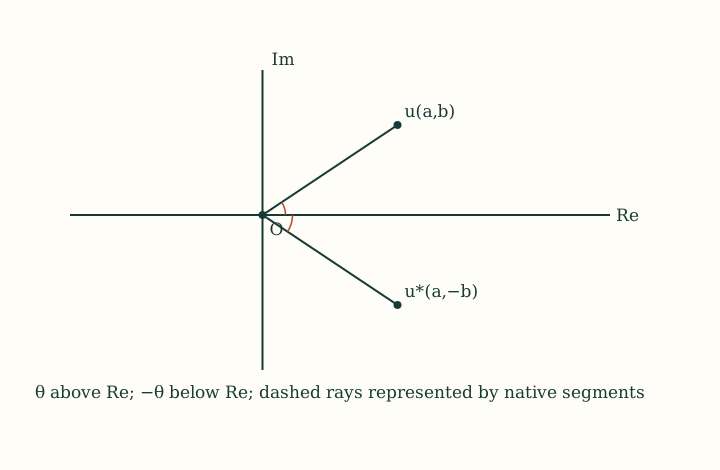
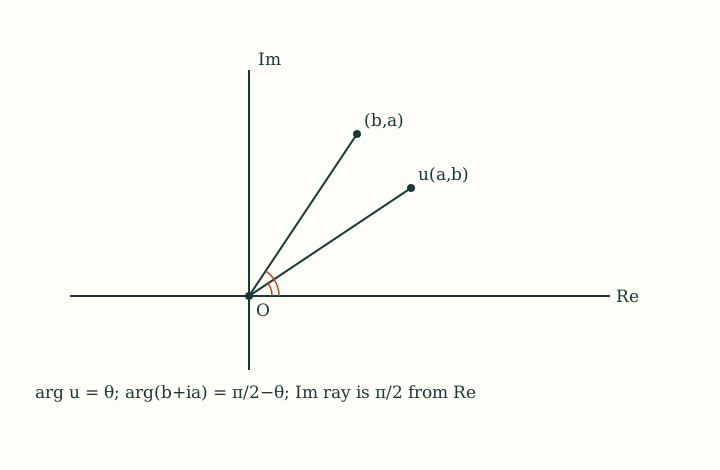
The first diagram places above the real axis at angle , and below at . The second places at angle ; the positive imaginary axis is from the real axis. Both diagrams label Re, Im and origin .
Printed answer key
(a)(i) ; (ii) . (b) .
Native diagrams
Provenance
2025 TJC H2 Math (9758) JC2 MSM: COMPLEX NUMBERS. Question pages 1; solution pages 2, 3. These are original document page numbers, retained as text metadata.