Porisma

Original question & working

Conjugate roots and transformed equations · source reference

[2023/CJC/Prelim/I/4 modified] · Question pp. 2 · Working pp. 8, 9

Open the interactive lesson

The working and teaching notes are included in the interactive lesson.

View source review notes
Full original question, working & notes

Question

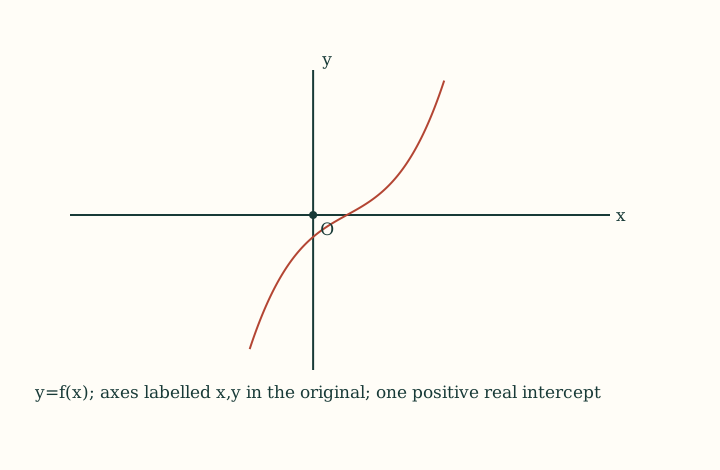
f(x)f(x) is a cubic polynomial with real coefficients. The diagram shows y=f(x)y=f(x).

(a) What can be said about all roots of f(x)=0f(x)=0? [2]

Suppose f(x)=2x3−7x2+16x+cf(x)=2x^3-7x^2+16x+c, with cc real.

(b) Show c=−15c=-15 if f(x)=0f(x)=0 has root x=1−2ix=1-2i. [1]

(c) Without using a calculator, determine the other roots. [3]

(d) Hence find roots of (i) −15w3+16w2−7w+2=0-15w^3+16w^2-7w+2=0 [3], and (ii) 2iw3−7w2−16iw+15=02iw^3-7w^2-16iw+15=0 [2].

[2023/CJC/Prelim/I/4 modified]

Source working

Printed working

(a) There is only one positive real root of f(x)=0f(x)=0. Since all coefficients are real, the other two roots are a pair of complex conjugates.

(b) Substitute x=1−2ix=1-2i:

2(−11+2i)−7(−3−4i)+16(1−2i)+c=0,2(-11+2i)-7(-3-4i)+16(1-2i)+c=0, 15+c=0⇒c=−15.15+c=0\Rightarrow c=-15.

(c) Conjugate root: x=1+2ix=1+2i.

2x3−7x2+16x−15=[x−(1+2i)][x−(1−2i)](2x−k)=[(x−1)+2i][(x−1)−2i](2x−k)=(x2−2x+5)(2x−k).\begin{aligned}2x^3-7x^2+16x-15&=[x-(1+2i)][x-(1-2i)](2x-k)\\&=[(x-1)+2i][(x-1)-2i](2x-k)\\&=(x^2-2x+5)(2x-k).\end{aligned}

Comparing constant terms, or by long division: −5k=−15⇒k=3-5k=-15\Rightarrow k=3. Last root x=3/2x=3/2. Thus the three roots are 1+2i,1−2i,3/21+2i,1-2i,3/2.

(d)(i) Replace xx with 1/w1/w:

2(1/w)3−7(1/w)2+16(1/w)−15=0,2(1/w)^3-7(1/w)^2+16(1/w)-15=0, 2−7w+16w2−15w3=0.2-7w+16w^2-15w^3=0.

Hence 1/w=1+2i,1−2i,3/21/w=1+2i,1-2i,3/2, and

w=11+2i=15−25i,11−2i=15+25i,23.w=\frac1{1+2i}=\frac15-\frac25i,\quad\frac1{1-2i}=\frac15+\frac25i,\quad\frac23.

(d)(ii) Put x=iwx=iw:

2(iw)3−7(iw)2+16(iw)−15=0,2(iw)^3-7(iw)^2+16(iw)-15=0, −2iw3+7w2+16iw−15=0⇒2iw3−7w2−16iw+15=0.-2iw^3+7w^2+16iw-15=0\Rightarrow2iw^3-7w^2-16iw+15=0.

Thus iw=1+2i,1−2i,3/2iw=1+2i,1-2i,3/2, giving

w=1+2ii=2−i,1−2ii=−2−i,32i=−32i.w=\frac{1+2i}i=2-i,\quad\frac{1-2i}i=-2-i,\quad\frac3{2i}=-\frac32i.

Printed answer key

(a) One positive real root and two conjugate complex roots. (c) 1+2i,1−2i,3/21+2i,1-2i,3/2. (d)(i) 1/5−2i/5,1/5+2i/5,2/31/5-2i/5,1/5+2i/5,2/3. (d)(ii) 2−i,−2−i,−3i/22-i,-2-i,-3i/2.

Native diagrams

Question sketch: monotone cubic with one positive zero

Provenance

2025 TJC H2 Math (9758) JC2 MSM: COMPLEX NUMBERS. Question pages 2; solution pages 8, 9. These are original document page numbers, retained as text metadata.