Original question & working
A cubic discriminates real from complex roots · source reference
[2020/VJC/Prelim/I/5] · Question pp. 2 · Working pp. 10, 11
Open the interactive lessonThe working and teaching notes are included in the interactive lesson.
Three distinct real roots require strict inequalities; “only real roots” includes repeated roots.
Full original question, working & notes
Question
(i) One root of , where is real, is . Without using a calculator, find and the other roots. [5]
(ii) If is a nonzero purely imaginary number, explain whether can have real roots. [1]
(iii) Instead let be real. By considering , find the range of for which has only real roots. [2]
[2020/VJC/Prelim/I/5]
Source working
Printed working
(i) Since the coefficients are real, is also a root. Let be the third root.
Comparing the coefficient of : . Other roots: . Constant terms: .
Alternative solution:
The conjugate is also a root. Put
Compare constants: , so .
(ii) Not possible to have real roots. If were a root, is impossible: LHS is real and RHS is nonzero purely imaginary.
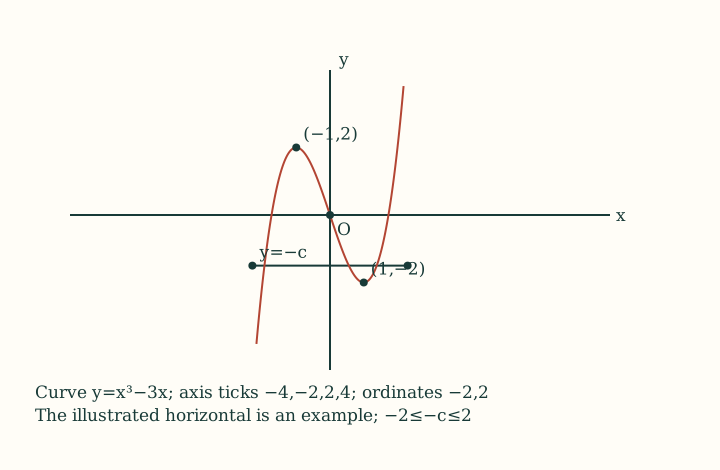
(iii) Consider . For only real roots, it must intersect at least twice. Hence , equivalently . At the endpoints, a repeated real root accounts for multiplicity.
Teacher note
All-real coefficients imply complex roots occur in conjugate pairs. The margin specifically states that , conjugate of , is also a root.
Graph labels
Axes , origin 0, extrema , curve , horizontal and axis ticks are retained in native SVG.
Printed answer key
(i) ; other roots . (iii) .
Native diagrams
Provenance
2025 TJC H2 Math (9758) JC2 MSM: COMPLEX NUMBERS. Question pages 2; solution pages 10, 11. These are original document page numbers, retained as text metadata.