Original question & working
Quartic roots and an Argand triangle · source reference
[2024/DHS/Prelim/I/7] · Question pp. 3 · Working pp. 17
Open the interactive lessonThe working and teaching notes are included in the interactive lesson.
The printed polynomial assumes a monic quartic; the literal root data permit any nonzero real scalar multiple.
Full original question, working & notes
Question
A, B and C represent complex numbers . These numbers are roots of , where is a quartic polynomial with real coefficients and is complex.
(a) Express as a product of two quadratic factors with real coefficients. [3]
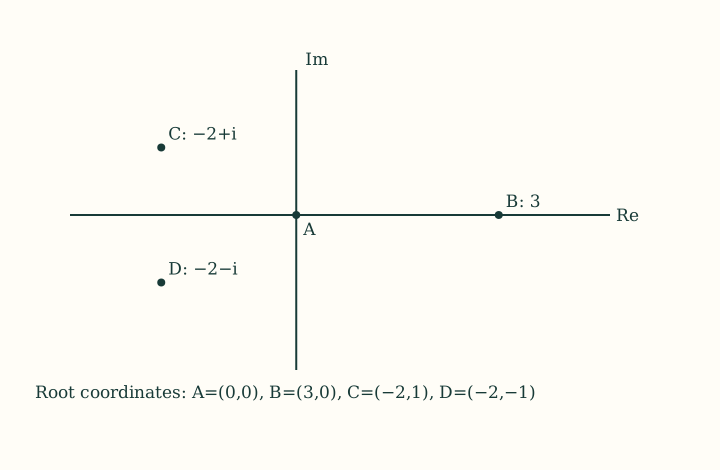
(b) Sketch an Argand diagram showing all roots. [2]
(c) W represents , with . Find and the area of triangle APW, where P represents . [4]
[2024/DHS/Prelim/I/7]
Source working
Printed working
(a) Conjugate root theorem gives as the fourth root.
(b) Argand diagram: , , , , Re and Im axes, with ticks .
(c) . W is C rotated clockwise about the origin; thus .
Qualification of the printed factorization
The question does not specify a monic polynomial. In general for an arbitrary nonzero real . The printed answer assumes . Its roots and geometry are unaffected.
Printed answer key
(a) . (c) , area units squared.
Native diagrams
Provenance
2025 TJC H2 Math (9758) JC2 MSM: COMPLEX NUMBERS. Question pages 3; solution pages 17. These are original document page numbers, retained as text metadata.