Original question & working
Find a square using a quarter-turn · source reference
[2016/VJC/Prelim/II/3] · Question pp. 4 · Working pp. 19
Open the interactive lessonThe working and teaching notes are included in the interactive lesson.
View source review notesFull original question, working & notes
Question
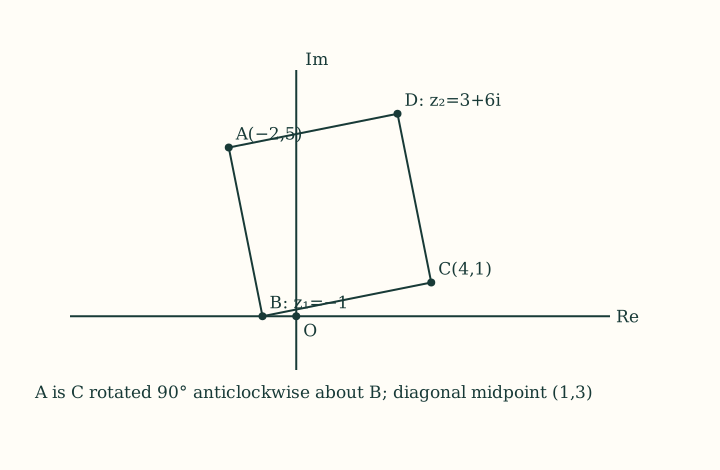
A, B, C and D represent respectively. ABCD is a square labelled anticlockwise. Show and find . [4]
[2016/VJC/Prelim/II/3]
Source working
Printed working
BC represents ; BA represents .
The printed midpoint line is .
Let . The diagonals of a square bisect each other, hence BD has midpoint :
Teacher note
A is obtained when C is rotated through anticlockwise about B.
Correction of midpoint typo
The midpoint of A and C uses , not the printed . The stated midpoint and final result are correct. Diagram labels A , B , C , D , O, Re and Im are retained.
Printed answer key
.
Native diagrams
Provenance
2025 TJC H2 Math (9758) JC2 MSM: COMPLEX NUMBERS. Question pages 4; solution pages 19. These are original document page numbers, retained as text metadata.