Original question & working
Arguments determine a triangle · source reference
[2020/DHS/Prelim/I/3 modified] · Question pp. 4 · Working pp. 19, 20
Open the interactive lessonThe working and teaching notes are included in the interactive lesson.
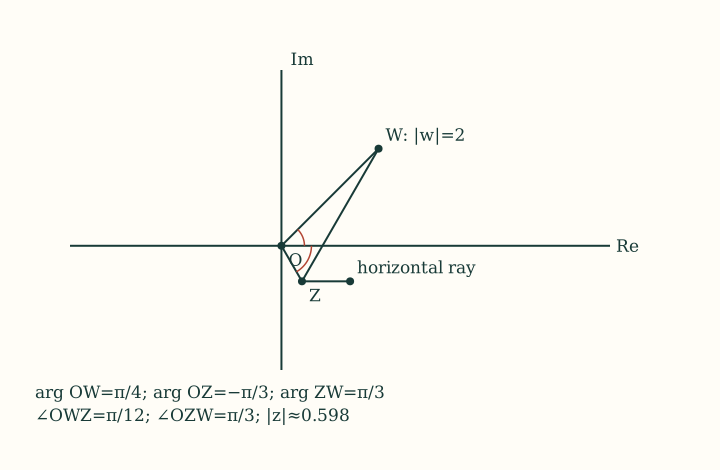
The angle of w−z belongs to the vector ZW, not WZ.
Full original question, working & notes
Question
, , and . Let W and Z represent respectively.
(i) Use an Argand diagram with reference to origin O to show radians. [2]
(ii) Hence or otherwise find . [2]
[2020/DHS/Prelim/I/3 modified]
Source working
Printed working
(i) Let W and Z represent w and z. represents .
(ii) The source states “(angle of equilateral )”.
Qualification
OWZ is not equilateral: its angle at W is . The angle at Z is nevertheless , because ZO has argument and ZW has argument . The sine-rule answer remains correct.
Diagram labels
O, W, Z, x, y, length OW , origin angle , clockwise OZ angle , direction ZW at the axis and at Z, with a horizontal auxiliary ray through Z.
Printed answer key
(ii) (3 s.f.).
Native diagrams
Provenance
2025 TJC H2 Math (9758) JC2 MSM: COMPLEX NUMBERS. Question pages 4; solution pages 19, 20. These are original document page numbers, retained as text metadata.