Porisma

Original question & working

Complex division yields an exact sine · source reference

[modified 2013/TJC/Prelim/I/5] · Question pp. 4 · Working pp. 22, 23

Open the interactive lesson

The working and teaching notes are included in the interactive lesson.

Argument subtraction may need reduction into the principal interval; here −11π/12 already lies there.

View source review notes
Full original question, working & notes

Question

A graphic calculator is not to be used in answering this question. p=1−ip=1-i, q=−1+3iq=-1+\sqrt3i, z=p/qz=p/q.

(i) Express zz as x+yix+yi, where x,yx,y are exact real values to determine. [2]

(ii) It is known that ∣z1/z2∣=∣z1∣/∣z2∣|z_1/z_2|=|z_1|/|z_2| and arg⁡(z1/z2)=arg⁡z1−arg⁡z2\arg(z_1/z_2)=\arg z_1-\arg z_2. By considering the moduli and arguments of p,qp,q, find exact ∣z∣,arg⁡z|z|,\arg z with −π<arg⁡z≤π-\pi<\arg z\leq\pi. [4]

(iii) Hence show sin⁡(11π/12)=(6−2)/4\sin(11\pi/12)=(\sqrt6-\sqrt2)/4. [3]

[modified 2013/TJC/Prelim/I/5]

Source working

Printed working

(i)

z=pq=1−i−1+3i−1−3i−1−3i=−1−3i+i−34=14(−1−3)+14(1−3)i.\begin{aligned}z&=\frac pq=\frac{1-i}{-1+\sqrt3i}\frac{-1-\sqrt3i}{-1-\sqrt3i}\\&=\frac{-1-\sqrt3i+i-\sqrt3}{4}\\&=\frac14(-1-\sqrt3)+\frac14(1-\sqrt3)i.\end{aligned}

(ii)

∣p∣=12+12=2,arg⁡p=−tan⁡−11=−π/4,|p|=\sqrt{1^2+1^2}=\sqrt2,\qquad\arg p=-\tan^{-1}1=-\pi/4, ∣q∣=12+(3)2=2,arg⁡q=π−tan⁡−13=π−π/3=2π/3,|q|=\sqrt{1^2+(\sqrt3)^2}=2,\quad\arg q=\pi-\tan^{-1}\sqrt3=\pi-\pi/3=2\pi/3, ∣z∣=∣p∣∣q∣=22,arg⁡z=arg⁡p−arg⁡q=−π/4−2π/3=−11π/12.|z|=\frac{|p|}{|q|}=\frac{\sqrt2}2,\qquad\arg z=\arg p-\arg q=-\pi/4-2\pi/3=-11\pi/12.

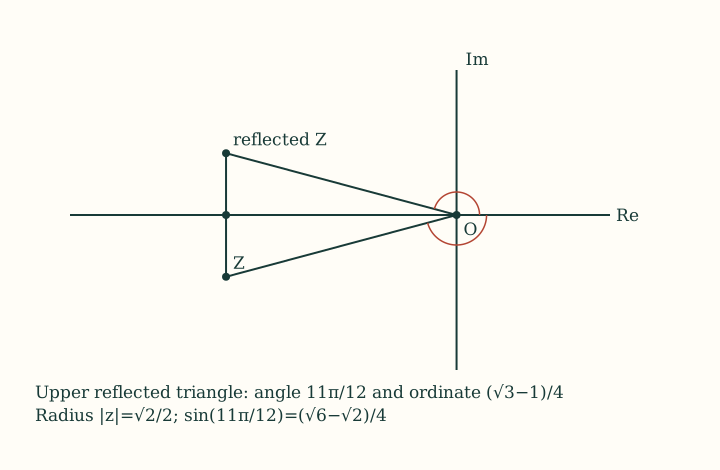
(iii) Argand diagram method: Reflect the negative imaginary component into the upper triangle:

sin⁡(11π/12)=(3−1)/42/2=2(3−1)4=6−24.\sin(11\pi/12)=\frac{(\sqrt3-1)/4}{\sqrt2/2}=\frac{\sqrt2(\sqrt3-1)}4=\frac{\sqrt6-\sqrt2}4.

OR:

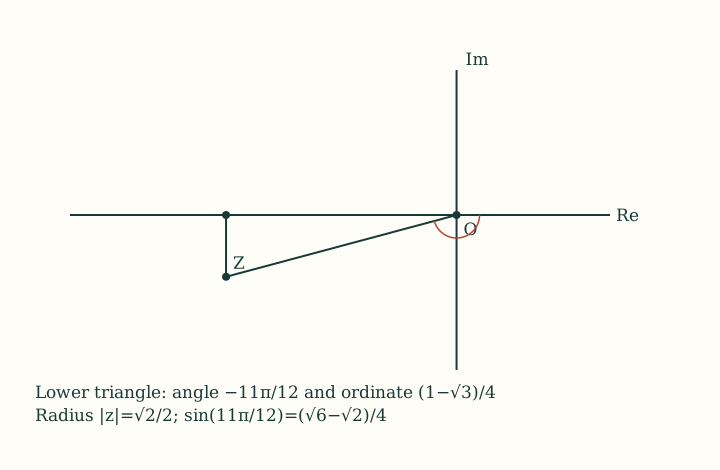
sin⁡(−11π/12)=(1−3)/42/2,\sin(-11\pi/12)=\frac{(1-\sqrt3)/4}{\sqrt2/2}, −sin⁡(11π/12)=1−322,sin⁡(11π/12)=3−122=6−24.-\sin(11\pi/12)=\frac{1-\sqrt3}{2\sqrt2},\qquad\sin(11\pi/12)=\frac{\sqrt3-1}{2\sqrt2}=\frac{\sqrt6-\sqrt2}4.

OR:

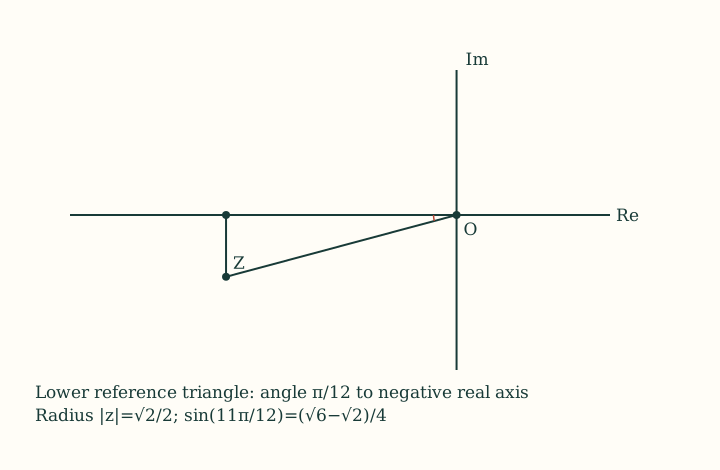
sin⁡(11π/12)=sin⁡(π/12)=−(1−3)/42/2=3−122=6−24.\sin(11\pi/12)=\sin(\pi/12)=\frac{-(1-\sqrt3)/4}{\sqrt2/2}=\frac{\sqrt3-1}{2\sqrt2}=\frac{\sqrt6-\sqrt2}4.

Diagram labels

The three argument diagrams retain Re/Im (or Re(z)/Im(z)), O, Z, radius 2/2\sqrt2/2, ordinate (1−3)/4(1-\sqrt3)/4, reflected ordinate (3−1)/4(\sqrt3-1)/4, right-angle projection, angles −11π/12-11\pi/12, 11π/1211\pi/12 and reference angle π/12\pi/12. The general argument subtraction rule in the question is interpreted modulo 2π2\pi when necessary; here the result already belongs to the requested principal interval.

Printed answer key

(i) (−1−3)/4+(1−3)i/4(-1-\sqrt3)/4+(1-\sqrt3)i/4. (ii) ∣z∣=2/2,arg⁡z=−11π/12|z|=\sqrt2/2,\arg z=-11\pi/12.

Native diagrams

Argument diagram: reflection Argument diagram: negative Argument diagram: reference

Provenance

2025 TJC H2 Math (9758) JC2 MSM: COMPLEX NUMBERS. Question pages 4; solution pages 22, 23. These are original document page numbers, retained as text metadata.