Repeat a square-root and line motif
A curve has equation , where
and for all real values of .
(i) Sketch the curve for . marks
(ii) On a separate diagram, sketch the curve with equation , for . marks
[2021/CJC/Prelim/I/1]
Solution
Periodic graphs
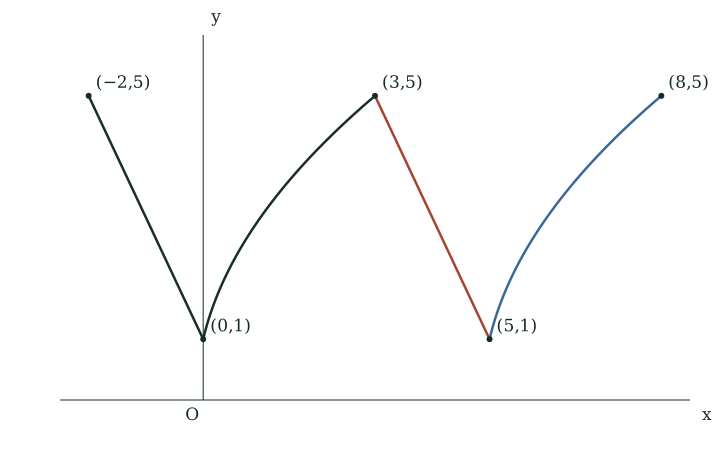
A curve has equation , where for , for , and for all real . Sketch the curve for .
Hint
Find the values at the ends of each piece: , , .
Sketch one period from to .
Copy it 5 units to the left and right to fill .
The left piece in is the end of the previous period: it is the falling line, from down to .
The graph has corners at where the arc meets the line, but it has no jumps.
Answer · (i)
Join with the square-root/linear pieces.
End values of one period
The curve is continuous: both pieces give 5 at (since ) and so the pattern joins up between periods.
Shape of each piece
On the square-root arc rises from 1 to 5, steeply at first and then flattening. On the straight line falls from 5 back to 1 with gradient .
Repeat with period 5
Copy one period to and . Within the key points are , , , and .
Explore the idea
Transformations
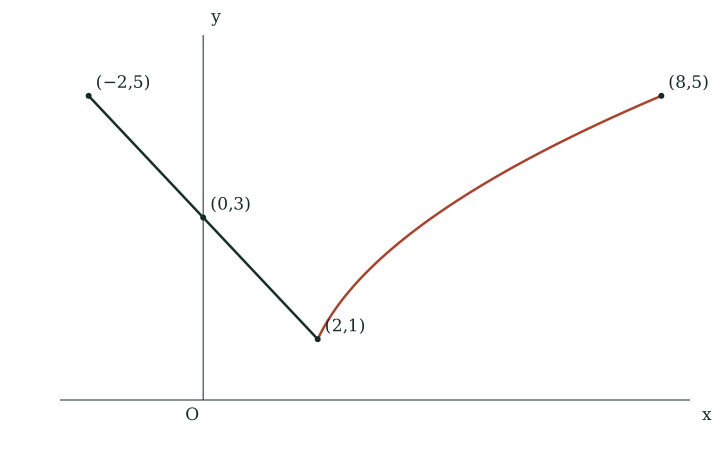
On a separate diagram, sketch the curve with equation for .
Hint
Write as a sequence of two steps on .
Translate first, then scale. Which direction does each go?
Track the key points: , , , , .
stretches the graph horizontally by factor 2 (it doubles -coordinates). The factor inside the bracket does the opposite of what it looks like.
To move an original point with horizontal coordinate , solve : its new coordinate is . Add 1 to the point coordinate, then double it. Evaluating the input instead halves first and subtracts 1; do not confuse the two directions.
Answer · (ii)
for ; for .
Translate 1 unit right
Replacing by shifts the graph right by 1. , , .
Scale by 2 parallel to the -axis
Replacing by doubles every -coordinate: , , . The period becomes 10.
Read off the pieces
For , so . For the input is in , equivalent to , where .
Explore the idea