Count ellipse intersections without losing the domain
The curves have equations and , where , respectively. Describe the geometrical shape of . mark
(a) State a sequence of transformations which transforms the graph of to the graph of . marks
(b) (i) Sketch on the same diagram, stating the coordinates of any points of intersection with the axes and the equations of any asymptotes. marks
(ii) Show algebraically that the -coordinates of the points of intersection of satisfy the equation . marks
(iii) Deduce the number of real roots of the equation in part (ii).
[2010/HC/Prelim/I/12]
Solution
Recognising a conic
The curves and have equations and respectively, where . Describe the geometrical shape of .
Hint
Divide by to get .
Compare with the standard ellipse .
A circle needs equal semi-axes. Here , so it is an ellipse.
Answer · Shape
Ellipse centred with semiaxes horizontally and 1 vertically.
Standard form
Divide by and rearrange. This is an ellipse with centre , semi-axis along and semi-axis 1 along . Since , the long axis is horizontal.
Transforming a circle
State a sequence of transformations which transforms the graph of to the graph of .
Hint
Which stretch widens the unit circle to semi-axis in the -direction only?
Then which translation moves the centre to ?
If you translate first, you must translate by so that the scale factor takes the centre to .
Answer · (a)
Stretch horizontally by , then translate right 2.
Stretch parallel to the -axis
Scale factor parallel to the -axis replaces by . The horizontal semi-axis becomes .
Translate 2 units right
Replace by . The centre moves from to .
Explore the idea
Curve sketching
Sketch and on the same diagram, stating the coordinates of any points of intersection with the axes and the equations of any asymptotes.
Hint
: the ellipse crosses the -axis at and never meets the -axis since .
: factorise , find the vertical asymptote and the oblique one by division.
Draw both and look at where they meet.
Because the ellipse never reaches the -axis.
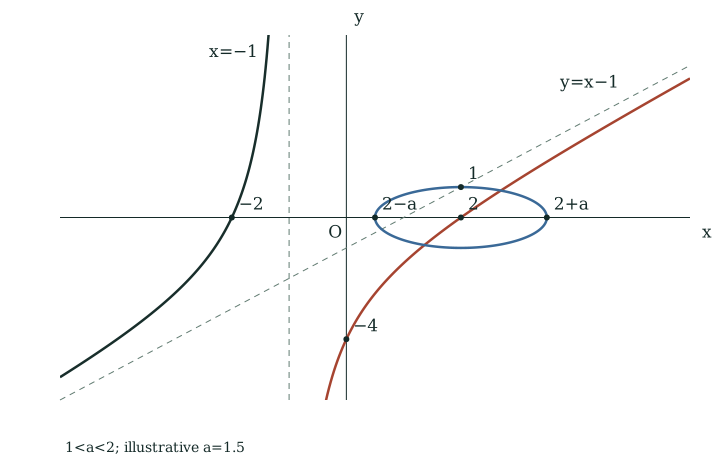
Answer · (b)i
: . : ; asymptotes .
; C1 has no y-intercept.
intercepts
Since , , so the ellipse lies entirely to the right of the -axis. The -intercept would need , impossible.
intercepts and asymptotes
by division, so the oblique asymptote is and the vertical one is .
Intersections
The ellipse sits on the right of , where is increasing from upwards (and negative between and ). The two curves cross twice.
Explore the idea
Algebraic substitution
Show algebraically that the -coordinates of the points of intersection of and satisfy the equation .
Hint
Substitute into .
Clear the denominator by multiplying by .
We multiplied by . Any root at would be extraneous, because is undefined there.
Answer · (b)ii
.
Substitute C2 into C1 and multiply by (x+1)²; x=−1 is excluded.
Substitute
Points on both curves satisfy both equations.
Multiply by
Each term on the right had denominator or none; multiplying clears them.
Expand the bracket
Distribute . Note that is excluded: it does not belong to .
Counting roots
Deduce the number of real roots of the equation in part (b)(ii).
Hint
Each real root is the -coordinate of an intersection.
Count the intersection points on your sketch.
A quartic has *at most* four real roots. The geometry tells us only two of them are real here.
Answer · (b)iii
2 real roots.
Roots ↔ intersections
A real root of the equation in (ii) is the -coordinate of a point lying on both curves (provided ).
Count from the sketch
The ellipse meets at exactly two points, and each has a different -coordinate. Substituting into the polynomial equation gives , impossible for , so clearing the denominator introduced no extra real root there.