A downward absolute-value graph with parameters
(i) For a<0 and b<−1 solve . marks
(ii) Given a<b<0, (a) state the condition on b for a negative real root mark; (b) under that condition sketch y=x−ab and y=b|x−a| together marks, solve mark, and deduce the inputs satisfying . marks
[2020/ACJC/Prelim/I/4]
Solution
Absolute-value equations
For and , solve .
Hint
Split into the two cases of the absolute value: and .
Solve each linear equation for .
The absolute value gives two equations, hence two roots.
Answer · (i)
or .
Case :
since , so .
Case :
Collect -terms: .
Solve the second
Since , and . Multiplying by gives , as required for this branch. The other root satisfies .
Conditions for a root
Given , state the condition on for the equation in (i) to have a negative real root.
Hint
is not negative, so the root must be .
Find the sign of this fraction.
If , the second algebraic candidate is positive and fails the branch condition ; it is not a root of the original modulus equation. At , the left branch gives , which is impossible.
Answer · (ii)a
.
Sign of the numerator
A product of two negatives is positive.
Make the fraction negative
Positive over negative is negative.
Curve sketching
Under this condition, sketch and on the same diagram.
Hint
: a V with vertex , opening downwards since .
: a line of gradient 1 with -intercept .
Mark the intersections at and .
flips it: .
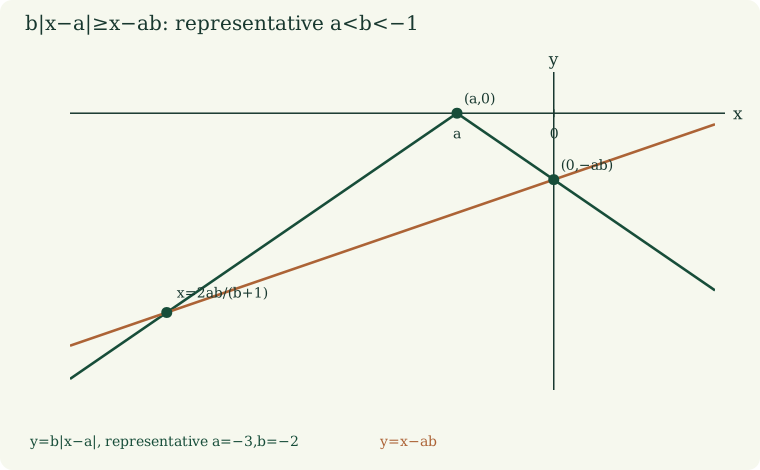
Answer · (ii)b
Downward V vertex ; line ; intersections at .
.
The V
For the slope is (steeply down); for it is (steeply up).
The line
Both the line and the V pass through : at , because .
Second intersection
It lies to the left of the vertex on the rising side of the V.
Explore the idea
Inequalities from graphs
Hence solve .
Hint
The V must be on or above the line.
Read the interval between the two intersections.
The V is above the line *between* the crossings. Outside them the line is above the V.
Answer · (ii)c
.
Read the sketch
Between the two crossings the downward V lies above the line. At the crossings they are equal, which is allowed by .
Exponential substitution
Deduce the values of satisfying .
Hint
Multiply by to get .
Match with the previous inequality with replaced by : .
Keep only .
Replacing by and then multiplying by reverses the inequality: becomes .
Answer · (ii)d
.
Rearrange
Multiply by and use .
Replace by in the answer to the previous part
The inequality has the form of with .
Exclude zero and solve
so . Multiply by .
Take logarithms
for . Note because and .
Explore the idea