Invert, then repeat periodically
(a) for real ; for all real x. The parameter a is constant.
(i) Find the inverse of f and its domain in terms of a. marks
(ii) Given that the composite exists and , find a without finding the composite rule. marks
(b) for , and for , with for all real x.
(i) Find h(9). mark
(ii) Sketch h on . marks
[2023/ACJC/Promo/5]
Solution
Inverse functions
for real , where is a constant. Find and its domain in terms of .
Hint
Let and solve for .
Swap and .
The domain of is the range of , found from the endpoints of the domain of .
The inverse's domain is the range of . Here , not .
Answer · (a)i
, .
Make the subject
Add , then take logarithms.
Rename
Swap the variable names.
Range of
is increasing, positive, and equals at . Subtract .
Domain of the inverse
This also guarantees so the logarithm exists.
Using an inverse equation
for all real . Given that the composite exists and , find without finding the composite rule.
Hint
Apply to both sides of .
, so .
Substitute the rules.
That works but is longer. The equation is much quicker.
Answer · (a)ii
.
Apply to both sides
undoes , so applying to the left side leaves .
Evaluate each side
and .
Solve
.
Periodic functions
for and for , with for all real . Find .
Hint
has period 3: subtract multiples of 3 until the input is in .
is not in . Reduce to 3, the right-hand end of the period.
Answer · (b)i
.
Reduce to one period
. The value belongs to the interval (closed at 3), not to .
Sketching a periodic piecewise function
Sketch for , labelling the end-points.
Hint
Sketch one period : the exponential on then the quadratic on .
Copy it 3 units left and right.
Mark open and closed ends carefully.
At and the value comes from the quadratic piece (right-closed), . The exponential piece at would give 1, but is not in its domain: that point is open.
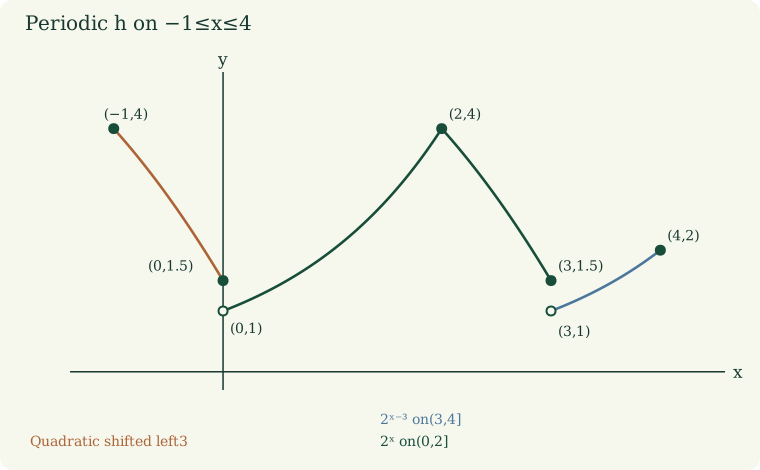
Answer · (b)ii
Period 3; closed values ; open .
One period
at the open left end; at (closed, in the first piece); at .
Shift left by 3
On , the graph follows : it has value 4 at (inherited from ) and at (from ). Both endpoints are closed.
Shift right by 3
The piece on starts just above 1 and reaches 2.
Explore the idea