Locate the crossing before taking the absolute area

(i) Verify without a calculator that θ=π/4\theta=\pi/4 is a root of tan⁡2θ−2cos⁡2θ=0\tan^2\theta-2\cos^2\theta=0. mark

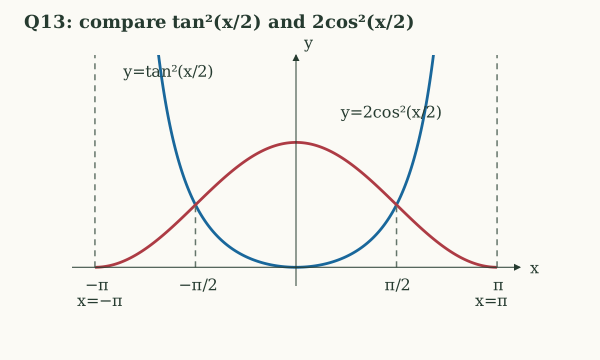
(ii) By sketching y=tan⁡2(x/2)y=\tan^2(x/2) and y=2cos⁡2(x/2)y=2\cos^2(x/2), solve exactly tan⁡2(x/2)>2cos⁡2(x/2)\tan^2(x/2)>2\cos^2(x/2) for −π<x<π-\pi<x<\pi. marks

(iii) Hence evaluate exactly ∫02π/3∣tan⁡2(x/2)−2cos⁡2(x/2)∣dx\int_0^{2\pi/3}|\tan^2(x/2)-2\cos^2(x/2)|dx. marks

[2011/IJC/Prelim/I/11]

Total marks: 9

Solution

(i)

Exact values

Verify without a calculator that θ=π4\theta=\frac\pi4 is a root of tan⁡2θ−2cos⁡2θ=0\tan^2\theta-2\cos^2\theta=0.

Hint

  1. Substitute θ=π4\theta=\frac\pi4: tan⁡π4=1\tan\frac\pi4=1 and cos⁡π4=12\cos\frac\pi4=\frac1{\sqrt2}.

Answer · (i)

tan⁡2(π/4)−2cos⁡2(π/4)=1−1=0\tan^2(\pi/4)-2\cos^2(\pi/4)=1-1=0.

(ii) sketch

Sketching reciprocal-trigonometric curves

Sketch y=tan⁡2x2y=\tan^2\frac x2 and y=2cos⁡2x2y=2\cos^2\frac x2 for −π<x<π-\pi<x<\pi.

Explore this idea

Hint

  1. tan⁡2x2\tan^2\frac x2 has vertical asymptotes at x=±πx=\pm\pi and touches 0 at x=0x=0.

  2. 2cos⁡2x2=1+cos⁡x2\cos^2\frac x2=1+\cos x is a cosine curve between 0 and 2.

Trigonometric graphs and asymptotes
Trigonometric graphs and asymptotesScroll across to see the full diagram.

Answer · (ii) sketch

Intersections (±π/2,1)(\pm\pi/2,1); tangent-square poles x=±πx=\pm\pi.

Explore the idea

tan²(x/2) and 2cos²(x/2) cross at x = ±π/2

Switch on the intersections and the asymptotes.

Switch on a feature to add it to the sketch and see how it is found. A full-mark sketch shows all of them.

  • Y = tan²(x/2)
  • Y = 2cos²(x/2)
  • Asymptotes x = ±π
Ideas to try
Between which two values of xx is the teal curve above the amber curve?
(ii) inequality

Reading an inequality from a graph

Hence solve tan⁡2x2>2cos⁡2x2\tan^2\frac x2>2\cos^2\frac x2 for −π<x<π-\pi<x<\pi.

Hint

  1. Find where the tangent-squared curve is above the cosine curve.

Answer · (ii) inequality

−π<x<−π/2-\pi<x<-\pi/2 or π/2<x<π\pi/2<x<\pi.

(iii)

Integrating an absolute value

Hence evaluate exactly ∫02π/3∣tan⁡2x2−2cos⁡2x2∣dx\int_0^{2\pi/3}\left|\tan^2\tfrac x2-2\cos^2\tfrac x2\right|dx.

Explore this idea

Hint

  1. The integrand is negative on [0,π2)\left[0,\frac\pi2\right) and positive on (π2,2π3]\left(\frac\pi2,\frac{2\pi}3\right].

  2. Rewrite with sec⁡2\sec^2 and 1+cos⁡x1+\cos x, then integrate.

  3. Split the integral at x=π2x=\frac\pi2.

Answer · (iii)

33/2+2π/3−23\sqrt3/2+2\pi/3-2.

Explore the idea

The area splits at x = π/2

Drag x. The shading shows the selected interval; the lower curves compare the numerical signed integral with the change in the antiderivative.

Upper limit xx = 2.09
Try an example

How the shaded areas add up

The limits run left to right. Area above the axis adds; area below the axis subtracts.

Above-axis contribution
2.692
Below-axis contribution
0
Signed integral
2.692

All three bars share one scale. Positive contributions extend right of zero; negative contributions extend left.

Signed integral from 0.00 to x
2.692
piecewise antiderivative
2.692
agrees at displayed precision
Formula − integral
0
0.00% of the integral’s magnitude
Compare the running integral on a graph
  • Integrand
  • Numerical signed integral from the start to x
  • Part of the integrand above the axis
  • Part of the integrand below the axis
  • F(x) − F(start), from the antiderivative
Key idea

The absolute-value curve touches 0 at x=π2x=\frac\pi2, where the signed function changes sign; both parts add as positive area.

Ideas to try
Drag xx to 2π3≈2.094\frac{2\pi}3\approx2.094: the readout is about 2.69.