Porisma

Worked solution

Differentiate turning points and a stationary inflection

The diagram shows y=f(x)y=f(x) with a maximum at x=ax=a, minimum at x=bx=b, and stationary point of inflection at the origin. On a separate diagram draw y=f′(x)y=f^{\prime}(x). marks

Expand diagram

Use the scrollbars or arrow keys to inspect details.
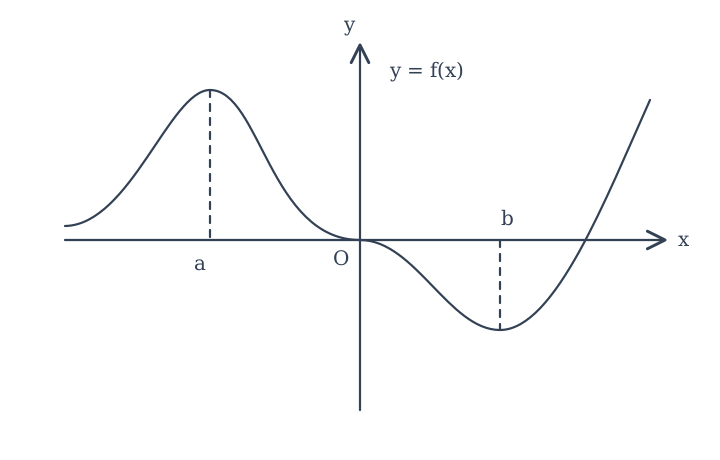
Given function rises to a maximum at negative x=a, decreases through a stationary inflection at the origin, continues to a minimum at positive x=b, then rises. The two turning-point x-values are marked a and b without numerical coordinates.

[2009/SRJC/Promo/2]

CJC · Review problems · Question 3

Answer

Zeros at a,0,ba,0,b: positive-to-negative crossing at aa, touch from below at 00, negative-to-positive crossing at bb.

Place the three zeros and their sign changes

At a<0a<0, f′f^{\prime} crosses from positive to negative. At b>0b>0, it crosses from negative to positive. At the origin, the stationary inflection makes f′(0)=0f^{\prime}(0)=0 but the function keeps decreasing, so f′f^{\prime} touches the axis from below rather than crossing.

How did this part go?

Retain the intervening source branches

The printed derivative has an unlabelled positive maximum before aa, a negative minimum between aa and 00, a local maximum at (0,0)(0,0), and another negative minimum between 00 and bb. It then rises through (b,0)(b,0). These qualitative extrema follow the slope changes drawn in the source; their numerical coordinates are not given.

How did this part go?

Compare your sketch

Expand diagram

Use the scrollbars or arrow keys to inspect details.
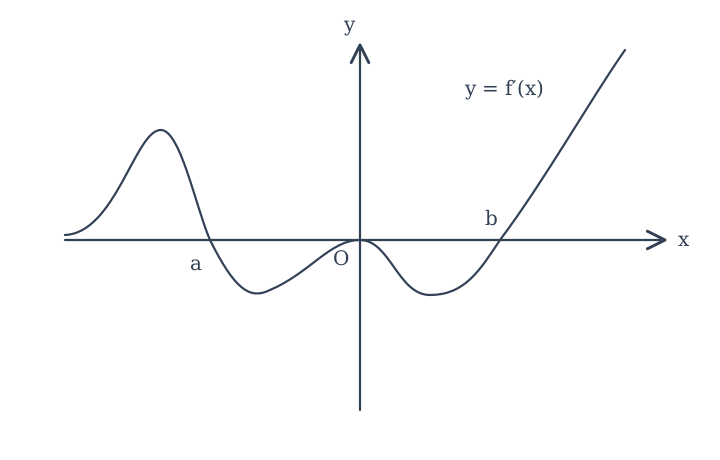
Derivative has zeros a,0,b. It is positive before a, negative between a and b except for its touch at the origin, then positive after b. The source shape includes a positive peak before a, negative troughs between a and zero and between zero and b, and a local maximum at the origin.

Common mistakes

Do not force the derivative to cross the axis at every stationary point.

Read the hint