Porisma

Worked solution

Read a derivative from an oblique asymptote and two extrema

The diagram shows y=f(x)y=f(x) with asymptotes x=3x=3 and y=−x+2y=-x+2, y-intercept 7/37/3, minimum (2,1)(2,1) and maximum (4,−3)(4,-3).

Sketch the curve y=f′(x)y=f^{\prime}(x). marks

Expand diagram

Use the scrollbars or arrow keys to inspect details.
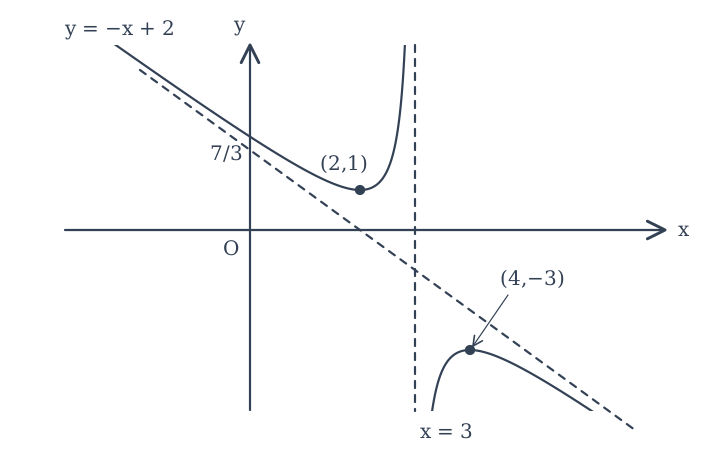
Given function with asymptotes x=3 and y=−x+2, y-intercept 7/3, minimum (2,1) on the left branch and maximum (4,−3) on the right. The left branch tends up without bound at 3 from the left; the right starts at negative infinity and rises to its maximum before falling.

[2010/VJC/Promo/6(ii)]

CJC · Review problems · Question 4

Answer

Derivative zeros (2,0),(4,0)(2,0),(4,0); source asymptotes x=3x=3, y=−1y=-1, with both inner ends rising to +∞+\infty.

Use the two stationary points

The minimum gives derivative zero (2,0)(2,0) with a negative-to-positive sign change. The maximum gives (4,0)(4,0) with a positive-to-negative sign change. The derivative is negative for x<2x<2, positive for 2<x<32<x<3 and 3<x<43<x<4, and negative for x>4x>4.

How did this part go?

Retain the source asymptotes and branch directions

The printed solution has vertical asymptote x=3x=3, with both sides tending to +∞+\infty, and horizontal asymptote y=−1y=-1, approached from above on both outer ends. The left derivative branch increases throughout and the right decreases throughout; neither has an additional stationary point. The limiting gradient −1-1 is the smooth behaviour shown near the original oblique asymptote, rather than a derivative limit forced by the asymptote equation alone.

How did this part go?

Compare your sketch

Expand diagram

Use the scrollbars or arrow keys to inspect details.
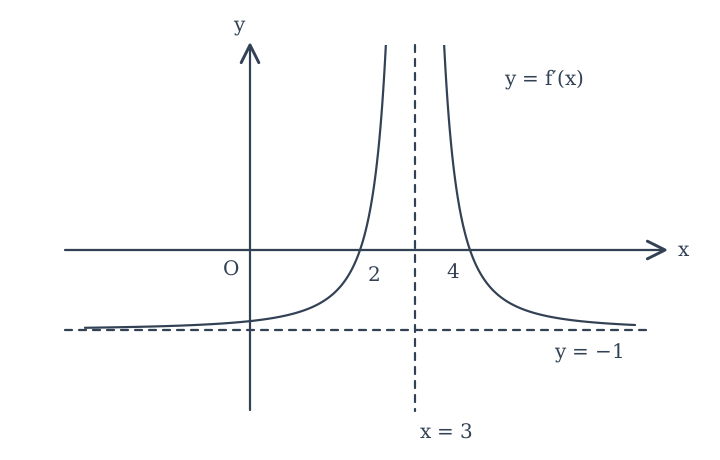
Derivative sketch with vertical asymptote x=3 and horizontal asymptote y=−1. Both branches lie above −1, rise to positive infinity near x=3 and cross the x-axis at 2 and 4 respectively. The left branch increases and the right decreases.

Common mistakes

The y-coordinate 7/3 belongs to the function, not its derivative.

Read the hint