Porisma

A hint to get started

Recover a function from its gradient and one value

The diagram shows y=f′(x)y=f^{\prime}(x), passing through the origin with turning points (−3,0)(-3,0) and (−1.5,−1)(-1.5,-1). The x-axis and x=1x=1 are its two asymptotes.

(i) Find the range of xx for which y=f(x)y=f(x) is strictly increasing and concave downwards.

(ii) State the x-coordinates and natures of all stationary points of y=f(x)y=f(x).

(iii) Given f(0)=1f(0)=1, sketch y=f(x)y=f(x) for x<1x<1, clearly indicating all stationary points, asymptotes and intersections with the axes.

Expand diagram

Use the scrollbars or arrow keys to inspect details.
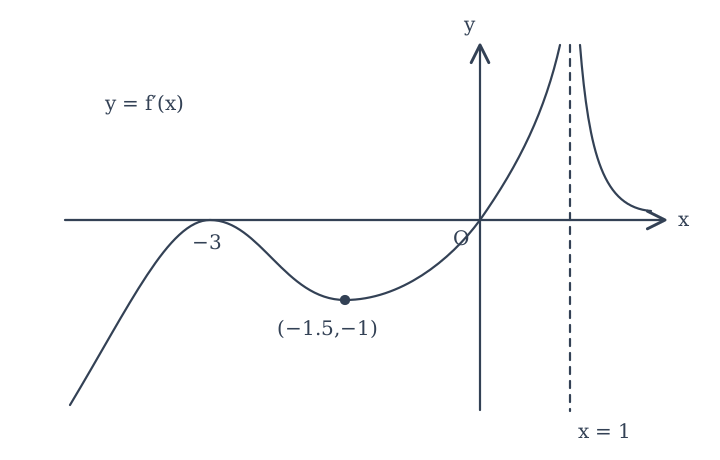
Given f′ passes through (−3,0), where it touches the x-axis from below, has minimum (−1.5,−1), then crosses the origin and rises towards positive infinity at x=1 from the left. For x>1 it falls from positive infinity towards horizontal asymptote y=0.

[2009/HCI/I/3]

CJC · Discussion · Question 6

Use sign changes for turning points and changes in the derivative’s direction for inflections.

Read the worked solution