Worked solution
Use an asymptote family to find when no real roots occur
C has equation .
(i) Find the asymptotes. mark
(ii) Sketch C, labelling asymptotes, axial intercepts and turning points. marks
(iii) Hence find the values of k for which has no real roots. marks
[2013/YJC/I/12]
CJC · Discussion · Question 2
Answer
Asymptotes x=2,y=x+2; curve turns (0,0),(4,8); no-real-root range 0<k≤1.
(i) Divide the numerator by the denominator
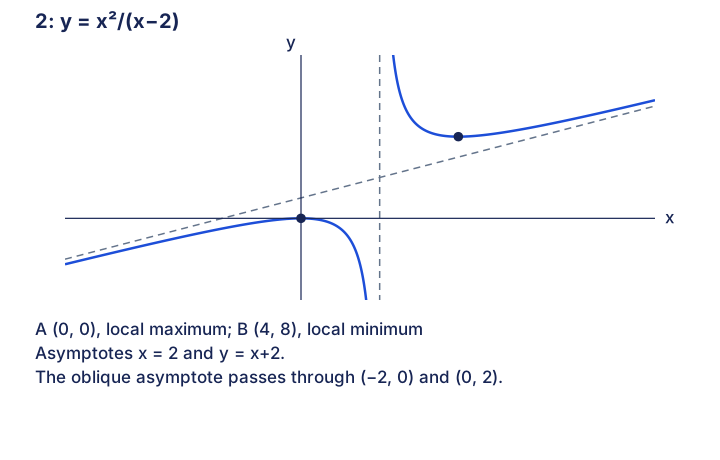
, giving asymptotes x=2 and y=x+2.
(ii) Label the two branches and stationary points
The only axial intercept is (0,0), a local maximum on the left branch. The right branch has a local minimum (4,8). These follow from . The source sketch also labels the oblique line’s axis crossings (−2,0) and (0,2); they are not extra curve intercepts.
(iii) Compare with lines through a fixed point
becomes for x≠2. The source compares C with y=k(x+2), which passes through (−2,0)for every k. No roots means no intersections, giving 0<k≤1. No root is lost by excluding x=2, since x=2 never satisfies the original equation.
(iii) Check the endpoint algebraically
The original equation is . For 0<k<1 its required x²is negative. At k=1 it becomes 0=−4, still impossible. At k=0 there is a real root x=0; outside 0<k≤1 the required x²is nonnegative. This explains the source’s included endpoint 1.
Compare your sketch
Expand diagramFit diagram to page
Use the scrollbars or arrow keys to inspect details.
Common mistakes
The asymptote’s axis crossings are not curve intercepts. Include k=1 even though the quadratic degenerates.
Solution notes
At k=1 the equation becomes 0=−4, so this endpoint belongs to the no-real-root range.
The oblique line’s axis crossings are not additional intercepts of the curve.