Worked solution
Start from the actual given graph f(x)+3
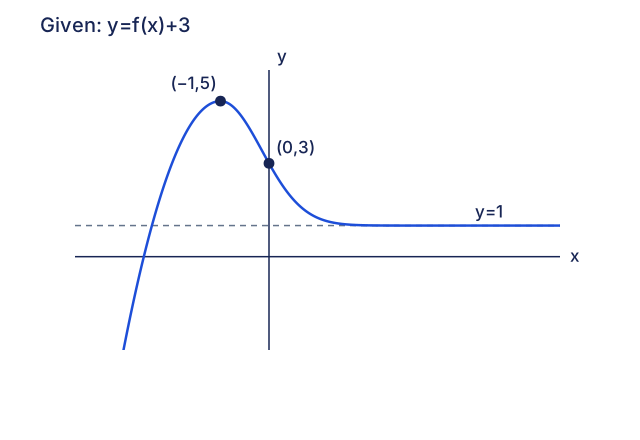
The supplied graph is , with maximum (−1,5), y-intercept 3 and a right-hand horizontal asymptote y=1.
Sketch on separate diagrams:
(i) ;
(ii) ;
(iii) ;
(iv) .
Clearly indicate asymptotes, turning points and intercepts where possible.
Expand diagramFit diagram to page
Use the scrollbars or arrow keys to inspect details.
CJC · Discussion · Question 2
Answer
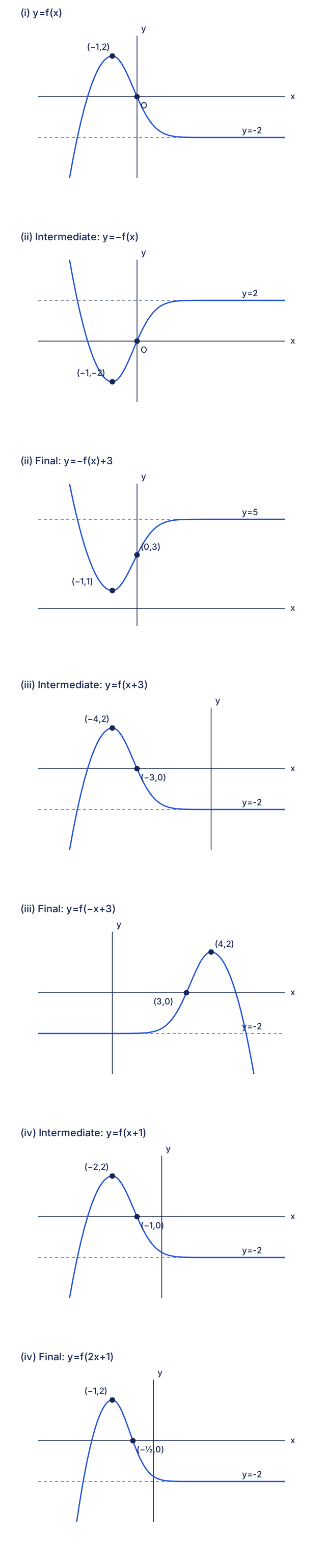
(i) Maximum (−1,2), O, y=−2.
(ii) Minimum (−1,1), y-intercept 3, y=5, no x-intercept.
(iii) Maximum (4,2), known zero 3, y=−2.
(iv) Maximum (−1,2), known zero −1/2, y=−2.
(i) Remove the given vertical shift first
Translate the supplied graph 3 units down to obtain f. Its maximum is (−1,2), known intercept is O=(0,0), and right horizontal asymptote is y=−2. The other x-intercept is shown but unlabelled; call it α<−1 rather than assigning a value.
(ii) Retain both source stages, including the coloured final annotation
Reflect f in the x-axis to get −f: minimum (−1,−2), origin and horizontal asymptote y=2. Then translate 3 units up to get −f+3: minimum (−1,1), y-intercept (0,3), horizontal asymptote y=5. Since the supplied f has maximum 2, this final curve has no x-intercept.
(iii) Translate, then reflect, as printed
. The intermediate has maximum (−4,2), known zero −3, and asymptote −2. Reflection in the y-axis gives final maximum (4,2), known zero (3,0), other zero (3−α,0), and left horizontal asymptote y=−2. Its y-intercept f(3) is not numerically determined by the source labels.
(iv) Translate, then compress, including the coloured final step
, with a horizontal scale 1/2 in the last step. The intermediate maximum (−2,2) and known zero (−1,0) become maximum (−1,2) and known zero (−1/2,0). The other zero is ((α−1)/2,0); the right horizontal asymptote stays y=−2. The y-intercept f(1) is not numerically specified.
Compare your sketch
Expand diagramFit diagram to page
Use the scrollbars or arrow keys to inspect details.
Common mistakes
Do not stop at the black printed intermediate sketches: the coloured annotations supply the final +3, reflection and horizontal-scale steps. Unlabelled intercepts cannot be assigned numeric values.
Solution notes
All four asks, all 7 intermediate/final source sketches and the given graph retained. Coloured annotations absent from native text extraction were visually compared and integrated into the relevant parts. Curves are qualitative reconstructions of supplied landmarks, not exact recovered formulas.