Worked solution
Transform symbolic coordinates without choosing k
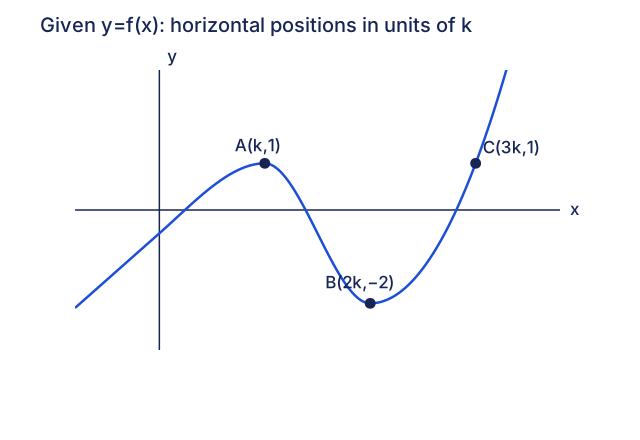
The given graph shows A=(k,1), B=(2k,−2), C=(3k,1), with k>0 as noted in the solution.
Sketch , indicating the coordinates corresponding to A, B, C.
Expand diagramFit diagram to page
Use the scrollbars or arrow keys to inspect details.
[2011/MJC/Promo/6(a)]
CJC · Discussion · Question 3
Answer
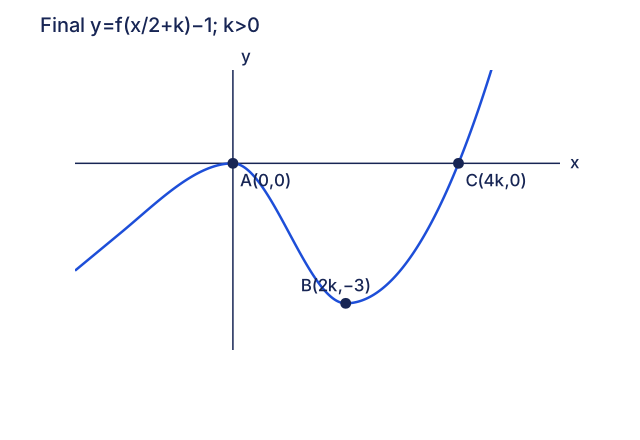
A′=(0,0), B′=(2k,−3), C′=(4k,0).
Translate by k to the left
. The point map begins .
Stretch horizontally by 2
. The combined horizontal map is , not 2x−k.
Translate down 1 and label all images
The full map is . Hence A→(0,0), B→(2k,−3), C→(4k,0). The first remains a maximum and the second a minimum in the source sketch. The note k>0 fixes their left-to-right order.
Compare your sketch
Expand diagramFit diagram to page
Use the scrollbars or arrow keys to inspect details.
Common mistakes
The horizontal translation is scaled by the subsequent stretch. Do not replace the unspecified k by a numerical value.
Solution notes
All source transformation equations, final labelled coordinates, and k>0 note retained. Both source graph panels reconstructed with symbolic horizontal labels.