Porisma

A hint to get started

Transform symbolic coordinates without choosing k

The given graph y=f(x)y=f(x) shows A=(k,1), B=(2k,−2), C=(3k,1), with k>0 as noted in the solution.

Sketch y=f(x/2+k)−1y=f(x/2+k)-1, indicating the coordinates corresponding to A, B, C.

Expand diagram

Use the scrollbars or arrow keys to inspect details.
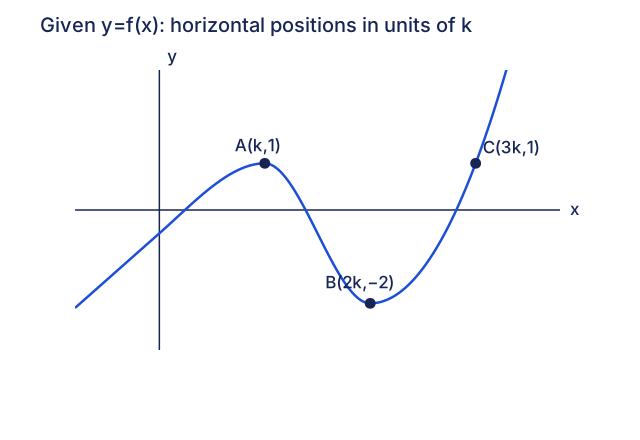
Source qualitative curve with A(k,1),B(2k,-2),C(3k,1), where k>0. Horizontal positions are normalised multiples of the unspecified positive k; no numerical k or extra intercept coordinate is assigned.

[2011/MJC/Promo/6(a)]

CJC · Discussion · Question 3

Solve the input relation or track the point map through each step.

Read the worked solution