Porisma

Worked solution

Transform symbolic coordinates without choosing k

The given graph y=f(x)y=f(x) shows A=(k,1), B=(2k,−2), C=(3k,1), with k>0 as noted in the solution.

Sketch y=f(x/2+k)−1y=f(x/2+k)-1, indicating the coordinates corresponding to A, B, C.

Expand diagram

Use the scrollbars or arrow keys to inspect details.
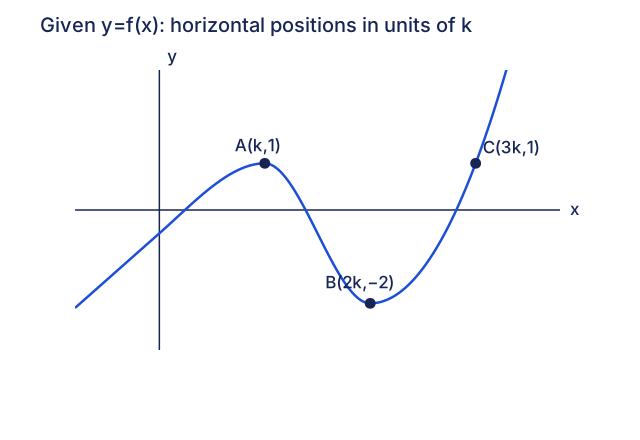
Source qualitative curve with A(k,1),B(2k,-2),C(3k,1), where k>0. Horizontal positions are normalised multiples of the unspecified positive k; no numerical k or extra intercept coordinate is assigned.

[2011/MJC/Promo/6(a)]

CJC · Discussion · Question 3

Answer

A′=(0,0), B′=(2k,−3), C′=(4k,0).

Translate by k to the left

f(x)→f(x+k)f(x)\to f(x+k). The point map begins x↦x−kx\mapsto x-k.

How did this part go?

Stretch horizontally by 2

f(x+k)→f(x/2+k)f(x+k)\to f(x/2+k). The combined horizontal map is x↦2(x−k)x\mapsto2(x-k), not 2x−k.

How did this part go?

Translate down 1 and label all images

The full map is (x,y)↦(2(x−k),y−1)(x,y)\mapsto(2(x-k), y-1). Hence A→(0,0), B→(2k,−3), C→(4k,0). The first remains a maximum and the second a minimum in the source sketch. The note k>0 fixes their left-to-right order.

How did this part go?

Compare your sketch

Expand diagram

Use the scrollbars or arrow keys to inspect details.
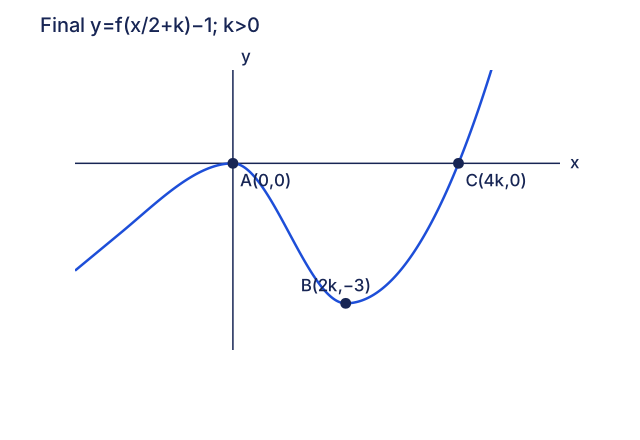
Final f(x/2+k)-1, with A at (0,0),B at (2k,-3),C at (4k,0). The source note k>0 is retained; horizontal spacing is symbolic in multiples of k, not a fixed numerical k. Curve interpolation is schematic.

Common mistakes

The horizontal translation is scaled by the subsequent stretch. Do not replace the unspecified k by a numerical value.

Solution notes

All source transformation equations, final labelled coordinates, and k>0 note retained. Both source graph panels reconstructed with symbolic horizontal labels.

Read the hint