Worked solution
Use zeros, poles and turning values to sketch three reciprocals
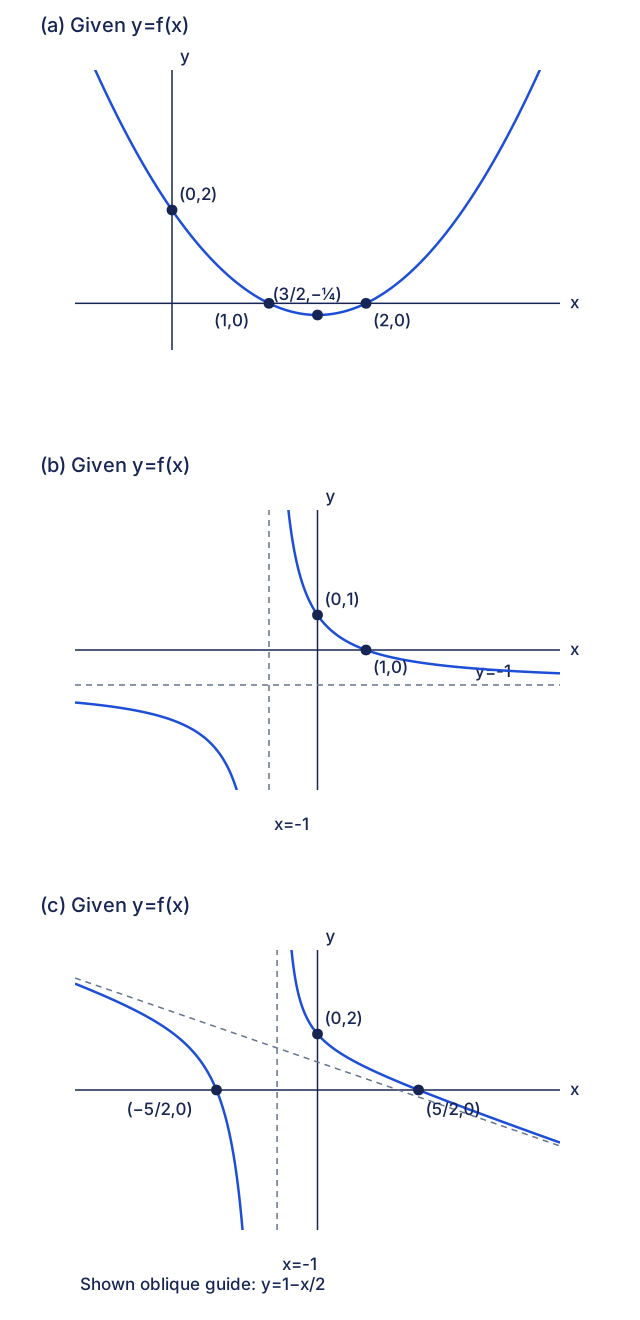
Given the three supplied graphs of , sketch on separate diagrams.
(a) Zeros x=1,2, y-intercept 2, minimum (3/2,−1/4).
(b) Vertical asymptote x=−1, horizontal asymptote y=−1, y-intercept 1, zero x=1.
(c) Vertical asymptote x=−1, zeros x=±5/2, y-intercept 2, and the oblique guide shown through (0,1), (2,0).
Expand diagramFit diagram to page
Use the scrollbars or arrow keys to inspect details.
Part (c): [2009/VJC/I/7]
CJC · Discussion · Question 6
Answer
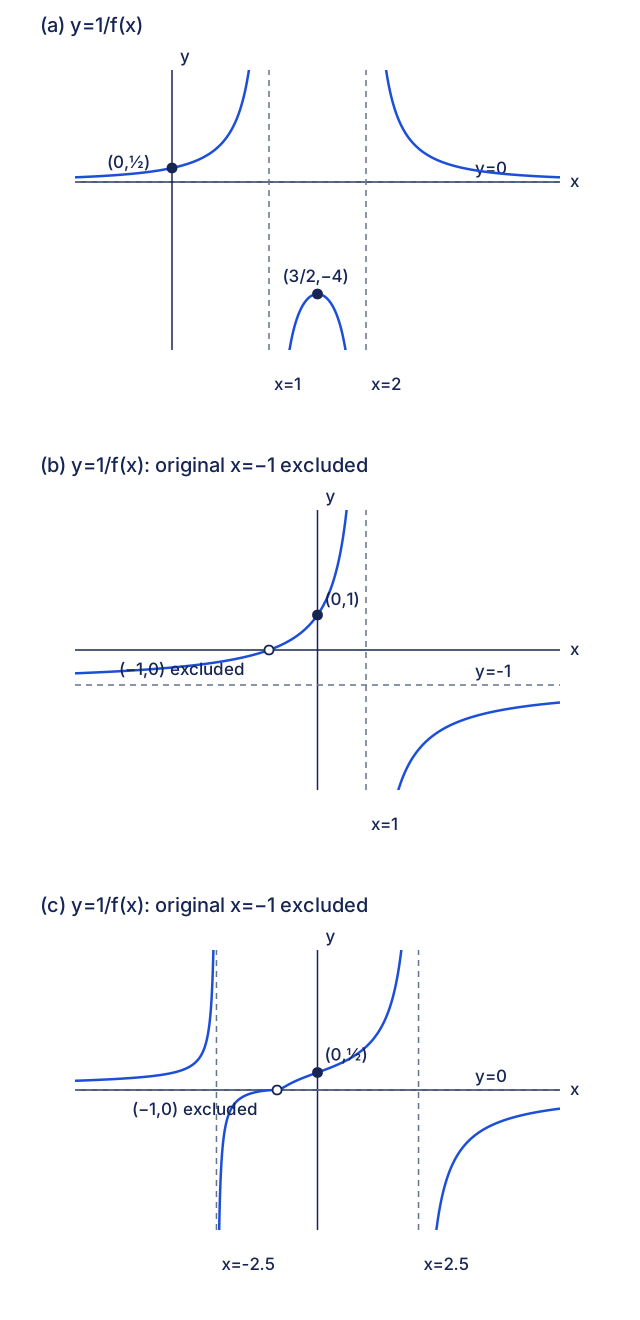
(a) Poles 1,2, horizontal 0, y-intercept 1/2, maximum (3/2,−4). (b) Pole 1, horizontal −1, y-intercept 1, open (−1,0). (c) Poles ±5/2, horizontal 0, y-intercept 1/2, open (−1,0).
(a) Map the parabola-like source landmarks
The zeros 1,2 give reciprocal vertical asymptotes there. The y-intercept becomes (0,1/2). The minimum (3/2,−1/4) becomes a maximum (3/2,−4) on the negative branch between the poles. Since the original grows without bound at both ends, the reciprocal has horizontal asymptote y=0. It has no x-intercept.
(b) Keep the original excluded input
The zero at 1 becomes a vertical asymptote x=1. The horizontal asymptote stays y=−1 and the y-intercept stays (0,1). At the original pole x=−1, the reciprocal tends to 0 but remains undefined: draw an open point (−1,0), not the printed filled point. There is no true x-intercept.
(c) Reciprocal of a curve with an oblique asymptote
The zeros ±5/2 give reciprocal poles x=±5/2. The y-intercept becomes (0,1/2). Original unbounded tails give horizontal asymptote y=0. The original pole input −1 remains excluded, with an open limiting point (−1,0) rather than the source’s filled crossing. Preserve the source branch signs: positive left of −5/2, negative between −5/2 and −1, positive from −1 to 5/2, and negative after 5/2.
Compare your sketch
Expand diagramFit diagram to page
Use the scrollbars or arrow keys to inspect details.
Common mistakes
The source sketches in(b), (c)fill a zero-limit point at x=−1. A limit is not a defined function value.
Solution notes
All three supplied graphs and all three reciprocal solution graphs reconstructed. Source graph-only data are represented by qualitative interpolations, not claimed exact formulas. The reciprocal domain holes are explicit qualifications. All labelled source features retained.