Worked solution
Recover f from a transformed input graph before reciprocating
The given graph is , with stationary points (8,−2), (14,2) and x-intercepts 6,10,18. The source diagram shows a vertical asymptote x=0 and left horizontal asymptote y=−4.
Sketch separately:
(a) ;
(b) .
Clearly show asymptotes, stationary points and axial intercepts.
Expand diagramFit diagram to page
Use the scrollbars or arrow keys to inspect details.
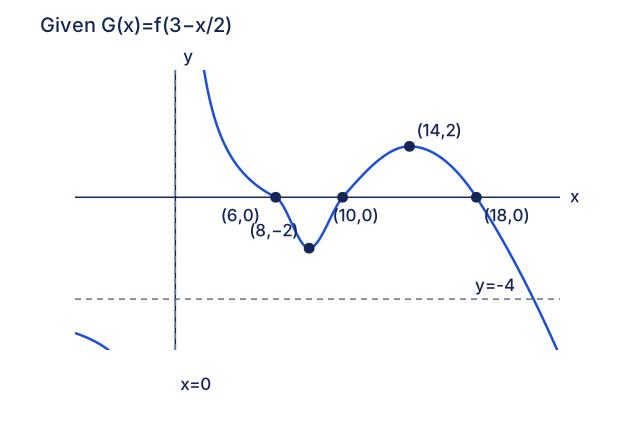
[2009/AJC/I/11]
CJC · Discussion · Question 8
Answer
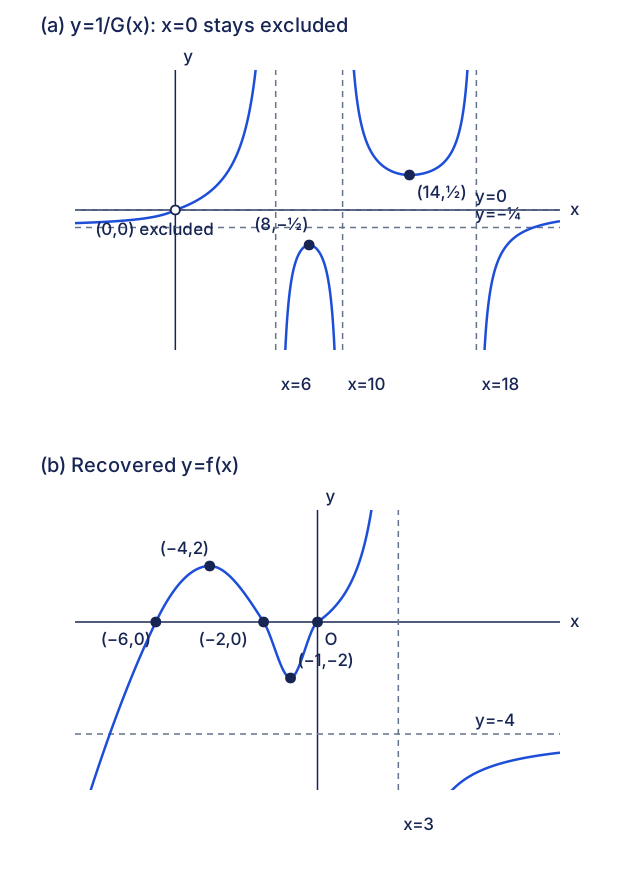
(a) Poles 6,10,18; maximum (8,−1/2), minimum (14,1/2); horizontal −1/4 left,0 right; open (0,0). (b) Pole 3, right asymptote −4; maximum (−4,2), minimum (−1,−2); zeros −6,−2,0.
(a) Map reciprocal features without changing x
Zeros 6,10,18 become reciprocal vertical asymptotes at those x-values. The negative minimum (8,−2) becomes a maximum (8,−1/2); the positive maximum (14,2) becomes a minimum (14,1/2). The left horizontal asymptote y=−4 becomes y=−1/4; the unbounded right tail gives reciprocal horizontal asymptote y=0.
(a) Preserve the original excluded origin
G is undefined at its original vertical asymptote x=0. Its reciprocal tends to 0 there, but(0,0) is an open limiting point, not the filled intercept in the printed sketch. There are no actual axial intercepts of 1/G.
(b) Retain the source forward transformation chain
The source shows how f produces G: by a translation 3 left; then by horizontal scale 2; then by reflection in the y-axis.
(b) Reverse the printed chain
Starting from G, reflect in the y-axis to get ; scale horizontally by 1/2 to get ; translate 3 right to get f. Equivalently a source point (X, Y) of G corresponds to on f.
(b) Label all recovered source coordinates
The stationary points become (−1,−2), (−4,2). Zeros 6,10,18 become 0,−2,−6. The pole x=0 maps to x=3; the left G horizontal asymptote becomes f’s right horizontal asymptote y=−4. Thus f has maximum (−4,2), minimum (−1,−2), x-intercepts −6,−2,0, and y-intercept 0.
Compare your sketch
Expand diagramFit diagram to page
Use the scrollbars or arrow keys to inspect details.
Common mistakes
The reciprocal does not define a new value at G’s original pole x=0. The source filled origin is a limiting-point ambiguity.
Solution notes
Both source transformation chains and all 3 source graph panels retained. Original zero-limit origin in the reciprocal is explicitly open. All source extrema/intercepts/asymptotes and side-of-tail behaviour preserved in qualitative reconstructions.