Conic sections
← Back to lesson · Complete chapter reading and print view
By the end, you can
- Identify parabolas, ellipses and hyperbolas
- Find centres, intercepts and asymptotes
- Preserve restrictions when interpreting a conic as a function
about 20 minutes for the lesson · practise at your own pace.
The central idea
Conic equations describe curves that may fail the vertical-line test. In standard form, a sum of positive squared terms gives an ellipse; a difference gives a hyperbola. Completing the square identifies a shifted centre. A parabola has one squared coordinate and one linear coordinate.
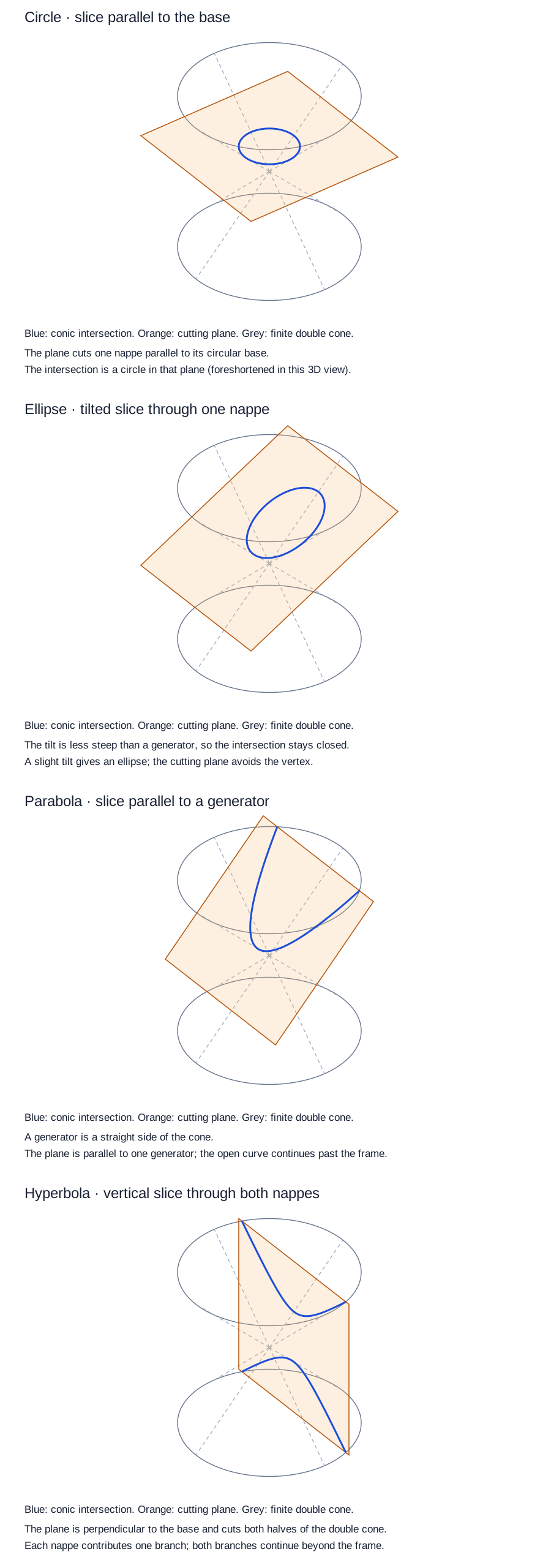
A plane cuts a double cone to give four familiar conics.
Parallel to the circular base, it gives a circle. A tilted plane cutting just one nappe (half) without becoming parallel to a generator gives an ellipse.
A plane parallel to a generator gives a parabola.
A plane perpendicular to the base and cutting both nappes gives the two branches of a hyperbola; on one nappe you see one branch.
The cuts here avoid the cone’s vertex, so they are non-degenerate curves.
The source motivates cones with ice-cream and traffic cones, ellipses with planetary orbits, parabolas with a thrown ball or fountain jet, and hyperbolas with a lampshade’s light on a wall.
These are geometric models: projectile paths are approximately parabolic when drag is neglected, and the light pattern depends on the wall’s cut through the light cone.
The source also mentions Earth as an ellipsoid, the three-dimensional analogue of an ellipse.
To begin exploring the shapes, the Teacher copy suggests video prompt 1 and video prompt 2. The printed QR points to the conic visualization and applications resource. These are the source’s learning pointers; their external contents are not reproduced here. The original printed illustration credits the University of Georgia conics introduction; the figure below is independently reconstructed.
Four plane cuts of a double cone
Expand diagramFit diagram to page
Use the scrollbars or arrow keys to inspect details.
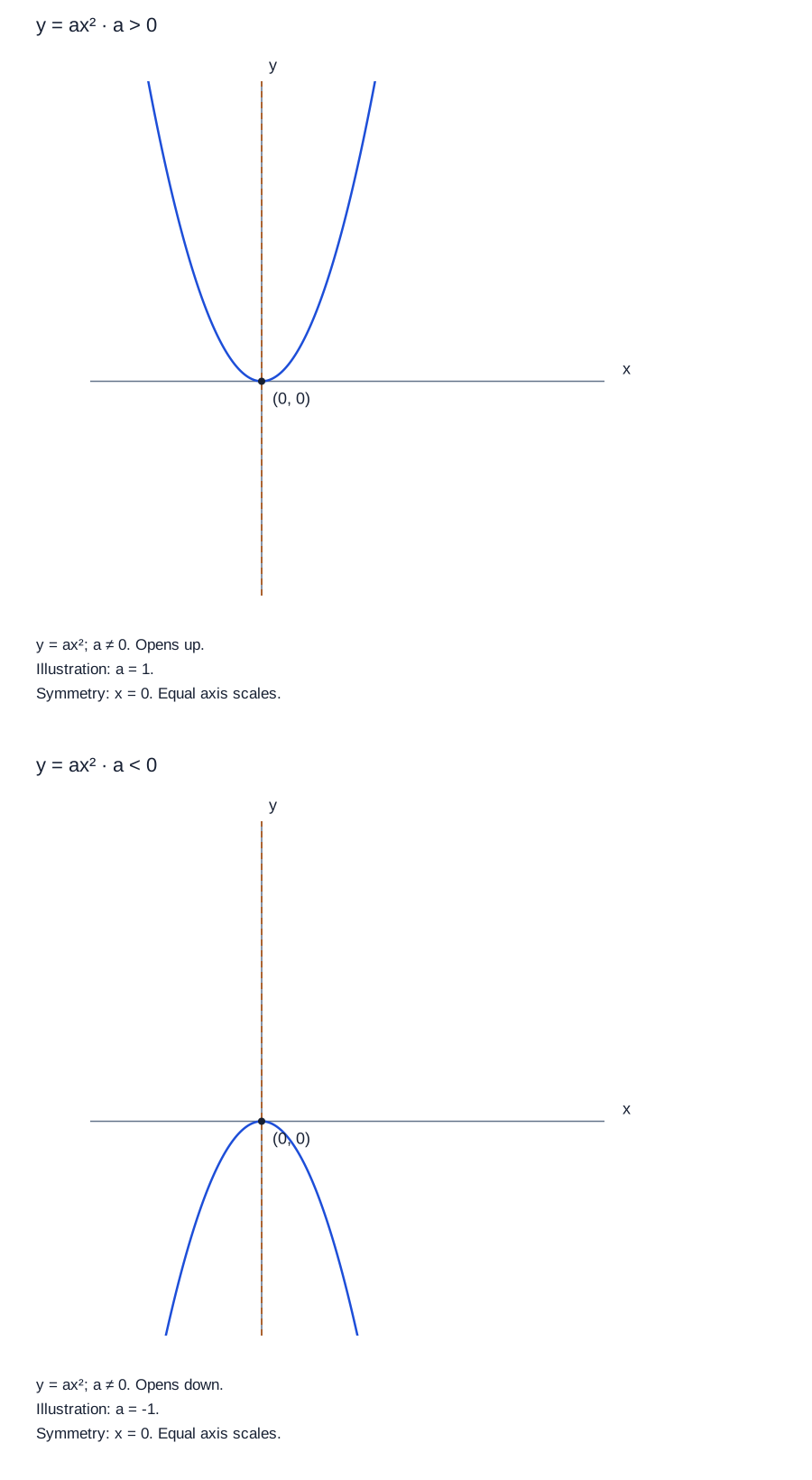
Vertical parabola sign cases
Expand diagramFit diagram to page
Use the scrollbars or arrow keys to inspect details.
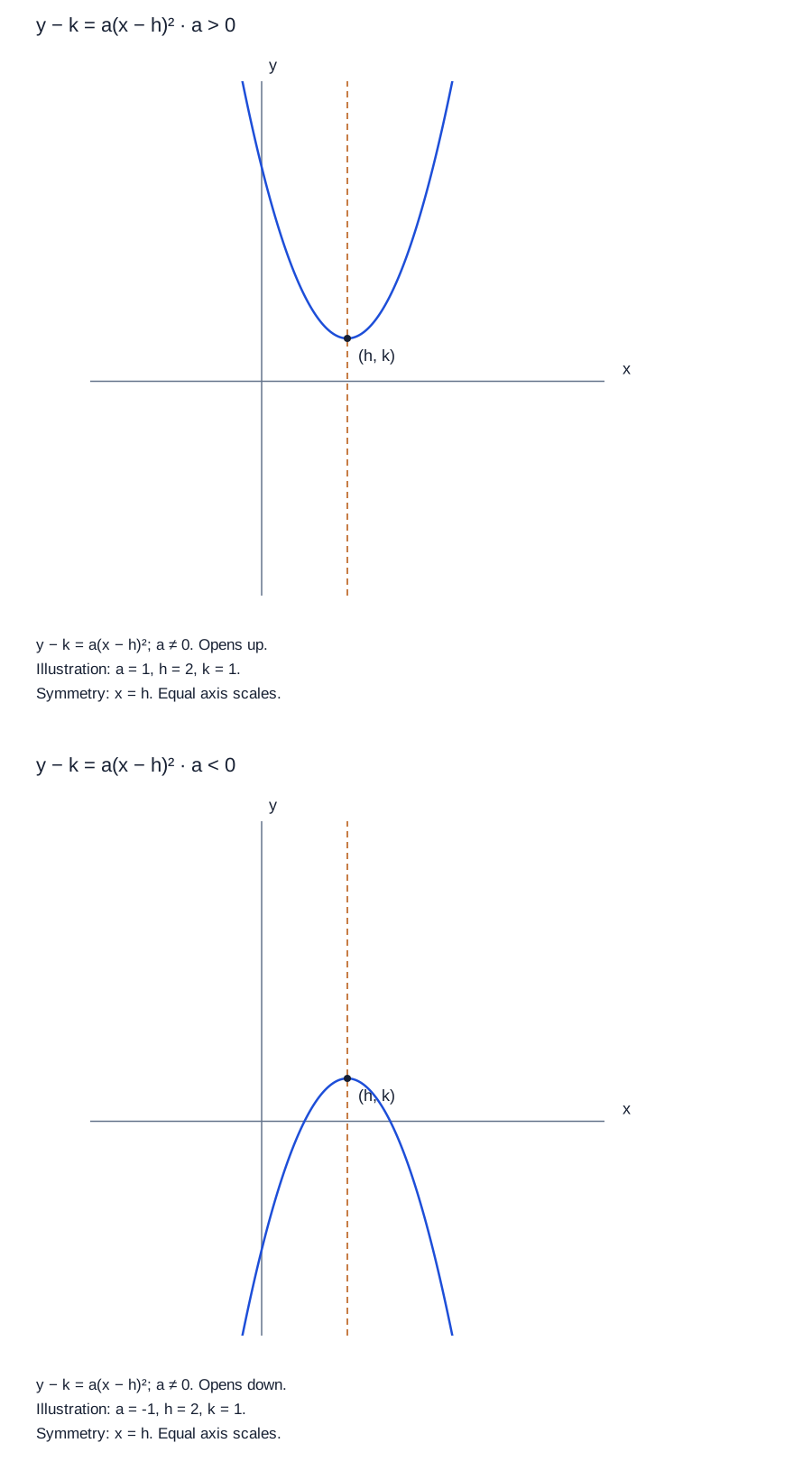
Vertical parabola translations
Expand diagramFit diagram to page
Use the scrollbars or arrow keys to inspect details.
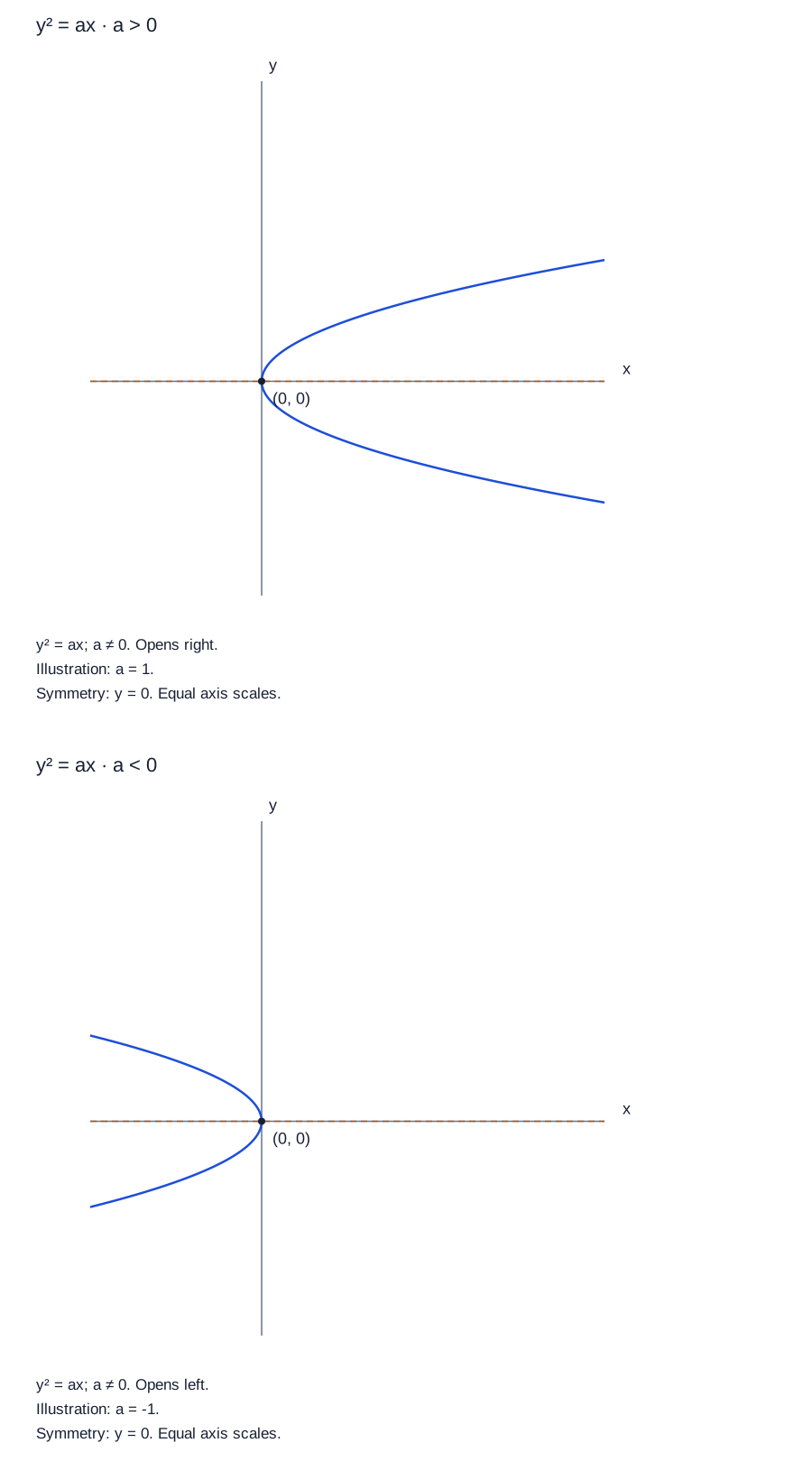
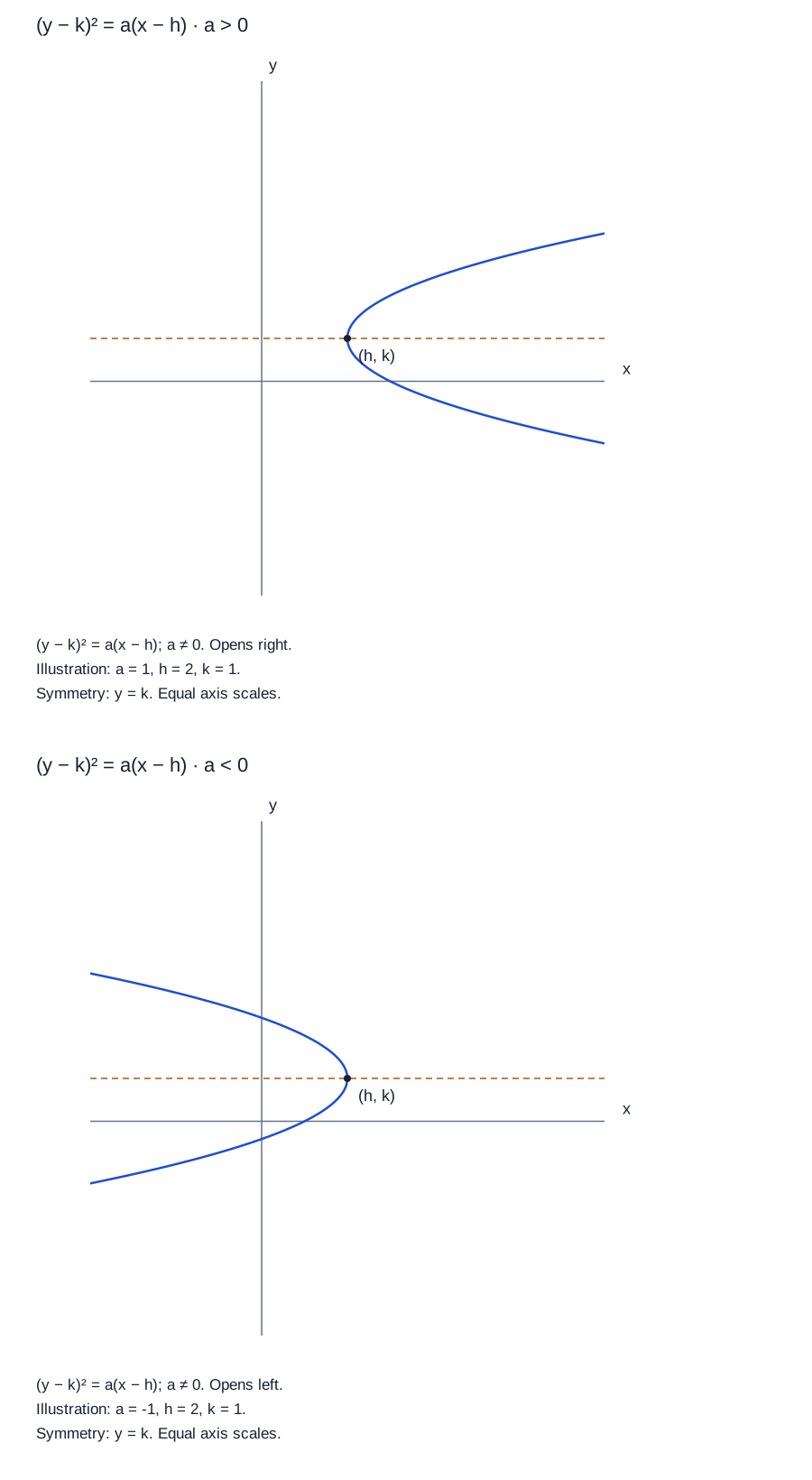
Horizontal parabola sign cases
Expand diagramFit diagram to page
Use the scrollbars or arrow keys to inspect details.
Horizontal parabola translations
Expand diagramFit diagram to page
Use the scrollbars or arrow keys to inspect details.
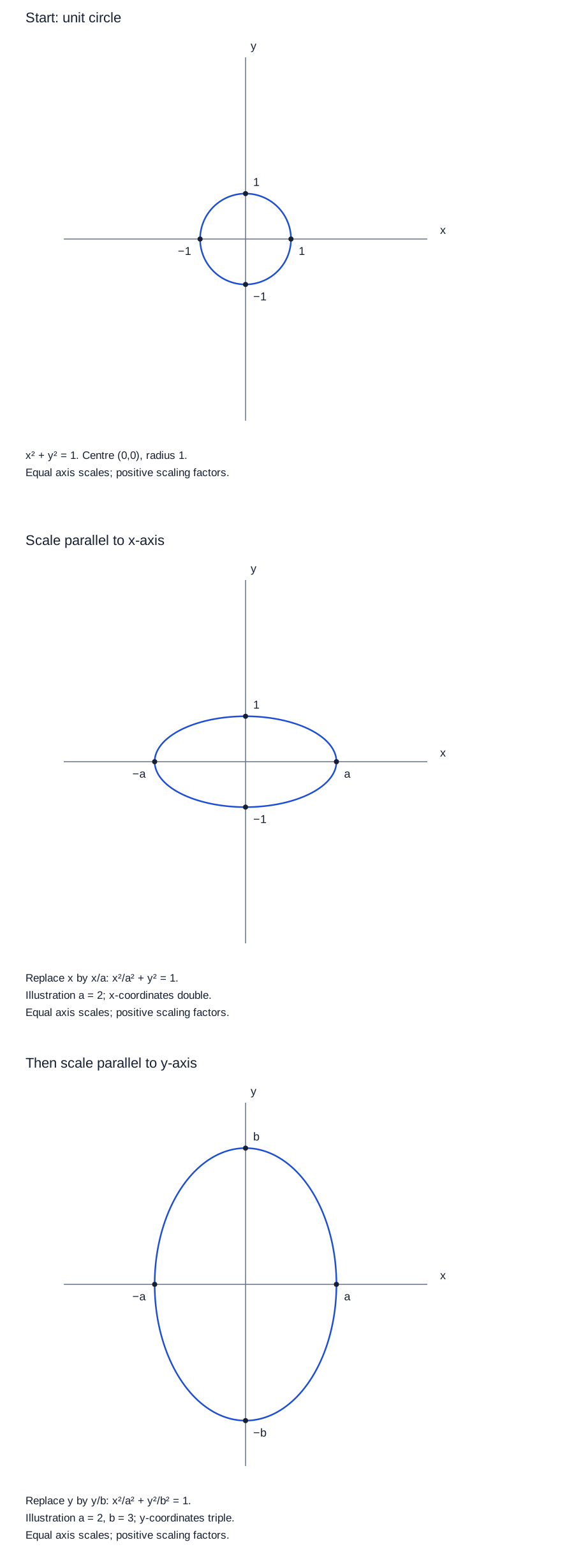
From a unit circle to an ellipse
Expand diagramFit diagram to page
Use the scrollbars or arrow keys to inspect details.
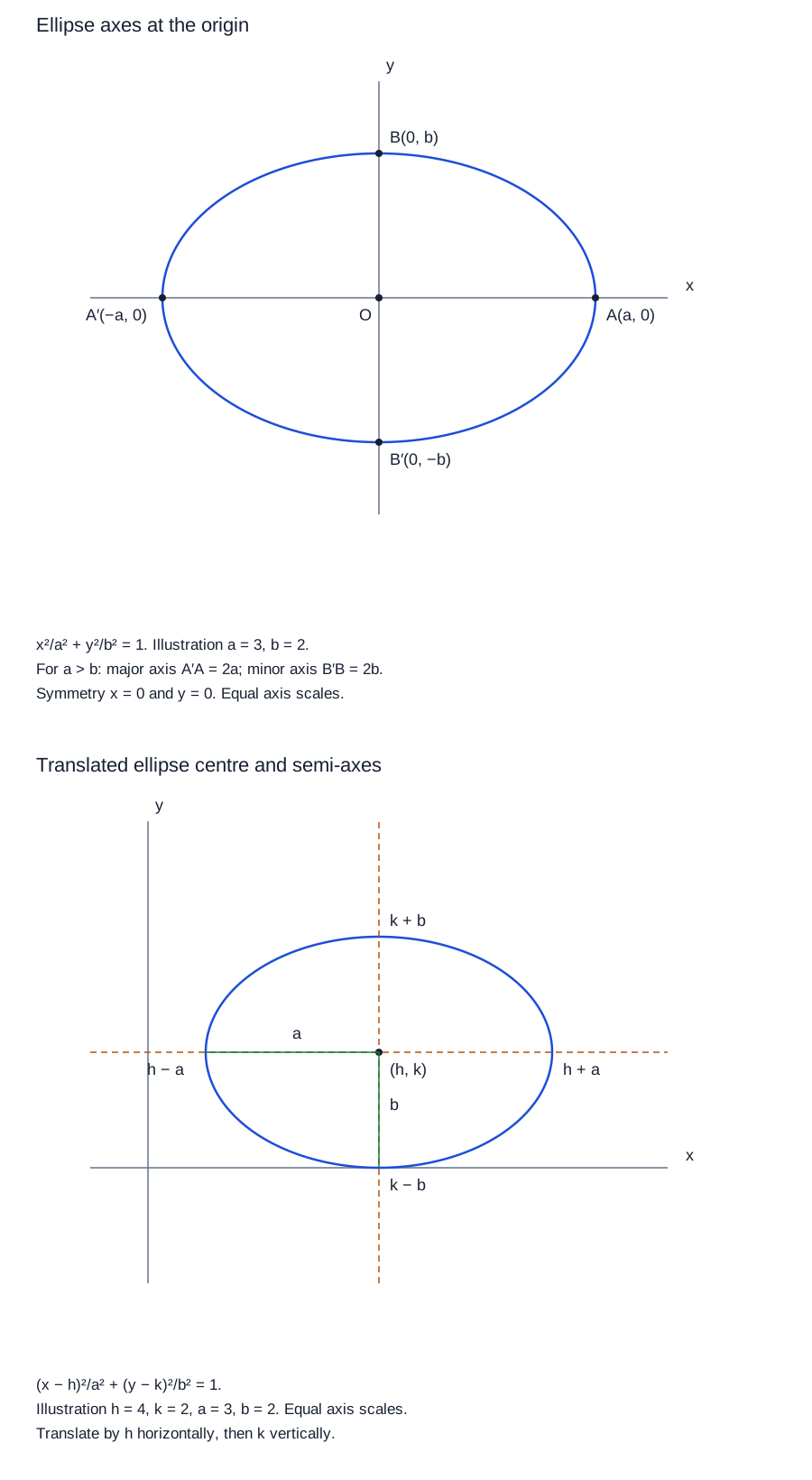
Ellipse axes and translation
Expand diagramFit diagram to page
Use the scrollbars or arrow keys to inspect details.
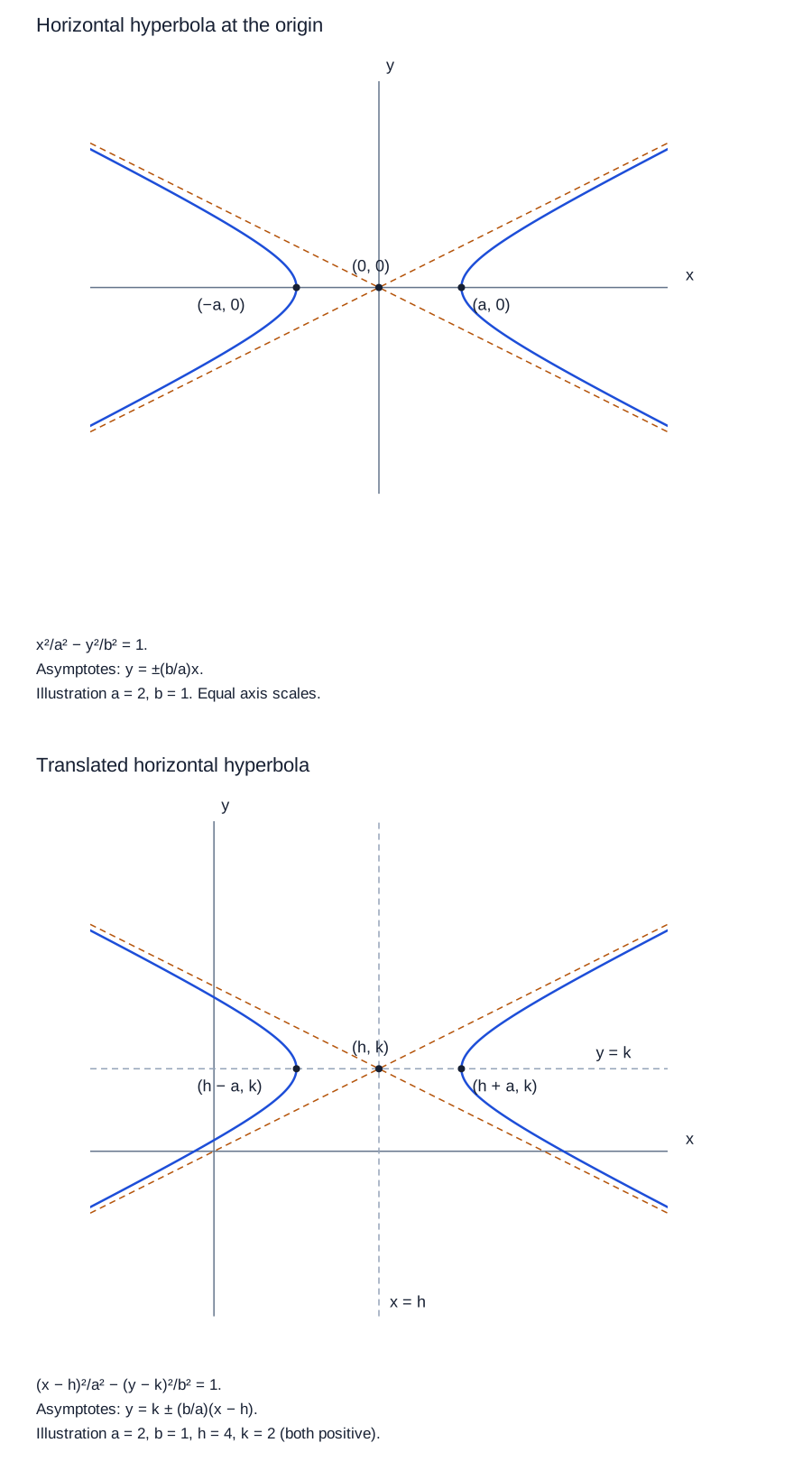
Horizontal hyperbola and translation
Expand diagramFit diagram to page
Use the scrollbars or arrow keys to inspect details.
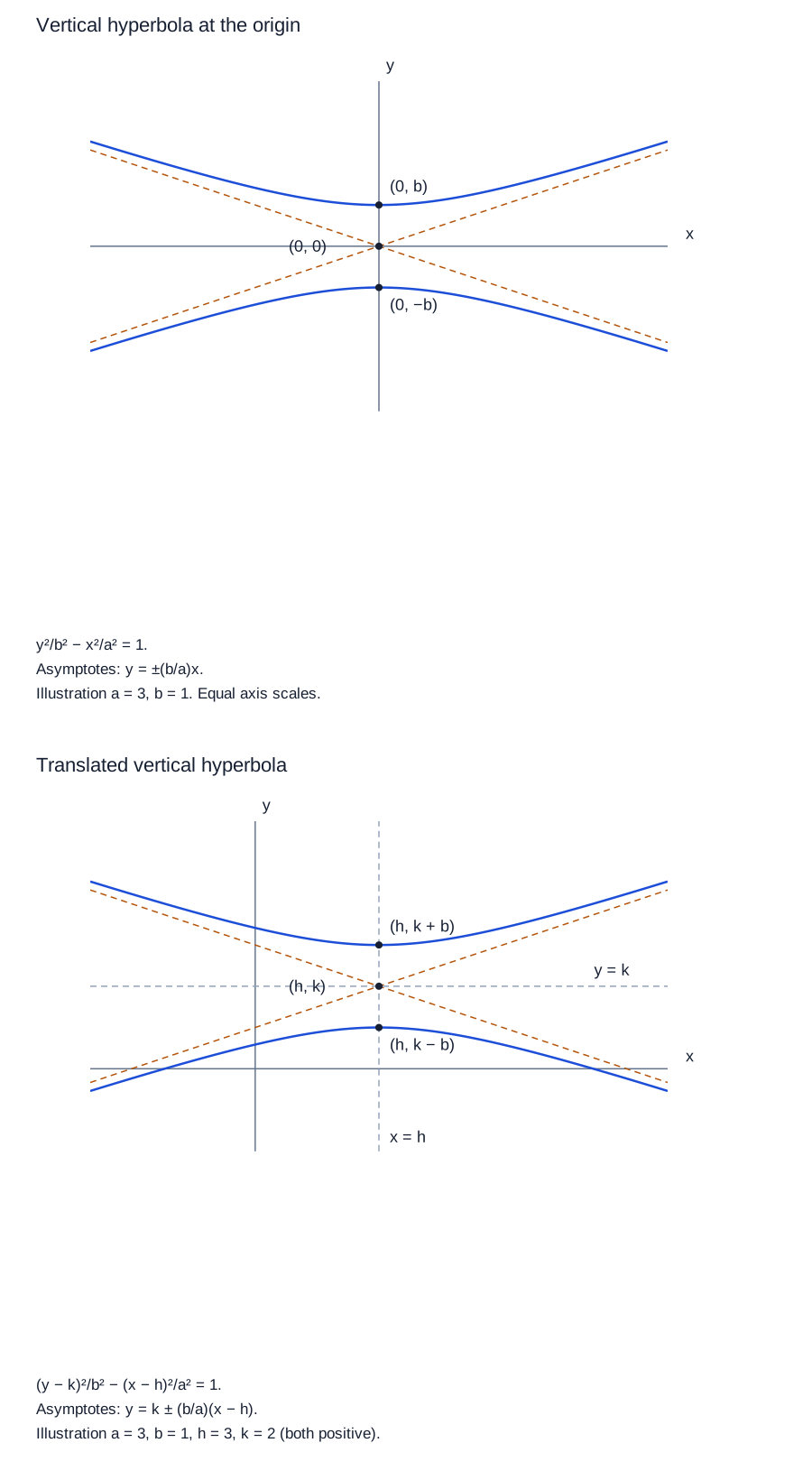
Vertical hyperbola and translation
Expand diagramFit diagram to page
Use the scrollbars or arrow keys to inspect details.
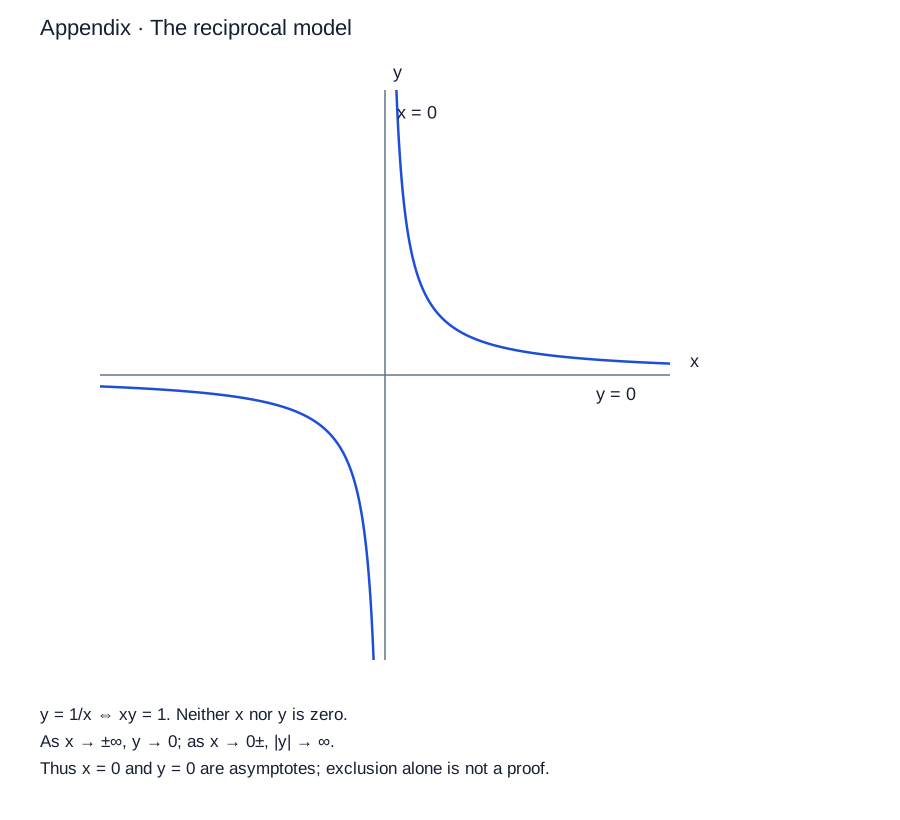
Reciprocal model for the appendix
Expand diagramFit diagram to page
Use the scrollbars or arrow keys to inspect details.
Explore
Use the worked example below, then change one input or assumption. Predict which part of the answer must change before calculating.
Related interactive example
Explore this related example, then return to the prediction task above.
Worked example
For , the centre is , horizontal intercepts are and vertical intercepts . Solving for y produces two branches for .
The denominator is the square of a semi-axis length, not the length itself.
Check your understanding
Find the asymptotes of .
The homogeneous equation gives . The hyperbola opens horizontally.
Mastery learning objectives
At the end of this chapter, I should be able to:
Choose a practice question
The printed skill map (printed page 138) is retained below. A dash represents a blank source cell. Some Discussion subpart labels do not match the questions printed on the following page; the study links below use the actual questions.
| Skill/concept | Lecture examples, as printed | Discussion questions, as printed | Review problems, as printed |
|---|---|---|---|
| Sketch parabola | 1 | 1(a) | — |
| Sketch ellipse/circle | 4 | 1(b)(c), 2, 3 (1st part) | 5 |
| Sketch hyperbola | 5, 7 | 1(d)(e) | 1, 6(a) |
| Sketch a conic on an existing curve to aid in solving the question | — | 3 (last part) | 2(iii), 3, 4(i) |
| Using gradient concept to aid in solving the question | — | 4(a)(iii) | — |
| Prior topic: Graphing Techniques | — | 4(a)(i)(ii)(b) | 2(i)(ii), 4(ii), 6(b) |
| Prior topic: Transformations | — | — | 2(iv) |
For the actual Discussion 1 equations, (a) and (b) are parabolas, (c) and (d) are ellipses, and (e) and (f) are hyperbolas. Discussion 3’s first graph is a rational curve, followed by an ellipse comparison. These qualifications preserve the printed map without directing you to the wrong conic.
Practice questions
Practice section 1 · Questions 1–6
Two parabola sketches: algebra and calculator branches · Read a parabola’s vertex and choose an equation · +4 more
Practice section 2 · Questions 7–11
Exact intercepts of a translated vertical hyperbola · Six conics: complete the square and identify graph features · +3 more
More practice
Ready to try this on your own?
For “Conic sections”, try a question without the working and explain your method. This records your confidence, saved in this browser only.