Porisma
All chapter practice

Definite integrals, areas and volumes

Practice section 5 of 9

Questions 25–30 in this collection

Practice questions

Discussion practice · 1 of 6

Take the limit of left-rectangle areas

The diagram shows part of the graph of y=x3+1y=x^3+1 from x=0x=0 to x=1x=1. The area under the curve may be approximated by the total area, AA, of nn rectangles as shown. The width of each rectangle is 1/n1/n.

Given that ∑r=1nr3=[n(n+1)2]2\displaystyle\sum_{r=1}^{n}r^3=\left[\frac{n(n+1)}2\right]^2, show that A=1+14(1−1n)2A=1+\dfrac14\left(1-\dfrac1n\right)^2.

Hence deduce the exact value of ∫01(x3+1) dx\displaystyle\int_0^1(x^3+1)\,dx.

Additional printed Student lecture ask: Construct a similar diagram so that overestimation occurs.

Expand diagram

Use the scrollbars or arrow keys to inspect details.
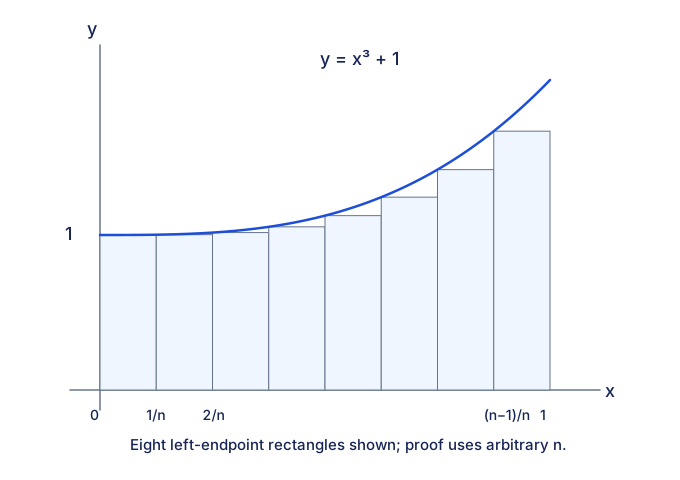
Increasing curve y=x³+1 on 0≤x≤1. Eight equal-width left rectangles illustrate the source construction for arbitrary n; each width is 1/n, first height 1, last height ((n-1)/n)³+1. Rectangles lie below the curve, with 0,1/n,2/n,(n-1)/n,1 marked on x-axis.

[2008/TPJC/II/5(modified)]

CJC · Discussion · Question 1

Solution

Discussion practice · 2 of 6

Integrate partial fractions with logarithm and arctangent terms

Using partial fractions, find ∫029x2+x−13(2x−5)(x2+9) dx\displaystyle\int_0^2\frac{9x^2+x-13}{(2x-5)(x^2+9)}\,dx. Give your answer as aln⁡b+ctan⁡−1da\ln b+c\tan^{-1}d, with rational a,b,c,da,b,c,d.

[2014/II/2]

CJC · Discussion · Question 2

Solution

Discussion practice · 4 of 6

Integrate a periodic piecewise function

f(x)=xexf(x)=xe^x for 0<x≤10<x\le1, and f(x)=e(2−x)f(x)=e(2-x) for 1<x≤21<x\le2. Also f(x)=f(x+2)f(x)=f(x+2) for all real xx.

(i) Sketch y=f(x)y=f(x) for −2<x≤4-2<x\le4.

(ii) Find ∫−13f(x) dx\displaystyle\int_{-1}^{3}f(x)\,dx exactly.

[2015/MJC/I/2]

CJC · Discussion · Question 4

Solution

Discussion practice · 5 of 6

Evaluate an improper logarithmic integral and a revolution volume

(a)(i) Find ∫1/3aln⁡(3x)x3 dx\displaystyle\int_{1/3}^{a}\frac{\ln(3x)}{x^3}\,dx, where a>1/3a>1/3.

(ii) Hence evaluate the same integral with upper limit ∞\infty. You may assume ln⁡a/a2→0\ln a/a^2\to0 as a→∞a\to\infty.

(b) The region under y=3/(1+4x2)y=3/(1+4x^2) between x=−3/2x=-\sqrt3/2 and x=3/2x=\sqrt3/2 is rotated through 2π2\pi about the x-axis. Use 2x=tan⁡θ2x=\tan\theta to show that the volume is 9π∫0π/3cos⁡2θ dθ9\pi\int_0^{\pi/3}\cos^2\theta\,d\theta, and evaluate it exactly.

[2015/IJC/I/10]

CJC · Discussion · Question 5

Solution

Discussion practice · 6 of 6

Equate areas using horizontal and vertical strips

For the curve y=x3y=x^3, the region between the curve, x=1x=1, x=qx=q and the x-axis has the same area as the region between the curve, y=1y=1, y=8y=8 and the y-axis, where q>1q>1. Find qq exactly as a1/ba^{1/b} for integers a,ba,b.

Expand diagram

Use the scrollbars or arrow keys to inspect details.
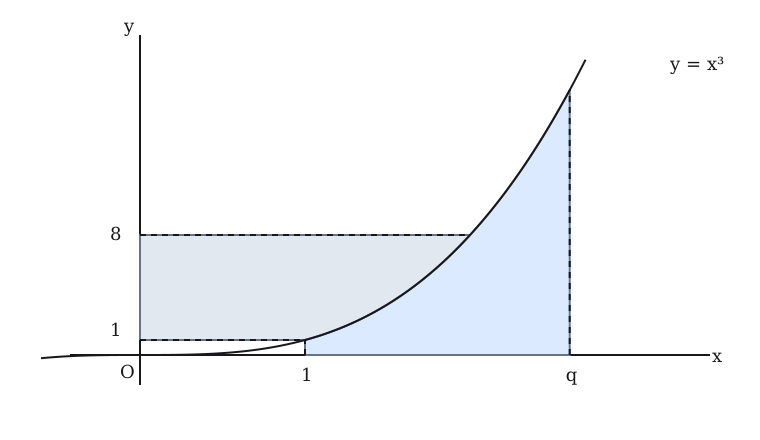
Curve y=x cubed with two shaded areas: below the curve between x=1 and x=q, and to the left of the curve between y=1 and y=8. Dashed boundaries identify x=1,x=q,y=1,y=8; q is to the right of x=2.

[2016/MJC/I/2(b)]

CJC · Discussion · Question 6

Solution

Back to all practice questions