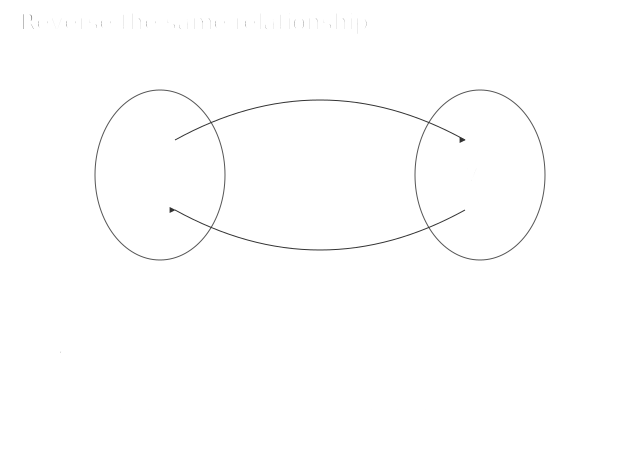
When does an inverse exist?
Find an inverse on the allowed domain
Check that outputs identify unique inputs before reversing a rule. The original domain determines the inverse branch, its range and which endpoints are included.
Check one-to-one behaviour first
Use the entire stated domain. A single pair of different allowed inputs with the same output rules out an inverse function on the original range.
- One-to-oneProceed on the stated domain
A horizontal line must meet the graph at most once. Strict increase or strict decrease on the domain is sufficient, but is not the definition or a necessary condition for every function.
- Repeated outputRestrict only when the task allows it
Without a suitable restriction there is no inverse function on the original range. A restriction keeps the rule but defines a different function. Follow the requested restriction criterion; do not assume there is one unique “largest” choice.
Do not start by swapping letters in a many-to-one rule. The reversed relation could have more than one output for an input.
Solve for the original input and choose its branch
Write y=f(x), then express the original input x in terms of y. Use the original input restrictions before renaming the inverse's variable.
- Square-root signKeep the allowed positive or negative root
From the relation gives . In this example the original input is negative, so only the negative root is allowed. Choosing the positive root would invert a different branch.
- NotationInverse does not mean reciprocal
The inverse reverses the mapping. It is generally different from . Rename the input only after solving; the new input represents an output of the original function.
For trigonometric functions, use the specified injective restriction or the principal branch when appropriate. Endpoint and angle-unit conditions remain part of the definition.
State the domain and verify the reversal
Define the inverse on the original range and give its range as the original domain. Carry open and closed endpoints across the exchange.
- DefinitionA rule alone is incomplete
For , , the range is . Thus has domain and range . The excluded vertex remains excluded.
- VerificationCheck on the correct sets
Verify for , and for . These identity mappings can have different domains. One numerical pair is a useful check, but does not prove the identities for all allowed inputs.
A reflected graph exchanges (a,b) with (b,a) across y=x, using equal axis scales. Keep the actual graph or explorer for geometry; this method map is a checklist for the reasoning.
Try a worked example
Read a case, make a prediction, then reveal the reasoning. The examples keep their stated values.
Example 6: keep the open endpoint
For , , predict the inverse domain before rearranging the rule. Is 1 an allowed inverse input?
Show reasoning
1. Find the reached outputs
The increasing rule sends positive inputs to outputs greater than 1. It never reaches 1, so the inverse domain is (1,∞).
2. Reverse and check
Solving y=2x+1 gives the inverse rule. The source pair f(5)=11 checks that the inverse sends 11 back to 5; the algebra establishes the reversal for all allowed inputs.
Example 7: keep the negative branch
For , , explain why the inverse cannot be . What happens to the excluded input 0?
Show reasoning
1. Use the original sign restriction
The inverse must return a negative original input. Since y>−1, the radical is positive and its negative gives the required branch.
2. Preserve both open boundaries
The original output −1 would require the excluded original input 0. The inverse therefore excludes −1 from its domain and 0 from its range.
3. Check the sign in the reverse composition
The square root of x² is |x|. Its negative equals x because x is negative; omitting this sign check would hide the branch error.
Compare the forward and reverse mappings
Expand diagramFit diagram to page
Use the scrollbars or arrow keys to inspect details.