Unit 11 of 12 · Sequences and series
Model geometry, motion and repeated payments
Define the term and observation time before combining progressions and sums.
Relate a circle partition to AP and GP conditions
Example 33 cuts a radius-two circle into ten unequal sectors with increasing areas . Their total equals the circle area:
The first, fourth and ninth are . Consecutive GP ratios give
The areas are positive and unequal, so division by , and is legitimate. Substitution gives , hence . The largest area is the tenth:
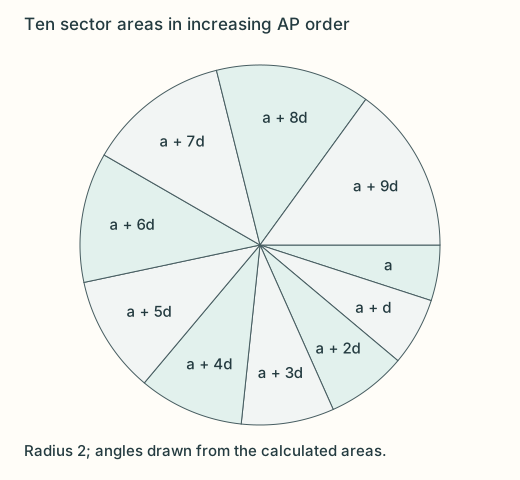
All ten labels in the source figure are retained. Its largest wedge is drawn as a quarter-circle, so treat that sketch as schematic. The calculated areas give angles , used in this redraw. Do not infer an area from the source wedge’s apparent angle.
Compare cumulative travel distances at the same leap count
Example 34 models a jaguar chasing a white-tailed deer initially metres ahead. The deer starts with a 9 m leap and reduces each subsequent leap by 5%, so
As , m. The source calls this a maximum distance. More precisely, every finite total is below 180 m and increases toward it: 180 m is the limiting upper bound, or supremum.
The jaguar starts at 6 m per leap and reduces each subsequent leap by 0.1 m, giving
Both animals complete the same leap count in the same duration. For the initial 11 m gap, catching requires . The source enters the difference into a calculator:
Its written table singles out:
| n | F(n), rounded | Sign |
|---|---|---|
| 49 | −0.021 | Negative |
| 50 | 0.350 | Positive |
| 51 | 0.658 | Positive |
The calculator screen also shows neighbouring counts 44–54. Computed values to four significant figures are:
| n | F(n) |
|---|---|
| 44 | -2.759 |
| 45 | -2.101 |
| 46 | -1.496 |
| 47 | -0.9459 |
| 48 | -0.4536 |
| 49 | -0.02095 |
| 50 | 0.3501 |
| 51 | 0.6576 |
| 52 | 0.8997 |
| 53 | 1.075 |
| 54 | 1.181 |
The first feasible integer is 50; checking all earlier integer counts 1–49 gives negative differences. The calculation is within the physical AP range of positive jaguar leap lengths, through leap 60. Do not extend the AP into negative distances, and do not compare just the individual leap lengths instead of the cumulative travel totals.
Count bounce heights and travelled legs separately
Example 35 drops a ball from 200 cm, with each rebound height times the preceding height. The source recommends drawing a diagram, making a table and observing the pattern. Define as the height after rebound :
| Rebound | Height in cm |
|---|---|
| 1 | |
| 2 | |
| 3 | |
| n |
The source table’s metre heading is inconsistent with the question and calculation; these values are in centimetres. The height after the kth floor contact is the kth rebound height, not the initial drop. At the fourth rebound apex, the initial descent counts once, heights 1–3 count twice and height 4 once:
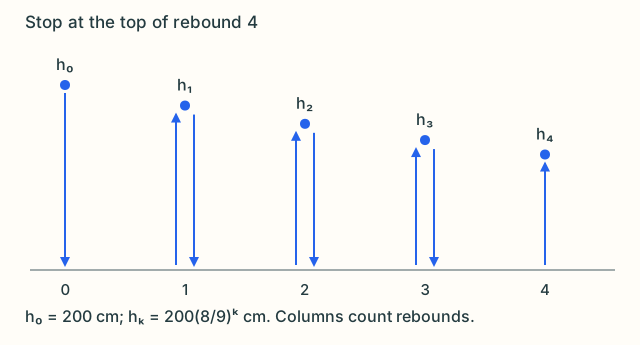
For part (ii), the first rebound below 0.01 cm satisfies the strict inequality
Dividing by the negative logarithm reverses the inequality. The least integer is 85: cm is still above the threshold and cm is below it.
The source totals the initial descent plus 84 completed up-and-down rebound heights:
The lecturer notes that the final rise to the 85th apex can be omitted at the requested nearest-centimetre precision.
Its comparison screen includes both totals: adding gives cm, which also rounds to 3400 cm.
The extra ascent is small, not exactly zero.
The examiner-report note’s “initial height + 2 x other heights” describes the completed paired legs; always identify the final endpoint before deciding whether the last height is counted once or twice.
Repeated payments and the observation time
For the annual deposits in Example 36, sketch the first few years before choosing the sum. A deposit at the beginning of a year earns interest at that year’s end.
Immediately after deposit ten, the ten payments have earned 9, 8, …, 1, 0 years of interest. Thus the balance is dollars to the nearest cent.
An extra multiplication by 1.05 would move the observation to the end of year ten.
Example 37 observes the other side of a repeated event: just before an injection. Write . Immediately after injection , the amount is ; before injection , it is . Since , the pre-injection limit is units. The post-injection limit is ten units larger. The limiting behaviour is a repeating decay-and-injection cycle, not a constant amount during the day.
Try these examples
Open an example in chapter practice. Try it first, then read its solution. Use “Learn this step” to return to this unit.