Vectors: lines and perpendicular feet
Build a line from a point and a direction
Separate the fixed position from the direction of travel along the line. A direction must be nonzero; the real parameter selects a point, with negative values allowed.
Identify a point and a nonzero direction
Choose one fixed point on the line and a direction parallel to it. If two distinct points are supplied, subtract their position vectors.
- Point and direction givenKeep their roles separate
locates A relative to O. The nonzero vector gives the line direction; it need not be a unit vector.
- Two distinct points givenForm a displacement
If A and B have position vectors and , use . The reverse direction is equally valid. Identical points alone do not determine a line.
A zero component is allowed. A direction vector with every component zero gives a single fixed point in the proposed equation, not a line.
Add a parallel displacement
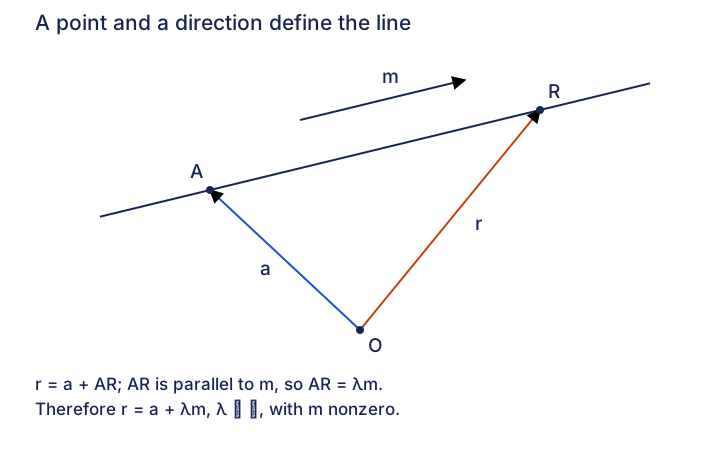
Let R be any point on the line. Reach it by going from O to A, then from A to R.
- Vector additionFollow the two displacements
The triangle law gives
- Parallel displacementUse a scalar multiple
Because AR is parallel to the nonzero direction,
Combining these statements gives the vector equation.
The fixed vector a is not generally parallel to the line. It is AR, the displacement between two line points, that is parallel to m.
Interpret the parameter and its range
With a nonzero direction, each real parameter value gives one point, and every point on the unrestricted line has one parameter value for this representation.
- Position and distanceKeep the sign for position
Zero gives A; negative values move opposite to the chosen direction. The distance from A is
Only for a unit direction does itself give that distance.
- Equivalent equationsThe same line can look different
Choose another point on the line and any nonzero parallel direction. With a free real parameter, the equation still describes the same line, although parameter values change. Restrictions on the parameter must be considered separately.
A restricted parameter range can describe only part of the line. Interpret a parameter as elapsed time only when the question explicitly defines that model and its units.
Try a worked example
Read a case, make a prediction, then reveal the reasoning. The examples keep their stated values.
The source exploration: points on both sides
Take and . The source places E at three times PQ from P, F halfway from P to Q, and G on the opposite side of P with PG twice PQ. Predict the parameter for each point before opening the reasoning.
Show reasoning
1. Reach Q and continue to E
One copy of PQ reaches Q; three copies reach E on PQ produced.
2. Stop halfway at F
The midpoint needs half the displacement from P to Q.
3. Reverse direction to G
G is on the other side of P, so its displacement is a negative multiple. The parameters 1, 3, one-half and minus 2 all belong to the same unrestricted line.
Two source points: one coordinate stays fixed
Use the source points and . Predict which coordinate is constant and whether a zero direction component prevents a line.
Show reasoning
1. Subtract the position vectors
AB is a nonzero direction even though its y component is zero.
2. Use A as the fixed point
The parameter ranges over all real values. Zero gives A and one gives B.
3. Read the fixed coordinate
Keep the same parameter in all three coordinates. The constant coordinate is an equation, not a fraction with denominator zero; the linked question continues to Cartesian form.
Same line, different parameter values
Authored comparison using the same source line: replace by and call the new parameter . Both parameters range over all real values. Predict how the parameter for B changes.
Show reasoning
1. Recognise the nonzero scale factor
The direction has been multiplied by minus 2. This reverses and rescales its displacement per parameter unit, while preserving the unrestricted line.
2. Match displacements
The two equations reach the same point only when their parameters are related. The old value one for B becomes minus one-half.
3. Separate the parameter from distance
The original direction has length square-root 5. The distance from A to B is square-root 5 coordinate units, not the original parameter value one. A signed parameter is not automatically a distance or elapsed time.
Compare with the source vector construction
Expand diagramFit diagram to page
Use the scrollbars or arrow keys to inspect details.