Original question & working
A turning point fixes a rational curve · source reference
2011/PJC/Promo/9 · Question pp. 4 · Working pp. 13, 14
Open the interactive lessonThe working and teaching notes are included in the interactive lesson.
View source review notesFull original question, working & notes
Printed question
The curve has equation , where are constants. It is given that is an asymptote of .
(i) State the value of . [1]
(ii) Given also that has a turning point at , find the values of . [4]
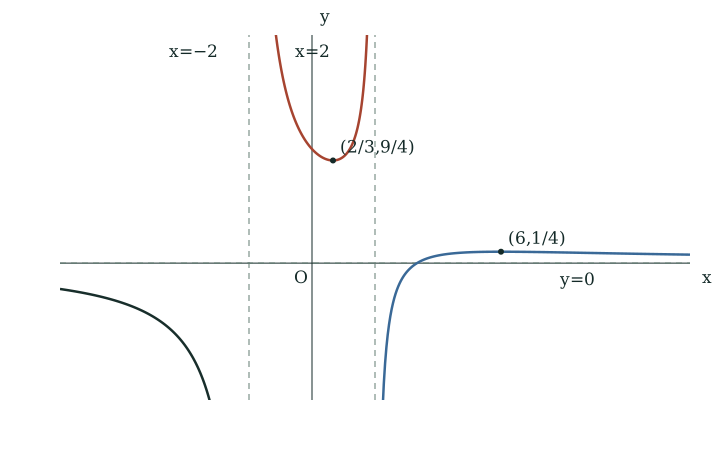
(iii) Sketch , stating the equations of the asymptotes and the coordinates of the turning points. [You need not indicate the coordinates of intersections with the axes.] [3]
(iv) Hence find the range of values of for which the equation has no real root. [2]
[2011/PJC/Promo/9]
Printed working
(i) .
(ii) Sub the point and into equation of curve,
.
.
.
— (1).
.
Since there is a turning point at ,
at .
.
— (2).
Solving simultaneously, , .
.
(iii) Graph below: turning points ; asymptotes .
(iv) .
.
.
Hence, for to have no real roots, the graph of and must not intersect. From the sketch, they will not intersect for .
Teacher notes
When , denominator .
has turning pt at 1) lies on , so satisfies eqn of curve AND 2) At , .
Re-express equation such that one side of it is , where .
Note: CANNOT use as question says “Hence” which means must use the curve sketched in the previous part.
Printed answer key
(i) . (ii) . (iii) Native graph above. (iv) .
Source provenance
2025 TJC H2 Math (9758) JC2 MSM: GRAPHS AND CURVE SKETCHING. Question/answer booklet printed pages 1–14; solutions printed pages 1–28. Running metadata and repeated headings are transcribed in the topic metadata article.