A turning point fixes a rational curve
The curve has equation , where are constants. It is given that is an asymptote of .
(i) State the value of . mark
(ii) Given also that has a turning point at , find the values of . marks
(iii) Sketch , stating the equations of the asymptotes and the coordinates of the turning points. [You need not indicate the coordinates of intersections with the axes.] marks
(iv) Hence find the range of values of for which the equation has no real root. marks
[2011/PJC/Promo/9]
Solution
Asymptotes
The curve has equation , where , , are constants. It is given that is an asymptote of . State the value of .
Hint
A vertical asymptote occurs where the denominator is zero.
With the denominator also vanishes at , giving a second asymptote .
Answer · (i)
.
Denominator zero at
is a vertical asymptote, so the denominator must vanish there.
Turning points
Given also that has a turning point at , find the values of and .
Hint
A turning point gives two facts: the point lies on the curve, and there.
Use each fact to write one linear equation in and .
Solve the pair.
Two unknowns need two equations: the point being on the curve, and the gradient being zero.
The numerator and denominator both depend on . Do not differentiate them separately.
Answer · (ii)
.
The point lies on the curve
Substituting and : the denominator is , and .
The gradient is zero
Quotient rule. Only the numerator matters when we set .
Set the numerator to zero at
, so , and dividing by gives .
Solve
Substitute into .
Curve sketching
Sketch , stating the equations of the asymptotes and the coordinates of the turning points. You need not indicate the coordinates of the intersections with the axes.
Hint
The curve is now . List its vertical and horizontal asymptotes.
There are two turning points. One is given; find the other.
The three branches meet asymptotes at .
has two roots. Both and are vertical asymptotes.
The minimum lies on the central branch above the axis, and the maximum on the right branch. Check with the shape, not just the heights.
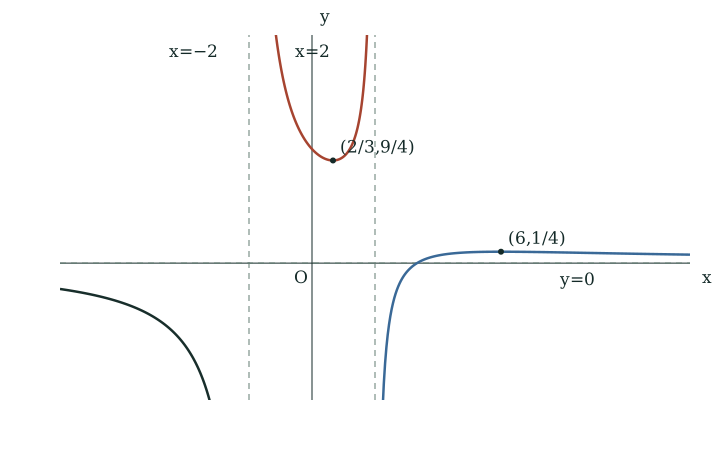
Answer · (iii)
Asymptotes ; minimum , maximum .
Asymptotes
The denominator is . As , the degree of the denominator is higher, so .
The other turning point
Putting , into the numerator of gives . The roots are (given) and , where .
Classify and join up
The central branch (between and ) dips to a minimum, the right branch rises from to a maximum and then decays towards 0, and the left branch is negative.
Explore the idea
Roots from a graph
Hence find the range of values of for which the equation has no real root.
Hint
Rearrange so that one side is the curve from (iii): isolate .
Real roots of the equation are intersections of with the curve.
Read off the values of for which the horizontal line misses the curve.
The question says “hence”, so you must use the graph. A discriminant approach can check the result, but the requested justification should use the preceding sketch.
At and the line touches the curve at a turning point, giving exactly one repeated root, so those values are excluded.
Answer · (iv)
.
Rearrange
Move the -terms across, factor out , then divide by (valid for ). Substituting or into the original left side gives 4 or 16, so neither is a lost root.
Interpret
A real root of the equation is a point where the line meets the curve . No real roots means the line misses the curve completely.
Read off from the sketch
The curve covers all heights and . Between those, no branch reaches, so the line does not meet the graph.
Explore the idea