Original question & working
Determine when a horizontal level has a negative input · source reference
2012/NJC/Promo/11(a) · Question pp. 5 · Working pp. 15, 16
Open the interactive lessonThe working and teaching notes are included in the interactive lesson.
View source review notesFull original question, working & notes
Printed question
The curve has equation given by , where is a negative constant.
(i) Write down the equations of the asymptotes of . [2]
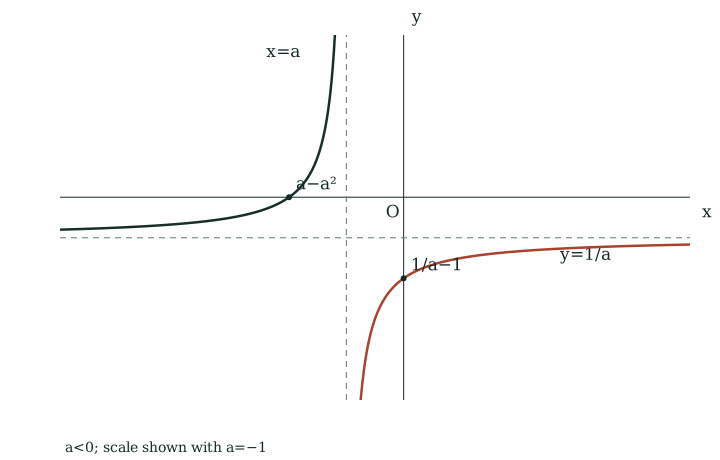
(ii) Sketch the graph of , labelling clearly the asymptotes and axial intercepts. [2]
(iii) Deduce the range of values of for which the equation has one negative real root. [2]
(iv) State the range of values of for which the curve is concave downwards. [1]
[2012/NJC/Promo/11(a)]
Printed working
(i) .
Asymptotes are and .
(ii) Printed graph below labels -intercept and -intercept .
(iii) has 1 negative real root
there is 1 point of intersection between curve and line whose -coordinate is negative.
or .
(iv) .
Teacher notes
-
To find vertical asymptote: Put denominator . So .
-
To find horizontal asymptote: Use long division to express where is the horizontal asymptote.
For eqn to have 1 negative real root, the line must intersect the part of curve to the left of the -axis (i.e. on the negative part of the -axis — 2nd and 3rd quadrants) for pt of intersection to have negative -coordinate.
Region where gradient of curve is decreasing.
Printed answer key
(i) Asymptotes . (ii) Native graph above. (iii) or . (iv) .
Source provenance
2025 TJC H2 Math (9758) JC2 MSM: GRAPHS AND CURVE SKETCHING. Question/answer booklet printed pages 1–14; solutions printed pages 1–28. Running metadata and repeated headings are transcribed in the topic metadata article.