Determine when a horizontal level has a negative input
The curve has equation given by , where is a negative constant.
(i) Write down the equations of the asymptotes of . marks
(ii) Sketch the graph of , labelling clearly the asymptotes and axial intercepts. marks
(iii) Deduce the range of values of for which the equation has one negative real root. marks
(iv) State the range of values of for which the curve is concave downwards. mark
[2012/NJC/Promo/11(a)]
Solution
Asymptotes
The curve has equation , where is a negative constant. Write down the equations of the asymptotes of .
Hint
Divide the numerator by the denominator: write .
The constant is the horizontal asymptote; the zero of the denominator gives the vertical one.
, not just . The is the horizontal asymptote.
Answer · (i)
.
Split the fraction
and .
Read off the asymptotes
The denominator vanishes at . As the fraction , so .
Curve sketching
Sketch the graph of , labelling clearly the asymptotes and axial intercepts.
Hint
Intercepts: put and .
Is the curve increasing or decreasing? Look at the sign of .
For the branches would decrease. Here flips them.
The -intercept is on the left branch (); the -intercept is on the right branch ().
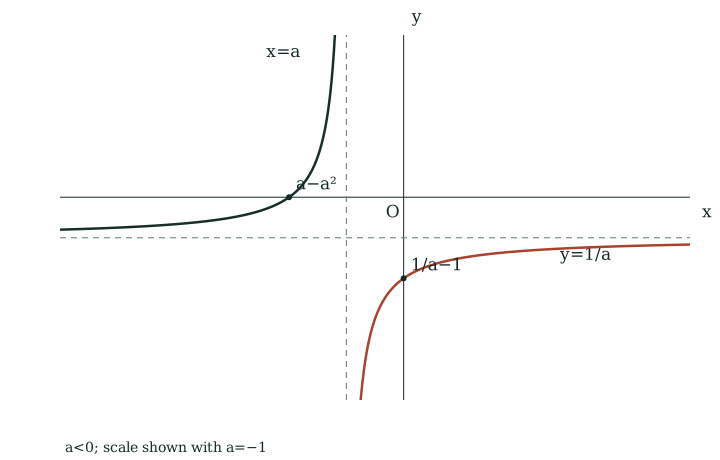
Answer · (ii)
Intercepts ; both branches increase.
; diagram is a representative negative-a sketch.
-intercept
The numerator is zero. Since , , so the intercept is to the left of the vertical asymptote.
-intercept
. This is negative because .
Shape
, so the gradient is positive: both branches increase. The curve lies above for and below it for .
Explore the idea
Roots from a graph
Deduce the range of values of for which the equation has one negative real root.
Hint
A root is an intersection of with . For a negative root, the intersection must have .
Which parts of the curve have ? Both the left branch and the part of the right branch left of the -axis.
Read off which heights those parts reach.
The question asks for negative roots only. A positive root from the lower part of the right branch does not count.
At that height the root is , which is not negative, so the inequality is strict.
Answer · (iii)
or .
Restrict to
We only count intersections to the left of the -axis: the whole left branch (which lies above ) and the piece of the right branch between and (which lies below ).
Heights reached by the left piece
The left branch rises from the horizontal asymptote (far to the left) to at , so it covers every height above .
Heights reached by the right piece
On the right branch the curve rises from at up to the -intercept at .
Combine
Values between and give a root with (or none), and gives the root , which is not negative.
Explore the idea
Concavity
State the range of values of for which the curve is concave downwards.
Hint
Concave downwards means the gradient is decreasing: .
For the answer would be . Here the negative flips it.
Answer · (iv)
.
Second derivative
Concave downwards means the gradient decreases as increases, so we need the second derivative to be negative. Differentiate twice: , then .
Sign
The numerator is negative, so the whole expression is negative exactly when the denominator is positive.