Original question & working
Identity rules still have domains · source reference
[2011/DHS/Prelim/I/4] · Question pp. 2 · Working pp. 10
Open the interactive lessonThe working and teaching notes are included in the interactive lesson.
View source review notesFull original question, working & notes
Complete question
(a) If f is one-one, determine with justification whether exists. [1] (b) for real ; for real . (i) Given gh exists, define it including its domain and range. [2] (ii) Sketch g, its inverse, and together. [3] (iii) Find the inputs satisfying . [1]
[2011/DHS/Prelim/I/4]
Printed working
Part (a)
is one-one, so exists. Since , the composite function exists.
Part (b)(i)
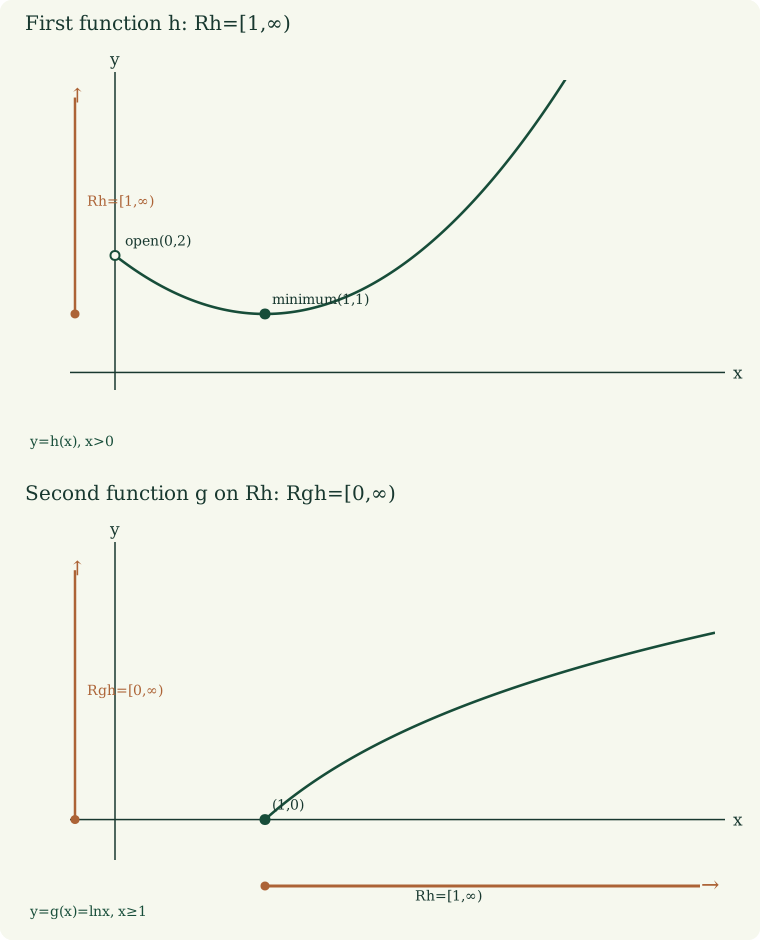
. Thus , .
; the source sketch of labels minimum and an open point at . The graph of starts at the closed point .
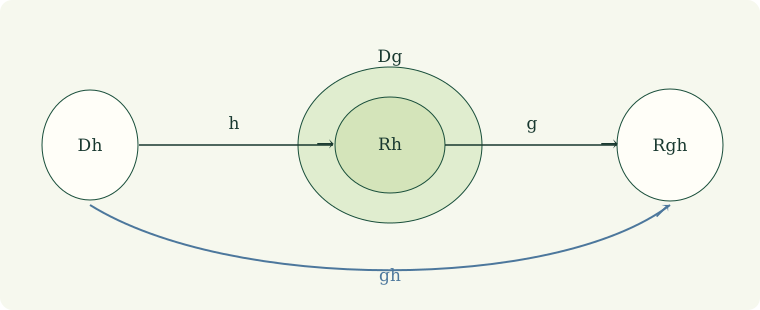
Thus . The accompanying composition diagram places inside and arrows , with an outer composite arrow .
Part (b)(ii)
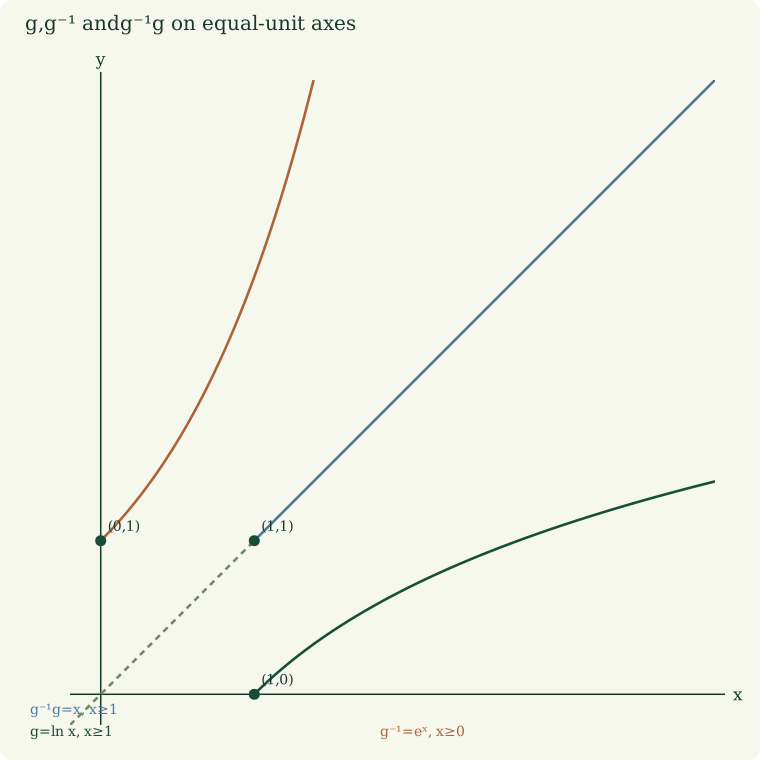
On equal-scale axes, draw , , starting at ; , , starting at ; and , , starting at . The underlying reflection line is dashed where it is not part of the restricted composite.
Part (b)(iii)
Thus , so .
Teacher margin notes
. To find : (1) find using the graph of the first function ; (2) sketch the second function ; (3) becomes the restricted domain of ; (4) use as the new domain and the graph of to find its range, which is .
When sketching and on the same diagram, the scale must be the same for the x- and y-axes; their graphs must be symmetrical about . Always include endpoints. .
. To compare the two composites, .
Source diagrams
Provenance
Question page references: 2. Solution page references: 10. The original compilation header and printed page numbers are preserved in the edition notes. Original PDFs and page images remain only in the private QA archive.