Identity rules still have domains
(a) If f is one-one, determine with justification whether exists. mark
(b) for real ; for real .
(i) Given gh exists, define it including its domain and range. marks
(ii) Sketch g, its inverse, and together. marks
(iii) Find the inputs satisfying . mark
[2011/DHS/Prelim/I/4]
Solution
Existence of composites
If is one-one, determine with justification whether exists.
Hint
means apply first, then .
It exists if .
Justify with .
Answer · (a)
Yes: , so exists.
Compare range and domain
The outputs of are exactly the inputs of , so each is an allowed input.
Defining a composite
for real and for real . Given that exists, define , including its domain and range.
Hint
The rule: substitute into .
The domain of is the domain of the first function, .
The range: feed into .
The domain of a composite comes from the inner function, here .
Answer · (b)i
, ; range .
Rule and domain
The composite takes the inputs of .
Range of
The minimum is , and is unbounded.
Range of
is increasing, with .
Explore the idea
Graphs of inverses
Sketch , and on the same diagram, with the same scale on both axes.
Hint
for starts at . Its inverse is with domain .
with domain .
Mark each starting point.
only for . The half-line starts at .
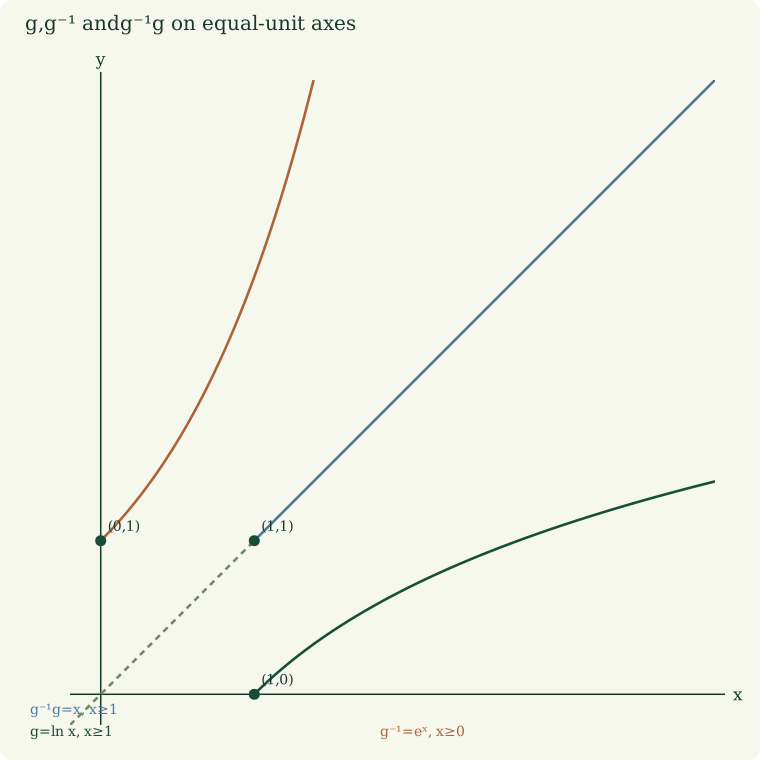
Answer · (b)ii
starts ; starts ; starts .
Domains x≥1, x≥0, x≥1 respectively.
The inverse of
The range of is , which becomes the domain of .
The composite
Domain of the composite is the domain of : . It starts at and lies on .
Starting points
Use closed endpoints and equal units on both axes. The functions and are mirror images in ; draw that line dashed outside the identity ray .
Explore the idea
Equal composites
Find the values of for which .
Hint
Each composite is on its own domain.
The equality holds where both are defined.
The two functions have different domains, and equality needs both defined.
Answer · (b)iii
.
Domains of the two composites
The domain of a composite is the domain of its inner function.
Intersect
Both composites equal , so they agree on the common domain.