Original question & working
Recover the signs hidden by an absolute value · source reference
2021/DHS/Promo/7 · Question pp. 3 · Working pp. 7
Open the interactive lessonThe working and teaching notes are included in the interactive lesson.
A minimum of |f| need not be a minimum of f. Closed endpoints describe full branches, not strict derivative inequalities.
Full original question, working & notes
Printed question
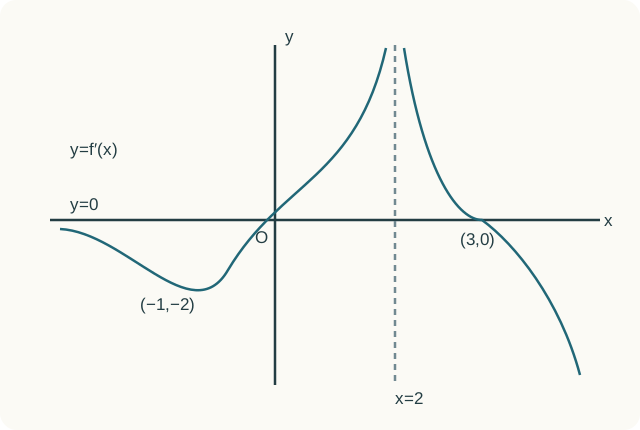
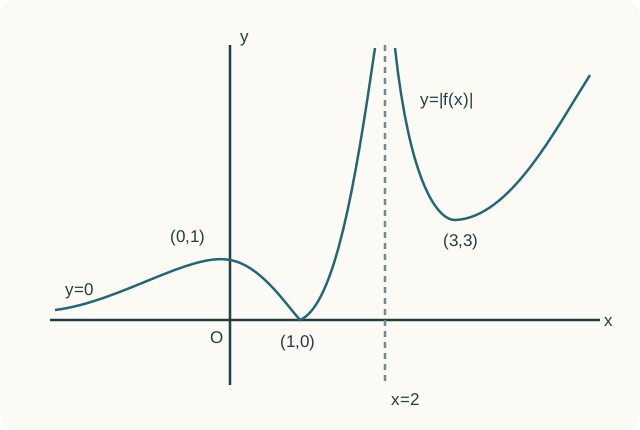
The graphs of and are shown below. The gradient graph has turning point , intercepts and , and asymptotes , . The absolute-value graph shows , , and asymptotes , .
(i) State the nature of all stationary points of the graph of . [2]
(ii) State the range of values of where (a) is decreasing, [2] (b) is concave upwards. [1]
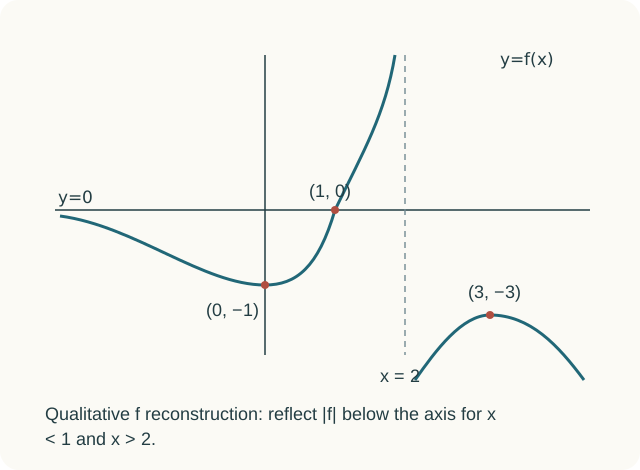
(iii) Sketch the graph of indicating clearly the asymptotes, coordinates of the stationary points and the intersections with the axes. [3]
[2021/DHS/Promo/7]
Printed working
(i) Maximum point , minimum point .
(ii)(a) Printed interval: or . (ii)(b) Printed interval: .
(iii) Reconstructed is negative for , crosses at , positive for , and negative for , with extrema and . Asymptotes are (to the left) and .
Endpoint qualification
For strict derivative sign statements use on or , and on . The printed closed endpoints express decreasing/convex interval conventions; derivative is zero at the displayed boundaries. The discontinuity at splits the increasing ranges.
Teacher notes
To sketch :
-
Curve is obtained from by reflecting the part where above the -axis.
-
To obtain reflect some parts of below the -axis.
3(a). From , -intercept becomes a stationary point at for .
3(b). for , : the gradient of is positive, so is strictly increasing on the separate intervals and . Reflect where and below the axis.
3(c). for or : the gradient of is negative, so is strictly decreasing there. Reflect where and below the axis.
Answer key
(i) Max , min . (ii)(a) or ; (ii)(b) . (iii) Same native reconstructed sketch.
Native diagrams