Recover the signs hidden by an absolute value
The graphs of and are shown below. The gradient graph has turning point , intercepts and , and asymptotes , . The absolute-value graph shows , , and asymptotes , .
(i) State the nature of all stationary points of the graph of . marks
(ii) State the range of values of where (a) is decreasing, marks (b) is concave upwards. mark
(iii) Sketch the graph of indicating clearly the asymptotes, coordinates of the stationary points and the intersections with the axes. marks
[2021/DHS/Promo/7]
Solution
Stationary points from
The graph of has a turning point , intercepts and and asymptotes , . The graph of shows , , and asymptotes , . State the nature of all stationary points of .
Hint
Stationary points are the zeros of : and .
Check whether changes from negative to positive (minimum) or positive to negative (maximum).
Use to find the -coordinates and signs.
Those are points on . The absolute value hides the sign of , which must be recovered.
Answer · (i)
Minimum ; maximum .
Zeros of
The -intercepts of the gradient graph.
Negative to positive: a minimum.
Positive to negative: a maximum.
-values
At , the shown has a local maximum while has a minimum, so this piece must be reflected: . At , has a local minimum while has a maximum, so .
Monotonicity from
State the range of values of where is decreasing.
Hint
Decreasing means : the graph of lies below the -axis.
is not in the domain; the decreasing ranges lie on either side, away from it.
Answer · (ii)(a)
Decreasing branches and .
The derivative is strictly negative only for x<0 or x>3; stationary endpoints may be included when naming whole branches.
Read off the gradient graph
The gradient graph is below the axis for and again for .
Concavity from
State the range of values of where is concave upwards.
Hint
Concave up means , so the graph of is rising.
Concave up means the gradient is rising, not that the gradient is positive. is negative on part of , yet is concave up there.
Answer · (ii)(b)
Concave-up branch .
Strict f″>0 only on −1<x<2; f″=0 at −1, and x=2 is excluded.
Where rises
The gradient graph rises from its turning point up towards the asymptote .
Reconstructing from
Sketch , indicating the asymptotes, the stationary points and the intersections with the axes.
Hint
Start with the graph of .
Decide which parts of are negative: where is decreasing to a minimum and to a maximum below the axis.
Reflect those parts below the -axis.
and look the same where only. The turning points here are below the axis.
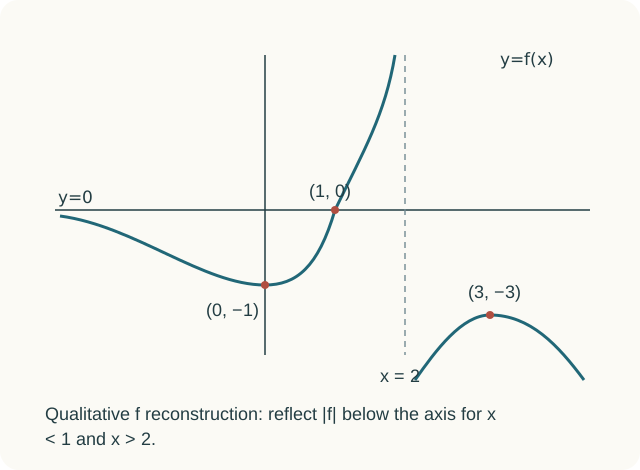
Answer · (iii)
Intercepts ; stationary points above; asymptotes , left-end .
Which parts were negative?
For and for , is negative: is a minimum below the axis, and is a maximum below the axis. Only the stretch is positive (rising from to at the asymptote).
Reflect
Reflect the parts of over and in the -axis. The stretch stays where it is.
Label
Intersections with the axes: and .
Explore the idea