Original question & working
The product substitution absorbs a linear term · source reference
[2012/RVHS/Prelim/II/1 (modified)] · Question pp. 1 · Working pp. 2
Open the interactive lessonThe working and teaching notes are included in the interactive lesson.
View source review notesFull original question, working & notes
Printed question
Use the substitution , where is a function of , to reduce the differential equation to .
Hence show that the general solution to the differential equation is of the form , where is a function in . [5]
Sketch, on separate diagrams, the particular solution curve for (i) and (ii) . [2]
[2012/RVHS/Prelim/II/1 (modified)]
Printed working
Given (1). Let .
Substitute into (1): (shown).
; ; .
; , where ; ; , .
The source sketches and on separate axes; both have vertical asymptote .
Printed answer key
; (i) and (ii) native sketches below.
Teacher note 1
Note that are variables, so need to use product rule in differentiation of with respect to .
Teacher note 2
Given DE of form . Rearrange by bringing all “” terms to the left where is and leave “” terms on the right before integrating with respect to (“separate” the variables):
The intermediate integral can be skipped once familiar with the process.
Diagram 10-03-A2
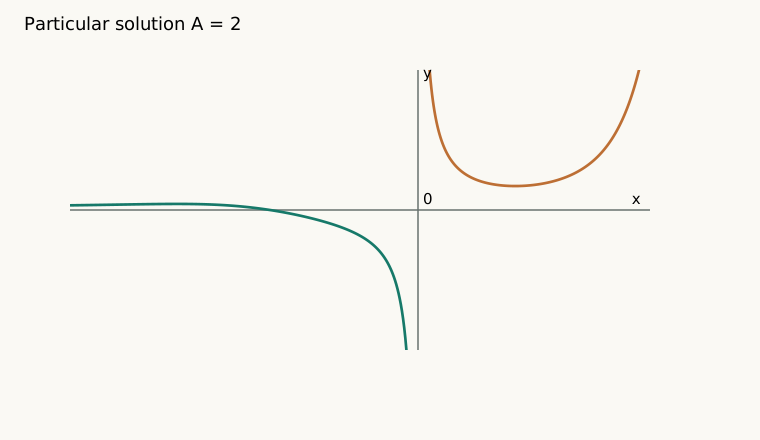
Two disconnected branches, x=0 excluded.
Diagram 10-03-Aminus3
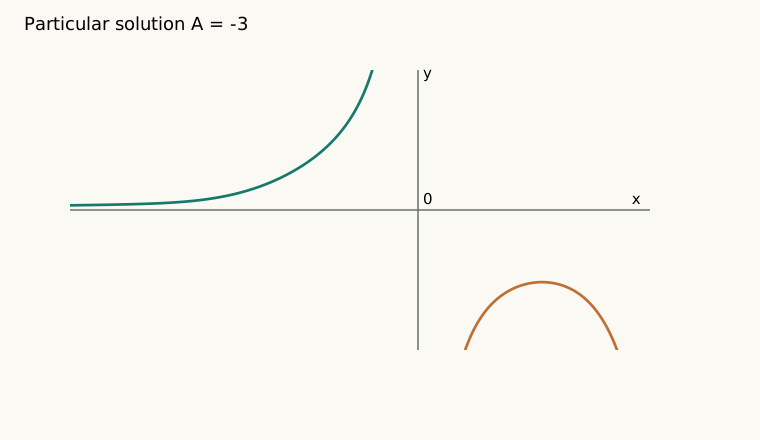
Two disconnected branches, x=0 excluded.
Mathematical review
. Thus and . The family, including , is for , with .
For , the zero is ; near zero , and as , . The positive branch tends to at both ends and has a minimum; the negative branch has a maximum before crossing zero and tending to at . For , the numerator is always negative: the negative-x branch is positive and rises from to ; the positive branch is negative and tends to at both ends, with a maximum.
These turning behaviors follow . The zero of the bracket on each appropriate side gives the corresponding turning point.
Provenance
TJC JC2 2025 H2 Maths (9758) MSM. Native transcription checked against original visible question, working and sidebars. Question page(s): 1. Working page(s): 2. Original records remain private for QA; this native article has no PDF or raster worksheet dependency.