The product substitution absorbs a linear term
Use the substitution , where is a function of , to reduce the differential equation to .
Hence show that the general solution to the differential equation is of the form , where is a function in . marks
Sketch, on separate diagrams, the particular solution curve for (i) and (ii) . marks
[2012/RVHS/Prelim/II/1 (modified)]
Solution
Product substitution
Use to reduce to .
Hint
Differentiate with the product rule.
Substitute and simplify.
is a product of two variables: .
Answer · Substitution
.
Differentiate
Product rule.
Substitute
Replace .
Simplify
The terms cancel; .
Separation of variables
Hence show that the general solution has the form .
Hint
Separate: .
Removing the modulus needs , which is absorbed into .
Answer · General solution
; .
; includes .
Separate and integrate
For , divide by and integrate. Check the excluded equilibrium separately.
Exponentiate
Remove the modulus with .
Restore the equilibrium
This solves the equation without division and is the case . Thus can be any real number, including zero.
Back to
; use the solution on connected intervals with .
Sketching a solution curve
Sketch the particular solution curve for .
Hint
: vertical asymptote .
Find where it crosses the -axis.
The two branches are disconnected: is excluded.
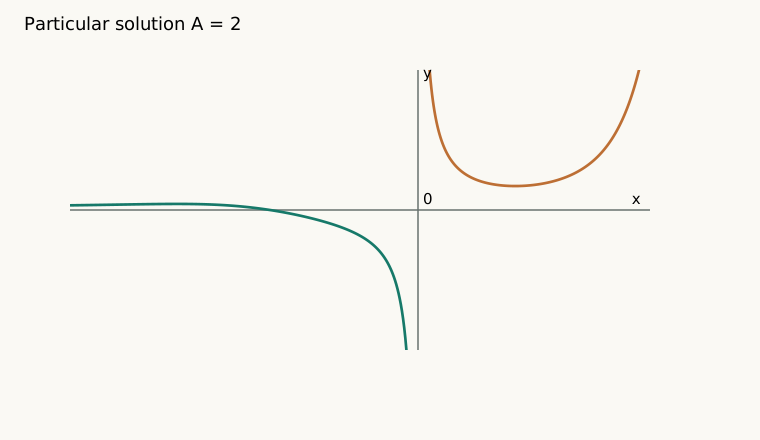
Answer · (i)
: zero , pole 0 and left limit ; turning branches as shown.
Zero
Only for .
Asymptote
Pole at the origin.
Shape
Left branch: tends to as , rises to a maximum before crossing the axis at the zero, then plunges to as . Right branch: starts at just right of 0, dips to a minimum, then climbs steeply.
Explore the idea
Sketching a solution curve
Sketch the particular solution curve for .
Hint
.
The numerator never vanishes: there is no -intercept.
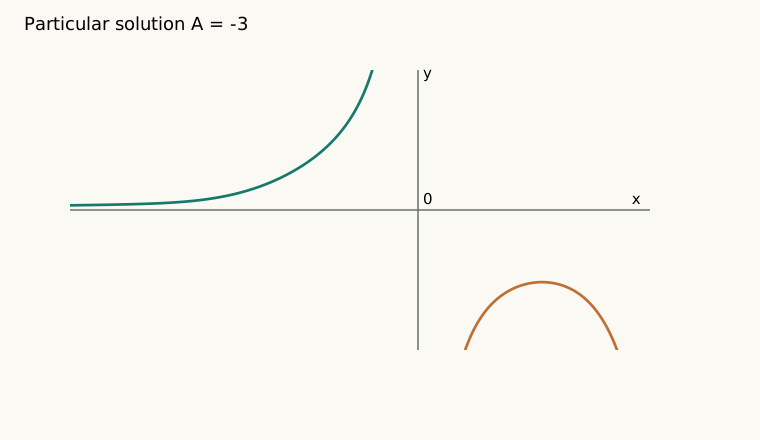
Answer · (ii)
: positive branch for , negative branch with maximum for .
Sign
The numerator is always negative.
Branches
For the quotient is positive (from at up to at ); for it is negative, rising from to a maximum and then falling away.
Explore the idea